Why
did Lew Wallace write Ben-Hur?
In 1876, Lew was on a train headed for a reunion of
Union soldiers. Also on the train was Robert C. Ingersoll, a noted agnostic. During
the trip, the two men began a conversation on the divinity of Christ and other
religious issues. In his efforts to sway Lew with his views, Ingersoll’s
arguments instead had an opposite effect.
When the men detrained in Indianapolis, Lew waved
the waiting cab off, stating he needed to walk to clear his thoughts. As he
walked to his hotel he realized he needed to create a powerful refutation of
Ingersoll’s arguments, but that he was ill prepared to do so.
In the mid-1870s, Lew had drafted a short story
about the three wise men and their journey guided by the Star of Bethlehem. He ultimately decided expand this story,
through exhaustive research, as a convincing argument supporting the divinity
of Christ. This "redraft" of his short story became Ben-Hur.
That's the story we relate to visitors about how Lew
wrote the best-selling novel of the 19th century. But a couple of weeks ago, some
great visitors who stopped in while waiting on car repairs asked me what
happened to Ingersoll, and I didn't know! I had to find out.
What
about Ingersoll?
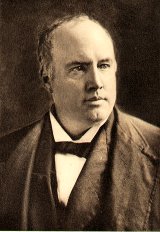
The son of a Presbyterian minister, Ingersoll was an
attorney. He served in the Civil War with the 11th Illinois Cavalry Regiment. He
fought and was captured at the Battle of Shiloh in 1862. He became the Illinois
Attorney General, was active in the Republican Party, was an abolitionist,
supported women’s suffrage, was a noted orator, and a famed agnostic.
After their conversation, as Lew pursued his writing,
Ingersoll also moved on. Later in 1876, Ingersoll nominated James G. Blaine for
President at the Republican Convention in Cincinnati. Hayes. While Blaine lost to
Rutherford B. Hayes, Ingersoll’s "Plumed Knight" nomination speech
was electrifying and long remembered. Almost 50 years later in 1928, Franklin
D. Roosevelt likely used that speech as a template for his "Happy Warrior"
speech when he placed Alfred Smith’s name in nomination as the Democratic
candidate for President.
In 1884, Ingersoll spoke at the Republican National
convention in Chicago. On his trip home from the convention, Ingersoll passed
through Crawfordsville. It’s not known whether Ingersoll and Lew crossed paths
on this particular trip, but while in Crawfordsville, Ingersoll was encouraged
to give an oration. Joanna Lane graciously offered the front porch of her home,
Lane Place, for the event. The wife of Senator Henry S. Lane, Joanna was a
committed Republican who did all she could to support the party. She was also a
devout Methodist; sharing her lawn with the agnostic Ingersoll must have been a
trial for her. The crowd was enormous and according to news accounts of the
day, Mrs. Lane listened attentively.
Like Lew, Robert Ingersoll travelled in powerful
circles. Walt Whitman considered
Ingersoll the greatest orator of his time and stated: "It should not be
surprising that I am drawn to Ingersoll, for he is Leaves of Grass... He lives,
embodies, the individuality, I preach. I see in [him] the noblest specimen--American-flavored--pure
out of the soil, spreading, giving, demanding light."
Ingersoll later delivered
the eulogy at Whitman's funeral.
 Ingersoll's
Continuing Legacy
Ingersoll's
Continuing Legacy
Ingersoll died in
1899 and was buried in Arlington
National Cemetery.
In 1902, a twelve volume set of his complete works was published. In the early 20th
century he was referenced in works by authors such as William Faulkner,
Sherwood Anderson, Sinclair Lewis, and P.G. Wodehouse.
More recently a popular edition of Ingersoll's work, edited by Pulitzer
Prize winner Tim Page, was published in 2005, by Steerforth Press. Ingersoll's
thinking is being brought to new audiences with, "What's God Got to Do
With It: Robert Ingersoll on Free Speech, Honest Talk and the Separation of
Church and State".
As Robert Ingersoll once said: "There are in nature neither rewards
nor punishments, there are consequences." How interesting that one of the
consequences of a conversation on a train in the 1870s questioning the divinity
of Christ led to the creation of a work like Ben-Hur.




.jpg)