Showing posts with label Civil War. Show all posts

Friday, June 28, 2013

People Lew Knew: Mahlon D. Manson, Crawfordsville General

On April 22, 1861, Oliver P. Morton, Governor of the State of Indiana and Commander in Chief of the Militia signed the enrollment paper for Mahlon D. Manson as Captain of the Crawfordsville Guards. This enrollment was countersigned by Lew Wallace. Before, during and after the Civil War, the lives of Mahlon Manson and Lew Wallace intersected many times.

Manson was born in Piqua, Ohio, about 1820. His father died when Manson was three years old. As a young man, he became a clerk in a druggist store and continued to pursue that profession. In 1842, he moved to Montgomery County, Indiana, where he taught school and pursued a medical degree by attending classes at the Ohio Medical School in Cincinnati and by taking a course or two in New Orleans. Although he pursued a medical degree, it appears he never practiced medicine and instead continued his career as a druggist.

Like Lew Wallace, when the Mexican War broke out Manson volunteered for service. Unlike Wallace, Manson saw significant action in General Winfield Scott’s campaign from Vera Cruz to Mexico City. After the War, Manson returned to Montgomery County and resumed his career as a druggist. Again like Wallace, he became heavily involved in the Democratic Party and in 1851 was elected to the State House of Representatives. In 1856, he was a delegate to the National Democratic Convention that nominated James Buchanan and John Breckinridge. He continued his support of the Democratic Party in 1860 when he supported Stephen A. Douglas for President.

When War broke out in 1861, he took an active part in raising the first company in Montgomery County under Lew Wallace.  Company G of the 10th Indiana selected Manson as Captain. He was quickly promoted to Major and just ten days later to Colonel. In June 1861, he participated in the Battle of Rich Mountain in (West) Virginia and in January of 1862 he was involved in the Battle of Mill Spring (Kentucky). His troops then removed to Louisville, Kentucky, and for much of the spring and early summer he remained in the area, receiving a promotion to Brigadier General.

In 19th century biographies that praised Brigadier General Mahlon Manson, some authors skipped over aspects of his military career. One battle that some early biographers minimized was the Battle of Richmond, Kentucky. Kentucky was a border state during the War and Indiana Governor Morton was deeply concerned about the possibility of losing Kentucky to the Confederates. In the summer of 1862, rumors began circulating about a large Confederate army massing near Knoxville and Chattanooga. By late August, Morton had rushed almost 15,000 men into Kentucky with another 5,000 on the way. General Don Carlos Buell, who had served at the Battle of Shiloh with Lew Wallace, was in charge of the district that included central Kentucky and sent Major General William Nelson along with Brigadier Generals Mahlon Manson and Charles Cruft to take command of the Union troops that were massing in Kentucky. Unfortunately, Buell didn’t send any significant troop support as he believed this Confederate threat was a ruse and that their true aim was to regain parts of Tennessee lost after Shiloh.

On August 29, the Confederate cavalry moving north in Kentucky encountered Union troops. Manson was in charge of the Union army in the area of Richmond. On August 30, after some early Union success, the Confederates began to take control of the field of battle. Out of a force of approximately 6,500 Union men, 206 were killed, 844 were wounded and 4,303 were taken prisoner. In contrast the Confederates saw 78 men killed, 372 wounded, and 1 missing. As some historians have reported, the Battle of Richmond was the closest thing to a battle of annihilation in the entire war. Manson was one of the Union men wounded (in the thigh) and captured. He was exchanged in a prisoner swap two months later. The few Union troops left after the battle fled to Louisville leaving much of central Kentucky and Cincinnati open and vulnerable—enter Lew Wallace.

Some of Manson's items on display at Richmond, KY
Photo by Stephanie Cain
With the catastrophic Union defeat the Confederate army was poised within about eighty miles of both Louisville and Cincinnati. Wallace, who was in the area, was asked to take command of the troops in Cincinnati and prepare the basically defenseless city for a likely Confederate attack. Wallace’s extraordinary organizational skills and military acumen served him well and within about ten days, he had transformed the defensive perimeter around Cincinnati as well as Newport and Covington, Kentucky. After a brief skirmish with the troops of Confederate General Henry Heth, on September 11, Wallace awoke on the 12th to the news that that the Confederates had withdrawn and Cincinnati had been saved from invasion.

In spite of his stunning defeat at Richmond, Manson’s military career was not over and he continued to serve as a Union leader. In May of 1864, he was involved in the Battle at Resaca (part of the Atlanta campaign) where he was again wounded. In an effort to demonstrate to General Haskell how he might best avoid enemy fire, Manson jumped up on the defensive works and was struck by a piece of shell that injured his right shoulder, forever disabling his arm. He was carried from the field, returned to duty a few days later and then had to be taken to Nashville where he was hospitalized for almost three months. Realizing that he would not be able to be fully effective, he resigned his commission in December of 1864.

The lives of Manson and Wallace would continue to influence one another. As a result of the Battle of Richmond, the Buell Commission was formed to inquire into Major General Don Carolos Buell’s performance with respect to the invasion of Kentucky. Buell was Manson’s superior who placed Manson in command, but failed to send significant troop support. Wallace was appointed chair of this commission which effectively removed Wallace from battle command for the balance of 1862 and much of 1863.

After the war, Manson continued his active involvement in the Democratic Party. In 1864, he was nominated for Lt. Governor, but lost. In 1866, he was nominated for Secretary of State, but lost. Then in 1868, he was nominated for as Representative of the 9th District in Congress—and again, lost. In 1870, he was nominated as Representative a second time, and he won—defeating Lew Wallace!

At this time, Manson also served on the Committee on Invalid Pensions. In 1873, he became a member of the State Democratic Committee, became its chairman in 1875 and was in an official capacity lobbying on behalf of Democratic interests in the controversial election of 1876 where Wallace represented Republican interests. In 1876, he was elected State Auditor and in 1884 elected Lt. Governor. He resigned his post as Lt. Governor to accept a post as a Collector of the Internal Revenue Service in Terre Haute.

Beyond their political intersections, Manson and Wallace would have crossed paths in other ways. The Mansons and Wallaces were both members of the Methodist Church in Crawfordsville, both men were members of the Grand Army of the Republic and the local Masonic Lodge, both were involved with the building of the Soldiers and Sailors Monument in Indianapolis and finally, both were laid to rest in Oak Hill Cemetery.

The parallels in the lives of Manson and Wallace, two of Crawfordsville’s five Civil War generals, are striking. Even the closing comments of one 19th century Manson biographer would equally describe Wallace.
"An eloquent orator, he commands the attention, convinces the reason, arouses the enthusiasm and awakens the zeal of his hearers. A brave and gallant soldier, a prudent and conscientious statesman, a public spirited citizen, a faithful friend, an honest man in business, and a true man in all the relations of life, it is not surprising that he holds a high position in the esteem and affection of the people of the State. He rose from poverty to justly deserved eminence and the bright light which beats upon his life discovers no flaw in his character. Not by accident or aid of others, but by earnest toil, constant perseverance, through smoke and blood of battle, he has attained success in life, military glory, political and social popularity and the love and honor of his fellow-citizens. Such men as he make all men their debtors."

Tuesday, June 11, 2013

Lew Wallace and the "Hung in Black" Speech

One of our Facebook friends recently asked us about Lew's speech given in Philadelphia after Lincoln's famous "Hung in Black" speech. This blog post is adapted from our research and response.

On June 7 and 8, 1864, the Republican National Convention met in Baltimore and nominated Abraham Lincoln to a second term in the White House. Earlier that year, Lew Wallace had been appointed Commander of the 8th Army Corps in Baltimore by Lincoln. Lew had already successfully supported an election in Maryland that assured that the state would remain in the Union. Holding the Convention in Baltimore furthered the Union cause.

On June 16, the President traveled from Washington to Philadelphia for the Philadelphia Fair, which was being held as a benefit to the Sanitary Commission. The Sanitary Commission was a private relief agency established by federal legislation to support sick and wounded Union soldiers. Upon his arrival the President was greeted by local dignitaries and great applause by people lining Chestnut Street.

Buildings of the Great Central Fair
Seeing the exceptional response, the Executive Committee of the Fair raised the price of admission to $1 during the time the President was to be there. President Lincoln, Mrs. Lincoln, and one of their sons arrived at the Fair at 4:30. The crowd swelled to over 15,000 people as people strained to get a glimpse of Lincoln.

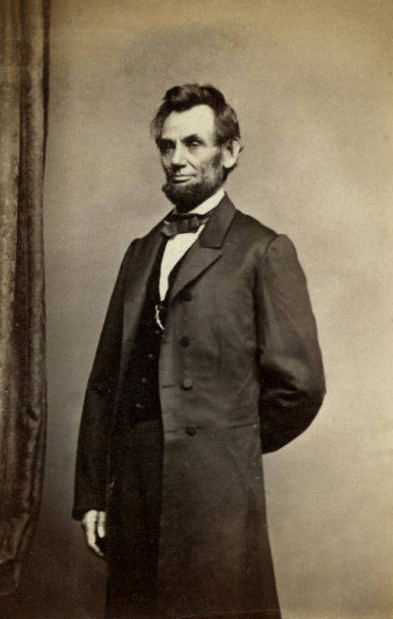
Late in the day, Lincoln returned to his hotel for the formal dinner. Joining him at his table were the Honorable Edward Everett (who had been the featured speaker at the Gettysburg Dedication in 1863), former Governor Cannon of Delaware, the Mayor of Philadelphia, several local dignitaries, and General Lew Wallace. The evening began with a toast to the health of the President by Thomas Webster, to which Lincoln responded. In acknowledging the toast he noted the work of the Sanitary Commission with comments that came to be known as his "Hung in Black" speech. Lincoln said:
Mathew Brady [Public domain],
via Wikimedia Commons

I suppose that this toast is intended to open the way for me to say something. War at the best is terrible, and this of ours, in its magnitude and duration, is one of the most terrible the world has ever known. It has deranged business totally in many places, and perhaps in all. It has destroyed property, destroyed life, and ruined homes. It has produced a national debt and a degree of taxation unprecedented in the history of this country. It has caused mourning among us until the Heavens may almost be said to be hung in black....
After noting the important work of the Sanitary and Christian Commissions, Lincoln went on to say, "When is this war to end? I do not wish to name a day when it will end, lest the end should not come at the given time. We accepted this war, and did not begin it. We accepted it for an object, and when that object is accomplished the war will end; and I hope to God it will never end until that object is accomplished." 

These comments by Lincoln were powerful words at a difficult time. Although Lincoln had been re-nominated by his party, his re-election in the fall was by no means assured. The North was still reeling the devastating Battle of the Wilderness in May. After the Wilderness came Cold Harbor, where more than 9,000 men were killed in one hour. In the six weeks before this speech, General Grant’s army had seen 52,000 casualties; people as close to the President as Mrs. Lincoln were demanding Grant's removal. Lincoln stood firm: "I can’t spare him. He fights!" As losses mounted and morale in the North teetered, Lincoln also faced the popular George McClellan, who was running for President as a Democrat, and urging a negotiated settlement with the South to end the war. 

After Lincoln concluded his comments, the next toast was directed to General Wallace. Lew made a brief speech intended to support Lincoln’s stance by declaring that General Grant was the right man in the right place. Lew said his mind was free from all doubt that Grant would capture the rebel capital and capture Lee’s forces. 

After Wallace’s comments, Edward Everett was toasted. In contrast to his long speech at Gettysburg, Everett kept his comments brief, saying in part: "After such an address from the man who has borne upon his shoulder the cares and burdens of this struggle, what can I acceptably say?"

After a few additional comments and presentations, the evening wound down. Lincoln made a more visits around town that night but declined invitations to speak. The next day, Lincoln and his party, which included Wallace, returned to the White House, where additional battles and losses would occupy the President’s days. One of these would be the Battle of Monocacy Junction just three weeks later, where Lew Wallace delayed Jubal Early as the Confederate General advanced on Washington, D.C.

Saturday, May 18, 2013

Armed Forces Day

According to the Department of Defense, Armed Forces Day was created in 1949, which means Lew would never have celebrated it. It would probably have been an important holiday to him, however. Lew was very proud of his military service and remained active in veterans' associations and war memorial efforts.

Lew served in both the Mexican War and the Civil War, and actually volunteered for the Spanish-American War. Because he was 71 at the time of the Spanish-American War, his offer was declined. He delivered speeches at occasions such as the dedication of the Greencastle's Soldiers Monument, the reunion of the 11th Indiana in Terre Haute, a United States Naval Academy graduation ceremony, and the dedication ceremony of the Indiana Soldiers and Sailors Monument. He even built a special case in his Study to display some of his military artifacts. With such evidence, we can say confidently that Lew would have appreciated Armed Forces Day.

Lew wasn't the first of his family to serve in the military--his father, David, was a West Point Cadet. Nor was Lew the last. His two grandsons, Tee and Lew, Jr., served in World War I. Tee enlisted in the American Field Ambulance in 1916, before U.S. entry into the war, and drove ambulances for the French Army. After his graduation from Yale, he enlisted in the U.S. Marine Corps. He was killed during a surveillance mission near St. Etienne in October of 1918.

Lew, Jr. was in the National Guard and served in Texas during the Mexican Revolution. In September of 1918, he was sent to France, where he served as a captain in the intelligence service. In 1919 his division was inactivated and he served as aide to General E.M. Lewis until 1920.

Later generations of the Wallace family also continued the tradition of military service. Lew's great-grandsons  III and Bill Wallace both served in World War II, and Lew's great-great-grandson Sanford Miller served in Vietnam.

With such a strong legacy, is it any wonder we think Lew would have approved of a holiday set aside for civilians to thank members of the military for their sacrifices?

Thursday, May 16, 2013

William Seward, Jr. and the Battle of Monocacy


A photo taken in 1906 of the 1832 Frederick, MD, B&O
station; photo courtesy of Wikimedia Commons
In the summer of 1864, John W. Garrett, President of the Baltimore & Ohio railroad, came to see General Lew Wallace. Mr. Garrett expressed concern for the safety of Washington (as well as his railroad). His personnel were reporting detachments of Confederate troops in the Shenandoah Valley and, according to him, such appearances were precursors of trouble. General Wallace decided to go to the western limit of his command, the Monocacy River, southwest of Frederick, Maryland. Upon his arrival at the blockhouse guarding the rail junction (Monocacy Junction) he found the country alive with rumor. A Confederate army, reported to be between 5,000 and 35,000 men strong, was thought to have crossed the Potomac River on the 2nd or 3rd of July. Its exact whereabouts and destination were both unknown. The civilians that General Wallace sent to gather information were turned back by rebel cavalry at every pass in the mountains west of Frederick. General Wallace believed this cavalry was screening a larger army.

Two miles north of the junction, a stone bridge called the Jug Bridge crossed the Monocacy, carrying the National Road that led to Baltimore. At the junction there was an iron railroad bridge and, a few hundred yards southwest of it, the wooden covered bridge of the Georgetown Pike, the road to Washington. Any invading army intent on Washington or Baltimore would have to come this way. After brief consideration, General Wallace believed that Washington was the objective. He began putting men in place. 

On July 9, 1864, 6,500 troops under the command of General Wallace met 14,000 battle–hardened veterans of the Army of Northern Virginia, commanded by General Jubal Early, on the farm fields near Monocacy Junction. Confederate troops held the field at day’s end, but Wallace and his men had delayed them long enough that reinforcements ultimately sent by Union General-in-Chief U.S. Grant would reach the lightly-defended U.S. capital just in time. Early’s plans to capture Washington were quashed. The battle of Monocacy is now known as the “battle that saved Washington.”

General Grant later wrote that Wallace had done more for the cause by losing this battle than many generals had accomplished by winning.

As the Battle of Monocacy loomed, the city of Washington panicked. One of the men in Wallace’s small army was Colonel William Seward, son of Lincoln’s Secretary of State, William Henry Seward, and the commander of the hard-fighting Ninth New York Heavy Artillery. Seward’s regiment was in the middle of the Monocacy battle and according to Wallace’s official report the Ninth New York had 102 killed and wounded with 99 missing for a total of 201 casualties. Seward’s family, in Washington, received continuing reports from the battlefield and was well aware of Wallace’s valiant defense but ultimate defeat.

William Henry Seward, Jr.
The Secretary of State stayed at the War Department reading telegrams coming in from the battle until almost midnight. He had just returned home when Secretary of War Edwin Stanton arrived at the Seward residence to tell the family that there were reports that young William was wounded and taken prisoner. Colonel Seward’s brother, Augustus, left early the next day to go to Baltimore in an effort to ascertain the truth of the rumors. Based on reports he could gather, Augustus determined that his brother had been wounded, but not captured—although his whereabouts were unknown in the panic and chaos that was gripping both Washington and Baltimore.

By that evening there was a telegram at the Seward home from General Wallace: “I have the pleasure of contradicting my statement of last night. Colonel Seward is not a prisoner, and I am now told he is unhurt. He behaved with rare gallantry.” While Colonel Seward was reported safe on July 10, Washington definitely was not—Jubal Early’s veterans were marching on the city. On July 11, Early’s army arrived in front of Ft. Stevens, the northernmost fort in Washington’s defensive chain. Early could see the flag flying on the dome of the U.S. Capitol.

The city was in real jeopardy--Grant’s reinforcements had not yet arrived--but luck was on the Union side because Early delayed his attack. Grant’s reinforcements arrived on the night of the 11th and battled with Early’s men on July 12. During this fighting, President Lincoln arrived at Ft. Stevens and insisted on watching the action from the ramparts. He was thus exposed to Confederate sharpshooters, who killed an officer standing nearby, whereupon the President was convinced to move off the walls.

As it turned out, Wallace’s information relayed to the Seward family was still not correct. Colonel Seward had in fact been injured. He suffered a slight wound to his arm and broke his leg when his horse was shot and fell on him during the battle. Seward was unable to walk off the battlefield and only escaped capture when he found a mule and, using his silk handkerchief as a bridle, was able to ride off the field ahead of the Confederates. Within eight weeks Seward was promoted to brigadier general and served throughout the remainder of the war. A banker before the war, General Seward returned to a successful career in banking after his time in the military. He followed politics, supported charitable causes, served as a director for a number of corporations, and was involved in historical and patriotic societies until his death in 1920, over 50 years after Lew Wallace’s battle that saved Washington—a battle that directly affected the outcome of the Civil War and likely changed the history of the nation.

Many years later General Wallace encountered one of the Confederate commanders, J. B. Gordon, at a White House reception. Gordon told Wallace he was the only Yankee who ever whipped him. Wallace replied that, in the end, his men ran from the field. “In that sense you are right,” Gordon countered, “but you snatched Washington out of our hands.”

Sources: Shadow of Shiloh, Gail Stephens, Indiana Historical Society Press, 2010
                Seward, Lincoln’s Indispensable Man, Walter Stahr, Simon & Schuster, 2012

The General Lew Wallace Study & Museum celebrates & renews
belief in the power of the individual spirit to affect
American history & culture.

Wednesday, March 27, 2013

Civil War Music Coming to the Study

Lew was a fan of music. He played the violin and Susan played the guitar. One of his reasons for building the Study was so he could play the violin at midnight if he chose. We think he would approve of our upcoming event! A choral group from Wabash College will be performing a concert of Civil War songs inside the Study building Thursday, April 4.

Songs being performed will include:
Battle Cry of Freedom
The Soldier's Return
When Johnny Comes Marching Home
The New Emancipation Song
Ashokan Farewell
Battle Hymn of the Republic

Because seating is limited, RSVPs are required. Please call the Study at 765-362-5769 for details and to reserve a spot.

Tuesday, March 5, 2013

Wallace, Trustin Kinder & the Battle of Buena Vista

“A victory so great, so unprecedentedly glorious, could not have been purchased without loss on our side. Among the 700 heroes who were slain and wounded on that bloody day we who knew him from infancy have to mourn the death of Captain Kinder. Poor Truss. The glory which shall forever shine upon the field which was thy deathbed, which shall reflect luster upon thy name and fate, is but sorry consolation for the loss this death inflicts upon his country and friends. Peace, though, to his name. When we reach Saltillo we will mark his resting place and save it from obliteration and disrespect.”
Lew Wallace, age 20, writing to his “Friend Chapman” on March 12, 1847 regarding the Battle of Buena Vista fought on February 23, 1847.

Lew Wallace about the time he served
in the Mexican War
Trustin Kinder, Truss to his friends, was born in 1822 and grew up in Indianapolis. He graduated from Asbury College (DePauw University) in 1845. He returned to Indianapolis, but soon moved to Paoli, the county seat for Orange County, where he practiced law. In letters back home to friends in Indianapolis, he described Paoli as “. . .a very pretty little town of about six hundred inhabitants who are very kind and clever people. The scenery around the town is delightful. Indeed, it is quite romantic and I am inclined to think that if I was given to writing poetry that it would be an admirable location. But my genius not inclining that way, I just stand and look out and think upon the subject.”

When the Mexican-American War broke out, he volunteered for service and was voted First Lieutenant of Company B, 2nd Indiana Regiment of Volunteers. Kinder was a talented young lawyer and a gifted speaker. In support of the war, he delivered a speech of considerable length and great strength declaring that he “. . . would leave his bones to bleach on the sunny plains of Mexico rather that see his country’s flag dishonored and trailed in the dust.”

By the fall of 1846, Kinder’s letters were being posted from distant locations like Camp Belknap in Texas and Monterey in Mexico. On January 1, 1847 he wrote his parents to wish them a happy new year from a camp near Saltillo, Mexico. He detailed the march to the new encampment, the countryside, and some of the skirmishes that had raised excitement in the area. In letters Kinder also discussed activities of Lt. Governor Paris Dunning who was serving in Mexico but was also engaging in personal business that brought him financial gain such as selling liquor to soldiers at exorbitant prices. Kinder’s charges were quickly reported in Hoosier newspapers and created a stir but Kinder and other officers stood by the comments.

By early February of 1847, Kinder’s letters are reflecting increased fighting between the Mexicans and Americans. He also noted that members of Congress who were not supporting the war effort were doing a favor to the Mexicans noting that “In fifteen years they will deny their opposition to this war. They had better back out in time to save their credit, if they have any to save.” Finally, he wrote that rumors were afloat that reinforcements would be arriving and his regiment might be headed home in early April.


News of the Battle at Buena Vista did not reach Indianapolis for almost a month after the fighting on February 22 & 23. Although Lew Wallace’s letter was written just two weeks after the battle, with slow mail delivery, it did not reach home for several more weeks. In the Battle, General Zachary Taylor with 4,600 men faced Mexican General Santa Anna with over 15,000 men. During the fighting, the 2nd Indiana was given orders to retreat and some men left the field of battle in confusion leading Taylor and his son-in-law Jefferson Davis to later accuse them of cowardice. Kinder was wounded in battle and placed in an ambulance wagon. As the wagon was leaving the field it overturned when it fell into a shallow ravine. Before it could be righted it was attacked by Mexican lancers who killed and robbed Kinder. Although Taylor was considered victorious at Buena Vista, it was a hard fought and bloody win.

On April 5, the Indiana State Sentinel published a lengthy tribute to Trustin Kinder, saying in part: “. . . It is not for us to tell the merits of the departed one—for many know him, and many a weeping eye and heavy heart responded to the news that the open and noble-souled Kinder was gone.”

Kinder was buried in Mexico, but in an unusual effort his elderly father travelled to Mexico and in June made arrangements for the body to be shipped back to Indiana. It was announced that a procession would be formed at the Palmer House (hotel) which would proceed to the city limits to meet the remains and escort them to the Orange County Courthouse. After a short time in Paoli, the body was removed to Indianapolis.

Until the death of Oliver P. Morton in 1877, the funeral was the largest seen in Indianapolis and included a lengthy procession from the Kinder home to the State House Square where the body lay in state in the Capitol rotunda on July 12, 1847. A funeral train under military escort then took the body to the City Cemetery in Indianapolis. Kinder was considered the first war hero from Indianapolis and was the only casualty from the capital city to be returned from Mexico. His mother had the body moved to Crown Hill Cemetery in the fall of 1864 shortly after Crown Hill was established. This made Trustin Kinder the first man to die in service of his country to be interred in Crown Hill.

The Battle of Buena Vista affected Wallace deeply. He quit his father’s Whig party and joined the Democrats because of his contempt for the comments made by General Taylor, a leading Whig, regarding the actions of the 2nd Indiana. In 1861, Wallace served as adjutant general for Indiana at the outbreak of the Civil War. After barely two weeks of service with his initial mission accomplished Wallace resigned and Governor Oliver P. Morton placed Wallace in command of the 11th Indiana Volunteer Infantry regiment as its colonel.


Harper's Weekly image of Lew Wallace and his
11th Indiana Volunteers at the Indiana State House
in May of 1861 swearing to "Remember Buena Vista!"
 Before the regiment left Indianapolis, Colonel Wallace had his men march to the Indiana State House, where he had them kneel and swear an oath to avenge their comrades whom Wallace believed had been unjustly accused of cowardice at the Battle of Buena Vista by none other than Jefferson Davis. Wallace had his regiment take as its battle cry: “Remember Buena Vista!” This stirring scene was captured in a full-page illustration by the influential magazine Harper’s Weekly and circulated nationwide. Although Kinder was not singled out by Wallace at the time, he certainly would have reflected on his friend killed fourteen years earlier who had been lauded in the press as one whose “. . . memory will forever live; for he was of the number who nurtured the rose around which our affections twine—and who by his frank and noble nature secured the love of all with whom he daily walked.”

Thanks: Sharon Gerow for flagging Wallace’s letter in a book during her inventory of Wallace’s library.
www.griffingweb.com/trustin_brown_kinder.htm, Crown Hill Heritage Foundation

The General Lew Wallace Study & Museum celebrates and renews belief in the power of the individual spirit to affect American history and culture.


Friday, March 1, 2013

Employee Appreciation Day, Lew Wallace Style

Today is Employee Appreciation Day! If you're a manager, take a moment to say thank you to your staff. If you're an employee who hasn't received appreciation today...take heart. Even the great Lew Wallace didn't always receive thanks for his brilliant job performance.

As he wrote in his autobiography:
There can be no question, I think, that my services were fully appreciated except in Washington and the executive office in Indianapolis. Acknowledgements pour in upon me from every quarter save the two, silencing my detractors, especially such of them as had made light of the danger and my methods of meeting it and the other set who had sought to displace me.
General U.S. Grant, in particular, was less than appreciative of Lew's services, largely because of their misunderstanding at the Battle of Shiloh. It wasn't until the end of Grant's life that he acknowledged his condemnation of Lew might have been mistaken.

Regardless of official appreciation during the Civil War, Lew went on to do great things, including serving as a territorial governor, receiving several patents, and writing the best-selling novel of all time.

Saturday, February 9, 2013

Sleeping in the Snow

While a nor'easter dumps feet of snow on New England, we're reminded of Lew's snowy experience at Fort Donelson nearly 151 years ago. Tennessee may not see two feet of snow, but it still gets pretty cold. Here are a few excerpts from Lew's autobiography about sleeping in the snow:
The snow was all of a couple inches deep on the level; on the south side of the logs it had collected in cadaverous drifts. Frost in specks of glancing sheen still streaked the air. We walked about and beat our bodies to keep up circulation, teeth chattering meanwhile like castanets. Shade of Thor, how cold it was! Yet there was nothing to do but wait and be ready.
The next day, Admiral Foote attempted a gunboat assault on the water batteries of the fort, but was defeated. On the morning of February 15, the Confederates attempted to break out, and nearly succeeded. Lew was able to reinforce McClernand before the Union line crumbled completely. Lew's troops eventually retook the ground that had been lost in the breakout attempt. Then, more waiting:
There was nothing for us then but another night in bivouac without fires, and nothing to eat but crackers; literally suffering from the pinch of hunger added to misery from the pinch of cold. Yet I did not hear a murmur. This, I think, because there was not a soldier there so ignorant as not to know the necessity of keeping a tight grip upon our position.
Lew returned to his tent, hoping for food and fire, but discovered the tent looted and unattended. Discouraged, he returned to the command:
Behind their stacked muskets the thousands walked about, stamped, danced, threshed their bodies with their numbed hands, and kept the struggle with Jack Frost heroically going. If they were tired, hungry, cold, sleepy, so were we? Everybody watched the sky in the east, and had some Gheber of the kind sung by Tom Moore arisen and preached to us as became a fire-worshipper, there is no telling how many converts he might have made.
If you're in New England, trying to dig out from under this weekend's blizzard, at least you can take comfort that you aren't sleeping in the snow!

Monday, October 15, 2012

Meet Our Lecturers


The last installment of the 2012 Civil War Lecture Series is scheduled for Thursday, October 18 at the Crawfordsville District Public Library. We will have two lectures that evening, beginning at 7pm.

Chuck Beemer will present "Breakfast at Fort Donelson," discussing Lew Wallace's actions at Fort Donelson in February 1862. Immediately following Beemer's presentation, Roger Adams will present "Tarnished Stars:  Lew Wallace and the Defense of Cincinnati, September 1862."

Chuck Beemer was born and raised in Crawfordsville and holds a MA from the University of Wisconsin and a JD from the University of North Carolina. He recently finished a manuscript, "My Greatest Quarrel with Fortune: Major General Lew Wallace in the West, 1861-1862." He is the Vice President of the Western North Carolina Civil War Roundtable and serves on the Wallace Scholars Advisory Board to the General Lew Wallace Study & Museum.

Roger Adams is associate professor of library science and curator of rare books & special collections at Kansas State University Libraries. He is from Kenton Hills, Kentucky. Growing up near the earthwork fortifications built in 1862 for the defense of Cincinnati led to a life-long fascination with Wallace. Adams serves on the Board of the Lew Wallace Study Preservation Society and owns a large collection of Ben-Hur and other Wallace books.

Come out to this free event and benefit from the expertise of these two scholars. We'd love it if you would RSVP at (765)362-5769 or study@ben-hur.com.

Thursday, October 4, 2012

Clear Your Schedule for Two Civil War Lectures


Make sure to keep the evening of Thursday, October 18, open to attend the last lecture of the 2012 Civil War Lecture Series. The lectures are being held at the Crawfordsville District Public Library in the Donnelley Room at 7 p.m. The event is free and open to the public.

Chuck Beemer will present "Breakfast at Fort Donelson," discussing Lew Wallace's actions at Fort Donelson. The Battle of Fort Donelson in February 1862 was a strategic battle for the control of the Cumberland River in Tennessee. Brigadier General Wallace created a defensive line along Wynns Ferry Road against orders. The line held through three Confederate surges, protecting the Union right flank and leading the Confederates to surrender the fort the following day. Beemer will also discuss what these actions reveal about Wallace's character and personality.

Immediately following Beemer's presentation, Roger Adams will present "Tarnished Stars:  Lew Wallace and the Defense of Cincinnati, September 1862." Although Wallace lost his command after the Battle of Shiloh in April, 1862, he was called upon in September to help defend nearby Cincinnati, Ohio. Confederate armies had invaded Kentucky in the late summer and Cincinnati, with its strategic position on the Ohio River, was thought to be a prime target. Wallace was instrumental in preparing Cincinnati for such an attack and hoped to restore his military reputation along the way.

Both lectures are part of public programming associated with the museum's 2012 exhibit, "Courage & Conflict: Lew Wallace in 1862," on display in the carriage house on Study grounds until December 15, 2012.

Please RSVP for the lectures at (765)362-5769 or study@ben-hur.com.

Tuesday, April 17, 2012

Lew Wallace and Old John

During the Civil War, General John M. Thayer provided a description of Lew Wallace and his favorite horse, Old John.

I shall never forget the splendid picture the man and scene presented. The sun was barely rising of a cold, frosty morning. General Wallace was a princely figure, particularly in the saddle, and he rode a handsome blooded roan stallion, a single-stepper that was the pride of the division. As he came riding up, his military accoutrements flashing the red light of the rising sun, and the charger moving as though to the sound of music, he presented a sight that is not seen more than once in a lifetime.

Lew on Old John
Although Old John was a legendary horse and fondly remembered, there is much that we don’t know about him. It’s believed that Wallace purchased John from the Armantrout Farm. The Armantrouts were a family that settled about five miles south of Crawfordsville. The patriarch of the family, Frederick, served in the Revolutionary War and settled here with his son, Joseph in 1827. Joseph became one of the leading and most progressive farmers in the county. He pursued a number of ventures including the breeding of horses so it’s possible that Lew did acquire John from the Armantrouts, but we don’t know when Wallace bought the horse or how old the horse was.

During the Civil War, Lew relied on John and took great pains to provide for his horse. In his autobiography there are numerous references to John including this:

I loved this horse passionately. For five years he was my faithful, intelligent servant and friend; and in all that time there was never an hour in which I would not have gone hungry and thirsty if, by so doing, it had been possible to have saved him. He was in my mind when, long afterwards, in The Wooing of Malkatoon, I wrote these lines:

 But Othman waved them off: “Bring me my horse.
But yesterday from noon to set of sun
He kept the shadow of the flying hawk
A plaything ‘neath his music-making feet.
I will not comrade else.”
Tent born and bred,
The steed was brought, its hoofs like agate bowls,
Its breast a vast and rounded hemisphere,
With lungs to gulf a north wind at a draught.
Under its forelock, copious and soft
As tresses of a woman loosely combed,
He set a kiss, and in its nostrils breathed
An exhalation, saying, to be heard
By all around, “Antar, now art thou brute
No longer. I have given thee a soul,
Even my own.”
And as he said, it was,
And not miraculously, as the fool
Declares; for midst the other harmonies
By Allah wrought, the hero and his horse
Have always been as one.

Prior to the Battle of Fort Henry in February of 1862, Wallace wrote:

In a mood of royal expectancy, I called the servant who took care of John, my horse, the noblest of his kind. “Groom him now, and feed him well. He will have heavy work to do for me to-morrow.” And I sat till night fell watching that what I ordered was done.

As Wallace remembered his Fort Donelson experiences, John again played a featured role.

The big Heiman tent proved a welcome refuge, and, with my staff, I heaped blessings on the captain of the steamboat. While we were sounding the depths of his basket, I remembered, with a wrench of spirit, that my horse had gone since early morning without a drop of water or a bite of food. I reproached myself bitterly. It had been so easy to have dropped a bag of oats in one of the wagons! A teamster came to my help with a capful of shelled corn. Then, in place of water, the noble brute was given a long tether that he might make the most of the snow. Hard, truly!
 And from pitying the horse my sympathy went out to the men. . .

The morning of the 15th crawled up the eastern sky as a turtle in its first appearance after hibernation crawls up a steep bank. Just before it shook out its first faint signs of life, I went out to look after my horse John. Poor fellow! The blanket I had loaned him helped comfort him; but he had happed up all the snow in the circle of his tether, and that, not to speak of the appeal in his eyes, told me how he suffered for water. I had about made up my mind to take chances and have an orderly lead him back to the first running stream, when an unusual sound off to the right front of position attracted me. I listened. The sound broke at a jump into what was easily recognizable as a burst of musketry. . .

John was brought me, and I rode to Cruft and Thayer. Both were directed to have their men breakfast and stand by their arms. Cruft was told to call in his extra guard details.
 At my tent again, I borrowed a capful of corn for John, and while he was eating, the ever-handy basket surrendered its contents, and we were content to take our coffee out of the bottles cold.

Time and again, Wallace remembered sharing the burdens of war with John in the spring of 1862.

 . . . My horse objected to the dead men still lying in the road; but getting past them, the hill dipped down into a hollow of width and depth. At the left there was field; all else appeared thinly covered with scattered trees. The pickets in the hollow were maintaining a lively fusillade, so I turned into the field. I could then see the road ran off diagonally to the right. A bluff rose in front of me partially denuded, and on top of it Confederate soldiers were visible walking about and blanketed. Off to the left the bluff flattened as it went. In the direction I also saw a flag not the stars and stripes, and guessed that the fort lay in studied contraction under it. I saw, too, a little branch winding through the hollow, and thought of my poor horse, then two days without water. The men keeping the thither height caught sight of my party, and interrupted me in the study of their position. Their bullets fell all around us. One cut a lock of the mane of a horse of one of my orderlies. But I had what we came for, and got away, nobody hurt.

Upon rejoining them at the battery, the old regiments (Eighth and Eleventh) cheered me; whereat the fort opened, firing harmlessly at the sound. The Eleventh, from their stacked arms, crowded around John—“Old Balley,” they called him—and filling a capful of crumbled crackers, some of them fed him what he would eat. They would have given him drink from their canteens had there been a vessel at hand to hold the water.
 In these moves my horse had answered me readily but with his head down—a thing that had not happened before. The other horses of the company were worse off. There was need for me up on the height, but we stopped by the little brook and broke through the ice. While the poor brutes were drinking greedily, Colonel Webster came to me.

Finally, in April as the Battle of Shiloh loomed, Wallace wrote:

My last preparatory order brought John to the Landing. I went ashore to see him. The good horse might have to suffer again; but, fortunately for him as well as myself, the season of snow and boreal winds had passed.
 John, the good horse, had shared the night with me close by my sheltering tree. He was wet through and through, and like myself, more than willing to be in motion.
 “Ah, well the gallant brute I knew!”

Toward the end of the Civil War, there is a story of a horse race between General Wallace on “Old John” and General Ulysses S. Grant on his prize saddle horse “Cincinnatus.” Supposedly Lew was holding John back, and Grant realized it. He told Lew to let him run. “Old John” won the race, and Grant endeavored to buy him on the spot. Without even considering the offer from his superior, Lew replied, “not for love nor money.”

Research has not yet indicated just when John came into Lew’s life, how old he was when Wallace purchased him, and just when John died. We don’t even know when references to the horse went from “John” to “Old John.” Anecdotal stories indicate that John lived to be a very old horse and died around the turn of the twentieth century. This would have made John, very old indeed for a horse as he would have been in the neighborhood of forty years old. Again, according to legend, when John died, Lew had him buried on the grounds of the Study up near the southwest corner of the property. Visitors to the grounds as far back as the late 1920s have related that they were told by Mr. Elliott, the caretaker, that John was buried there.

One of the final references to John was recorded on January 1, 1900 by Miss Ella Kostanzer when she interviewed Wallace. Ella wrote:

I must relate an incident that was interestingly funny to me and which I think you will enjoy. In a high enclosure behind the house was “Old John” the General’s war horse, which carried him all through the Civil War. A creature of great size, power and spirit, he greatly annoyed his master by often breaking through the high fence and leaping over ordinary fences like a deer, getting into the streets and terrorizing the community. As no one but the General or his groom could get anywhere near him, it was very provoking to be compelled to throw pen and paper aside for the difficult task of capturing the old fellow. His conduct was most exasperating to the General.

Through legends and stories, John still continues to be a part of the history of the Study. It’s nice to think that when guests enter the Carriage House for a tour, the gift shop to the left was the stall that once housed the General’s pride and joy, the handsome blooded roan stallion named John.


Sources:


Erin Gobel-Researcher
Montgomery Magazine “General Lew Wallace’s Carriage House,” August 1999
Lew Wallace, Autobiography, 1906
Ella Kostanzer Interview with Lew Wallace, January 1, 1900


The General Lew Wallace Study & Museum celebrates and renews belief in the power of the individual spirit to affect American history and culture.


Saturday, July 16, 2011

A Look Back at GLWSM's Civil War Week 2011

From July 7-13, 2011, the General Lew Wallace Study and Museum hosted some terrific events to commemorate the sesquicentennial of the American Civil War.
On July 7, Jeannie Regan-Dinius, Director of Special Initiatives, Division for Historic Preservation and Archaeology, Indiana Department of Natural Resources, spoke to a packed Carriage House about the history of the Underground Railroad in Indiana.  The audience response was such that the Museum is making plans to bring Regan-Dinius back for a second engagement!


On July 8, Joan Flinspach, CEO of Presenting the Past and former President of The Lincoln Museum in Fort Wayne, illuminated the life and accomplishments of acclaimed Civil War photographer Mathew Brady for guests inside the Study.  The fascinating question-and-answer section afterward lasted almost until the sun went down!


The 7th Annual Lew Wallace Youth Academy completed its week of new experiences on July 9 with a visit to the Civil War Encampment, which was held on the Museum grounds on the weekend of July 9-10.  Academy students learned about Civil War-era surgery, embalming, armaments, and much more.


Throughout the weekend, visitors from throughout the Midwest met with living history interpreters from the Mid-States Living History Association to learn about the trials and triumphs of camp life during the tumultuous years of the Civil War.  Guests got to see a working telegraph, infantry drills and sharpshooter demonstrations, ladies' teas, camp music and seminars on saving history with the Curator of Social History at the Indiana State Museum, among many other things.

On July 13, guests were treated to an inside look into the private life of controversial First Lady Mary Lincoln during the lecture "Mary’s Legacy According to Her Son Robert Lincoln" by Donna McCreary, an award-winning living history presenter, educator and historian.


Civil War Week 2011 was an enormous success, and the General Lew Wallace Study and Museum staff would like to thank all of our partners for helping make it happen!

Saturday, July 2, 2011

CIVIL WAR WEEK FEATURES LIVE ENCAMPMENT, LECTURES

CRAWFORDSVILLE, IN, July 2, 2011— The General Lew Wallace Study & Museum is commemorating the sesquicentennial of the American Civil War with a lecture series and live encampment that will dynamically illustrate the hardships and triumphs of that era.

Three free, in-depth lectures on some of the Civil War’s most compelling subjects will be held at the Museum beginning this week.  On Thursday, July 7 at 7:00 p.m., the Museum will be hosting Jeannie R. Regan-Dinius from the Indiana Department of Natural Resources as she discusses the Underground Railroad in Indiana, including its history in Montgomery County.  The following evening, July 8 at 7:00 p.m., Joan Flinspach of Presenting the Past will talk about famed Civil War Photographer Matthew Brady.  On Wednesday, July 13 at 7:00 p.m., living history presenter Donna McCreary will illustrate the life of one of the nation’s most controversial First Ladies in “Mary’s Legacy According to Her Son Robert Lincoln.”  These lectures are free but space is limited; call the Museum at 765-362-5769 or email study@ben-hur.com to reserve a seat.

The scent of campfires and the sounds of Stephen Foster songs will fill the air once again at the General Lew Wallace Study and Museum for its annual Civil War Encampment weekend, July 9 and 10.  The Museum’s partnership with the Mid States Living History Association, Inc. allows visitors a rare chance to dig deeper into the experience of life as one of General Wallace’s rank-and-file soldiers.

Mid States, an Indianapolis-based group comprised of living history interpreters from throughout the Midwest, will present several activities on the Museum grounds over the course of the weekend that offer a greater insight into life as a Civil War soldier or civilian.  In addition to live demonstrations of camp cooking, construction, medical care, music, telegraphy and artillery training, visitors will have the chance to interact with both General Lew Wallace and the Governor of Indiana during that critical time, Oliver Morton.

“Our Encampment weekends are always popular,” said Associate Director Amanda Wesselmann.  “It’s an immersive experience that lets visitors really appreciate what General Wallace and his soldiers had to endure during the Civil War, much more so than they could just by reading a book or sitting in history class.”

The live activities include “School of the Piece,” an instructional training exercise for cannoneers that demonstrates the degree of textbook and practical training required to function on the field of battle.  Visitors will also be invited to participate in infantry training drills using toy “Woodfield” (wooden) rifles.  Demonstrations in Civil War-era medical care, camp construction and cooking will also be held throughout the weekend.  New this year will be a sharp-shooter display and a ladies’ tea.

Visitors are invited to experience the live drama of the Civil War on Saturday, July 9 from 1:00 – 7:00 p.m. and Sunday, July 10 from 1:00 – 5:00 p.m. at the General Lew Wallace Study and Museum in Crawfordsville.  For further information, contact the Museum at 765-362-5769 or email study@ben-hur.com.

Saturday, March 14, 2009

New Civil War Exhibit Opening Soon at GLWSM

CRAWFORDSVILLE, IN, March 14, 2009— Lew Wallace found passion and inspiration in battle at a young age.

“When night came, and my mother tucked me in the little trundle-bed with my elder brother, I had gained such store of wisdom pertaining to war that it passed into my dreams, and from them into my life; so I promised myself, saying many times, ‘Wait until I am a man.’”

American history bears witness to Wallace’s glorious victories and shocking setbacks in battle once he did become a man. To honor his militant spirit, the General Lew Wallace Study and Museum will soon debut its new exhibit, Embattled: General Wallace’s Leadership in the Civil War.

The Lynne D. Hohlbein Education Room in the General’s former Carriage House is being prepared with personal artifacts from Wallace’s career in the Civil War. The exhibit will tell the story of Wallace’s lifelong fascination with military struggle, beginning in his youth watching his father elegantly uniformed as the colonel of a county militia.

Taking a cue from its name, the Embattled exhibit will illustrate not only Wallace’s wartime glories, but also the denigration and loss of reputation he suffered as a result of his missteps in crucial battles. Some reports state that Wallace’s actions—most notably during the battle of Shiloh, Tennessee—may have cost lives.

“Wallace’s Civil War career was fraught with low periods as well as great victories,” said Amanda Wesselmann, Associate Director of the Museum. “We wanted to show a balanced view—not only Wallace as hero, but also Wallace as fallible.”

The Embattled exhibit also marks the first themed exhibit at the Museum that is guest curated. Gail Stephens, historian, author and Wallace scholar from Maryland, has done extensive research on General Wallace’s military history, especially his actions during the conflicts in Shiloh and Monocacy, Maryland, and is currently writing a history of Wallace’s Civil War career for the Indiana Historical Society Press. Stephens has written most of the interpretive text for the Embattled exhibit and has designed the exhibit to tell the complete story of Wallace’s military history.

“It’s been a great joy to work on the Embattled exhibit,” said Stephens. “In the course of several years of work on my book about Wallace’s controversial Civil War career, I’ve found a lot of new material about the man and his participation in the country’s greatest and most tragic conflict. I believe this portrait of Major General Lew Wallace adds weight and sophistication to previous accounts – and I believe he would see himself in it.”

As in previous exhibits at the Museum, the Embattled exhibit will feature General Wallace’s personal artifacts on display, as well as replica versions of some common Civil War-era materials that can be worn, handled and examined to give children a greater understanding of that era.

“It’s one thing to read about the Civil War in history books and learn how oppressive and scary the conditions sometimes were,” said Wesselmann. “It’s quite another thing to put on several layers of wool uniform and imagine marching for miles in the summer heat. Our goal is to help our visitors put themselves in the shoes of the men and women of the Civil War era.”

Accompanying this year’s exhibit is a full slate of events and educational programming that revolves around the theme of leadership in the Civil War. The Brown Bag Book Club, returning in June and continuing throughout the summer, will feature selections that explore leadership and success in today’s society (Malcolm Gladwell’s Outliers will be featured in July) as well as during the mid-1800s (June’s featured book will be Confederates in the Attic by Tony Horwitz, and August’s selection will be Team of Rivals by Doris Kearns Goodwin).

The Embattled: General Wallace’s Leadership in the Civil War exhibit will debut with an invitation-only Sneak Preview Party for donors and members of the Lew Wallace Study Preservation Society, held at the Carriage House Interpretive Center on Friday, March 20 at 6:00 p.m. The opening reception will feature remarks by Suanne Milligan, President of the Society, Guest Curator Gail Stephens and Museum Director Cinnamon Catlin-Legutko.

The Public Opening of the Embattled exhibit will take place on Saturday, March 21. Museum admission will be free that day and refreshments will be served. Guest Curator Gail Stephens will discuss her role in the new exhibit in a special discussion at 11:00 a.m. and again at 2:00 p.m. The Study building will also be open to view the new permanent exhibit, The Ben-Hur Legacy, created by Guest Curator Amanda McGuire.

“We’re very enthusiastic about this new exhibit,” said Wesselmann. “Finally, instead of rumors and hearsay, General Wallace’s Civil War leadership will get the balanced examination it deserves.”