
 Shortly after the end of the Civil War a fraternal organization was created in
The G.A.R. was especially popular and powerful in the Midwest . In Crawfordsville, the locals created the Lew Wallace Veteran Battalion. The General himself was an important member of the battalion. Well over 100 men from Montgomery Boone County
In September of 1887, Crawfordsville hosted a local encampment. A large tent city was established on the fair grounds called Camp Henry S. Lane, with flags of all sorts waving in the breezes and military music playing. The camp was electrified which lessened the need for men to gather around camp fires. However, a large camp fire was built the first night and Wallace delivered the first speech. The great spectacle of the event was a mock battle. The local paper admitted that owing to the confined space available it was going to be difficult to present much of a battle—but that the Rebel fort, which had been built for the occasion, would fall. The paper also suggested that people should probably leave their teams of horses downtown lest they become frightened and create pandemonium in the crowd. In addition to Wallace, important speakers included Colonel R.P. DeHart of Lafayette, the Honorable Andrew Marshall of Fountain County , the Honorable Joseph C. Suit of Frankfort and Generals George McGinness and Benjamin Harrison of Indianapolis
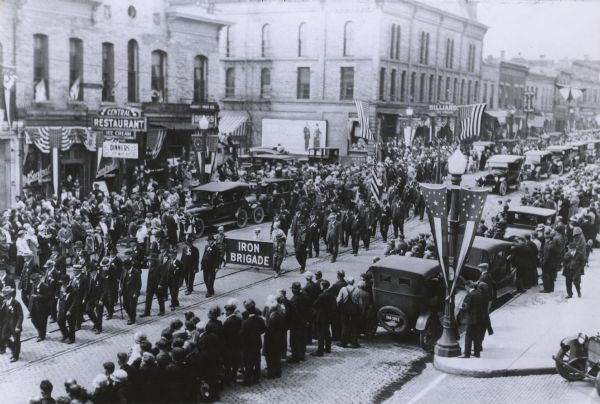 In 1895, the national G.A.R. encampment was held in
The encampment itself drew over 100,000 men from all over the country. General Wallace drilled and instructed the men prior to departure and then led the members of the Lew Wallace Veteran Battalion in the grand parade. A committee made all lodging arrangements (meaning a cot in the encampment), meal arrangements for the men and banners. The banners were attached to six-foot long staffs of Tennessee Tennessee cedars had protected the boys during the fierce battles they fought and would now support the aging veterans as they again demonstrated their support for the Union . Wallace and his battalion were special features of the encampment and Wallace was booked for at least three camp fire speeches (New Albany , Jeffersonville , and Louisville Chickamauga National Park
In 1899, Terre Haute Terre Haute
 In 1909, Crawfordsville hosted a 30th annual encampment of the G.A.R. By this time many of the Union soldiers, including General Wallace, had gone to their great reward but they were not forgotten in this event hosted from May 19th through the 21st. The homes of Montgomery County Civil War Generals Wallace, Canby, Morgan, Manson, and Hawkins were all featured as was the home of Confederate soldier Maurice Thompson. Wallace’s Study was specially featured with special note made of Wallace’s painting of the
The 1909 encampment was not the last G.A.R. event for Crawfordsville as picnics and gatherings continued for years. Men and women such as Louis Bischof, Henry Talbot, J. McCormick, Arch Austin, George Myers, J. Sellars, William Daggart, S.L. Ensminger, H. Cowan, B. Cowan and others continued to proudly remember the service of Union veterans. The local G.A.R. was also instrumental in the erection of the war memorial on the Courthouse grounds. After the death of Henry Talbot in 1924, almost sixty years after the end of the Civil War, the slow fade of the G.A.R. accelerated. As leaders such as Lew Wallace passed on, this important organization that meant so much too so many became a thing of the past much loved but no longer viable. Because of the buildings and memorials the G.A.R. sponsored, the elections it affected, the organizations it influenced, and the issues it addressed, its impact on communities throughout the country continues to be significant 145 years after it was formed and almost sixty years after it ceased to exist.


