Showing posts with label Lew Wallace. Show all posts

Saturday, October 5, 2013

People Lew Knew: Billy the Kid and Pat Garrett

On May 30, 1881, Lew Wallace boarded a rail car on the Atchison, Topeka, and the Santa Fe to leave New Mexico Territory. Lew had calmed the Territory during his term in office from 1878 through 1881, and his tenure in office was considered successful. He accomplished much in addressing the critical issues of the Territory; however, his time out west was not wholly satisfying to him and not without controversy. Just a month before his departure, Lew wrote his wife, Susan, a long letter. In it he penned words that have resonated with governors of New Mexico ever since: “All calculations based on our experiences elsewhere fail in New Mexico.”


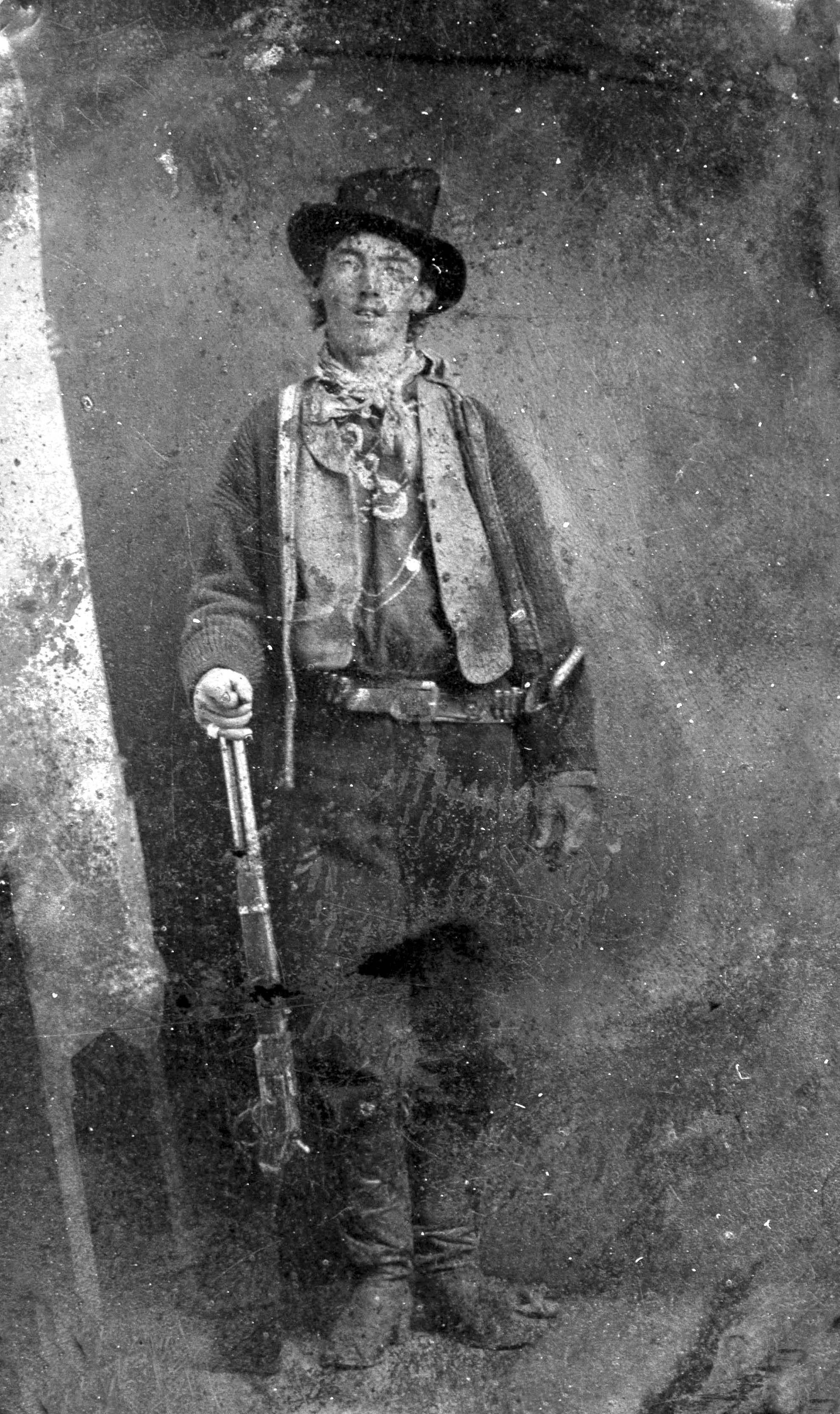
Although Lew left New Mexico and headed on to the publication of Ben-Hur and his service as U.S. Minister to the Ottoman Empire, he didn’t leave all of his New Mexico experiences behind him. While Lew was the Governor of the New Mexico Territory, Pat Garrett had been appointed Sheriff of Lincoln County by the Republican Party. Prior to that, Garrett had led a complicated life as a cowboy, buffalo hunter, and saloon operator. He was hot-tempered and had already killed a man. Within weeks of his appointment had already killed one of Billy the Kid’s gang members. Just days later, another gang member was killed and Garrett’s posse had captured the Kid.

A few months after his capture in April of 1881, Billy killed two prison guards and escaped. Lew had personally signed Billy's death warrant and ordered the posse that ultimately cornered the outlaw who had threatened to get Lew. This set up a massive man-hunt that was still in progress when Lew boarded his train to leave the Territory. In July of 1881, Pat Garrett shot Billy in a killing that remains controversial 130 years later.

Garrett’s term as Lincoln County Sheriff ended shortly after the killing. He ran for a number of political offices and lost each of them. As his career as a lawman foundered, Garrett moved back and forth between Texas and New Mexico throughout the 1880s and 1890s. With his rough persona and some of the whispers circulating about Billy's death, Garrett found it increasingly difficult to earn a living.

In December of 1901, the Crawfordsville Daily News-Review reported that thanks to Lew's intervention, Pat Garrett had been appointed collector of customs at El Paso, Texas. While Lew did accompany Garrett to the White House in support of the aging lawman, this newspaper report may have been giving Lew more credit than he deserved; Garrett had ingratiated himself with President Theodore Roosevelt, who made the appointment. 

As things turned out, Lew ultimately may have wished to distance himself from the former sheriff. Garrett served his five year term but was not reappointed. At a reception for Roosevelt’s beloved Rough Riders, Garrett showed up his friend, the notorious gambler Tom Powers. Among other things, Powers had been run out of his native Wisconsin after beating his own father into a coma. Photos of Garrett and Powers with the President opened Roosevelt to public criticism.

When his reappointment was denied, Garrett travelled to Washington to personally meet with Roosevelt. Instead of bringing someone with the reputation of Lew Wallace, as he had done in 1901, Garrett brought Tom Powers to the meeting! A plain-spoken man, Roosevelt made it clear to Garrett that he was not going to be reappointed. Although Lew Wallace and Pat Garrett shared a connection through their associations with Billy the Kid, these two men who brought law and order to the New Mexico Territory could not have been more different.

Wednesday, July 10, 2013

Ben-Hur Around the World

The Wallace name has spread far and wide and with it the name Ben-Hur. Schools, taverns, and businesses of all sorts have traded on the marketing juggernaut that was Ben-Hur in the late 19th century.  There are a handful of places around the world that also took these names in tribute and likely in hopes of trading on the famous names.

The small community of Wallace, Indiana, is located in southeast Fountain County. Established in the early 1830s, the village had a blacksmith, cabinet maker, general stores, shoemaker and two doctors. When the community received its first post office, local leaders named it after Lew's father, Governor David Wallace. In 1951, there were eight students in the high school graduating class and Wallace could boast about the same number of firms that had been in business in 1880. As of the 2010 census, there were 105 people spread among 52 households in Wallace. 

It is interesting, given Lew Wallace’s lack of enthusiasm for traditional learning, that at least two schools in Indiana adopted his name. Lew Wallace High School in Gary, Indiana, has had an impressive history and continues to have an active alumni association. In Indianapolis, elementary school P.S. #107 is also named for Lew Wallace. At least one school in Albuquerque has also been named in honor of Lew Wallace, and New Mexico also has a Lew Wallace building as part of their State government complex. 

The name Ben-Hur saw greater utilization by people looking to identify their communities. Ben-Hur, California is an unincorporated community in Mariposa County. Again, a rural post office led to the naming of the community in the 1890s. The post office was closed in the 1950s, but the Ben-Hur name continues to be associated with the tiny settlement that remains. Ben-Hur in Lee County of western Virginia is another unincorporated settlement.

Yet another of the Ben-Hur communities is an unincorporated area in Limestone County, Texas. This town near Waco was originally named Cottonwood, but by 1895, there were three other communities in Texas named Cottonwood. The local residents decided to rename the town. At that time Ben-Hur, Texas, had a population of about 100. By World War II it had a thriving population of over 200, but today there are fewer than 100 people and a couple of closed businesses in Ben-Hur, Texas. 

Perhaps the most exotic of the Ben-Hur communities is a small settlement in the Kalahari Constituency of the Omaheke Region of Namibia on the border between Namibia and Botswana. Just how or why Ben-Hur was used to identify this settlement is not known.

Monday, July 1, 2013

Lew Wallace in the Movies

The name of Lew Wallace is widely remembered for the wildly successful movie interpretations of his masterwork Ben-Hur in 1925 and 1959. These were not the only times that the General’s name (and even the General) showed up in Hollywood movies. In 1914, Wallace’s book, The Prince of India, was adapted as a silent movie. This forty-four minute film moved along at a rapid pace and bore little resemblance to Wallace’s book. Starring Thurlow Bergen and William Riley Hatch, the plot involved a devil-may-care newspaper reporter, a stolen gem, a fun-loving Indian prince, a temptress, and a climatic scene with a run away trolley car. Lew Wallace would not have been pleased with the artistic license taken in the filming of this movie. 

The General himself has been represented in several productions. These include Land Beyond the Law (1937) which starred Dick Foran, a matinee idol of "B" movies and one of the movie industry’s most successful singing cowboys. Foran played wild and woolly Chip Douglas, who becomes a lawman after his father is killed in the New Mexico territory; through his efforts he helps avoid a range war. Although uncredited in the movie, Governor Lew Wallace is portrayed by Joe King. King was a talented character actor, director and writer. Working steadily from 1912 until 1946, he was in such significant movies as: They Died With Their Boots On, Sergeant York, Destry Rides Again, Mr. Smith Goes to Washington, Alexander’s Ragtime Band, Cain & Mable, and Anthony Adverse.

In 1955, director Mervyn LeRoy brought Wallace to life in Greer Garson’s, Strange Lady In Town. In this movie, which co-starred Dana Andrews and Cameron Mitchell, Garson sets a western town on edge when she arrives and begins her own medical practice. Her first patient in Santa Fe has a toothache and is brought in by Billy the Kid. After all sorts of intrigue, Garson’s character attends the Governor’s ball where she meets Governor Lew Wallace who happens to mention two things. First, that he is working on a novel called Ben-Hur, and second, that he has a chronic heart condition. The ever helpful lady doctor suggests that perhaps his collar is too tight. This “miracle cure” for a heart condition actually contradicts what the town’s male doctor has told the Governor and more intrigue follows until (spoiler alert) the lady doctor and the gentleman doctor ride off together in his buckboard at the end of the movie.

The actor who portrayed Lew Wallace was Ralph Moody, a big, burly man who looked nothing like the real Lew Wallace. Moody often played gruff old men or Native Americans. He had an extraordinary career as a working actor from 1948 to his death in 1971 with well over 100 appearances in both movies and on TV. He was, in fact, one of Jack Webb’s favorite actors and appeared frequently in Dragnet.

Strange Lady in Town also introduced audiences to Susan Wallace in one of her rare portrayals on screen. Mrs. Wallace was portrayed by Louise Lorimer. Like Ralph Moody, Ms. Lorimer was a talented actress who worked steadily from 1934 until her retirement at age 87 in1985. She played alongside some of Hollywood’s leading lights in both the movies and on TV. Among the more significant movies she worked in were: Gentleman’s Agreement, Sorry Wrong Number, The Snake Pit, Sorrowful Jones, The Heiress, The Young Philadelphians, and Marnie. Her appearance as Mrs. Wallace was only slightly closer to reality than Ralph Moody’s presentation of Lew Wallace.

More recently Wallace has been portrayed (often more accurately) in documentaries and videos, including a 2006 film called: No Retreat from Destiny: The Battle That Rescued Washington. This production tells the story of the Battle of Monacacy. On the History and Discovery Channels, documentaries on Billy the Kid often discuss Wallace’s governorship using period photos and an occasional actor portraying Wallace.

Beyond the feature movies, Wallace’s Ben-Hur also appeared in books and movies as part of the plot. In Raymond Chandler’s The Big Sleep, the famed private eye, Philip Marlowe, enters a book store that he believes is a front for evil doings. In an effort to trap the seductive woman running the store, Marlowe asks: "Would you happen to have a Ben Hur 1860?" She asks: "A first edition?" to which Marlowe replies "Third. The one with the erratum on page 116." The lady obviously doesn't know her Ben-Hur (since it was published in 1880 and there is no edition with an erratum on page 116) and, therefore, isn't the store owner. In Anne of Green Gables, Anne is caught reading Ben-Hur at school when she is supposed to be studying another subject.

For over 130 years Ben-Hur and Lew Wallace have been part of popular American culture. The impact of Wallace’s book is demonstrated in the many ways it and its author have been incorporated in other creative endeavors over the past century. Keep your eyes open and ears tuned, as you never know when Lew Wallace or Ben-Hur will show up to move a plot along.  


Sources: Marie Stocks for finding blog comments on the Slate article regarding Wallace in the movies and Kyle Gobel for watching The Big Sleep. Internet Movie Database (IMDb)

Tuesday, June 25, 2013

Haunted Basements and the Mexican War

To put it politely, Lew Wallace was what today would be called an alternative learner. In his day, many in Indianapolis referred to Lew, the governor’s son, as rascal and worse. As a youth running around the capital city, Lew and his friends found their way into the basement of the Governor’s house that stood in the middle of the circle downtown where the Soldiers and Sailors Monument was to be built decades latter. For different reasons, this house was never occupied by any governors, but was used instead by others. One of the occupants was Judge Isaac Blackford who lived in and worked out of the old mansion. Many of the other local attorneys and judges began to use this house as an informal place to meet and socialize.

The basement of the house was a vast, unlighted cellar filled with boxes, barrels, and as Lew wrote in his autobiography, “. . . debris of such varied ins and outs as to be dangerous, if not quite impassable, to the unfamiliar.” The basement was also supposed to be haunted by a workman who, on good authority, was reportedly buried in deep, dark, dank cellar.

Lew and a few of his cohorts found this basement and its intrigue impossible to pass up and used the lower area of the house as a meeting and rendezvous spot much as the lawyers did upstairs. Boys being boys, they decided it would be fun to take long poles and begin punching the underside of the floors just as the attorneys were engaging in their debates and discussions. The more the men yelled and stomped their feet, the louder the boys would hit the underside of the floor. The rascals could easily hear when the men had had enough and were headed to the basement to apprehend the criminals so like rats, the boys scattered into the dark recesses of the cellar to preselected hiding places.

After a couple of these episodes, the men turned the tables and had the local sheriff of the court and several bailiffs lie in wait for the boys. At the first thump, the cellar doors were seized shut and with lanterns each boy was fished out by his shirt collar. As Wallace wrote: “With an inconceivable hardness of heart, the myrmidons took us up-stairs and before the judges. There I made the acquaintance of Isaac Blackford . . .” Lew continued his wayward existence and eventually struck out on his own when his father had had enough of his poor behavior and poor scholarship. During this time, young Wallace did undertake the study of law, but also grew increasingly interested in the turmoil in Texas and discovered that he had a gift for public speaking when he began recruiting men to fight in the Mexican War.

A few years after his escapade in the basement, imagine his dismay when he and others interested in pursuing a legal career appeared in court to take the bar examination. “We advanced and stood in a body outside the railing. As we did so, I observed the clear, gray eyes of his honor, Isaac Blackford, rest on me with a look so sharp and cold it shot me full of rigors. He had waited a long time for what the baseballists would call his innings. At last it was come. Would he make a worm of me and thread me on his hook?”

The good judge did not make a worm of Lew and thread him on a hook. The judge made no speech, but rather gave the young men their instructions and sent them with a bailiff off to a room to take the exam. The exam took hours and hours to complete and at the end of the ordeal, Lew was not particularly satisfied with his answers. As he recorded in his autobiography, at the bottom of the last page he wrote a note, “. . . the flippancy of which makes my face burn as I now write:
‘Hon. Isaac Blackford, Examining Judge:  Dear Sir,--I hope the foregoing answers will be to your satisfaction more than they are to mine; whether they are or not, I shall go to Mexico.  Respectfully, Lew Wallace.”
Two or three days after completing the examination, Wallace received a letter from the post office:  “Supreme Court-Room, Indianapolis.  Mr. Lew Wallace:  Dear Sir—The Court interposes no objection to you going to Mexico.  Respectfully, Isaac Blackford.”

As Wallace noted in his memoirs, the communication was not attached to a license to practice law. It took service in the Mexican War and the love of a good woman named Susan to bring Lew successfully back to his law studies in the early 1850s.

Tuesday, June 11, 2013

Lew Wallace and the "Hung in Black" Speech

One of our Facebook friends recently asked us about Lew's speech given in Philadelphia after Lincoln's famous "Hung in Black" speech. This blog post is adapted from our research and response.

On June 7 and 8, 1864, the Republican National Convention met in Baltimore and nominated Abraham Lincoln to a second term in the White House. Earlier that year, Lew Wallace had been appointed Commander of the 8th Army Corps in Baltimore by Lincoln. Lew had already successfully supported an election in Maryland that assured that the state would remain in the Union. Holding the Convention in Baltimore furthered the Union cause.

On June 16, the President traveled from Washington to Philadelphia for the Philadelphia Fair, which was being held as a benefit to the Sanitary Commission. The Sanitary Commission was a private relief agency established by federal legislation to support sick and wounded Union soldiers. Upon his arrival the President was greeted by local dignitaries and great applause by people lining Chestnut Street.

Buildings of the Great Central Fair
Seeing the exceptional response, the Executive Committee of the Fair raised the price of admission to $1 during the time the President was to be there. President Lincoln, Mrs. Lincoln, and one of their sons arrived at the Fair at 4:30. The crowd swelled to over 15,000 people as people strained to get a glimpse of Lincoln.

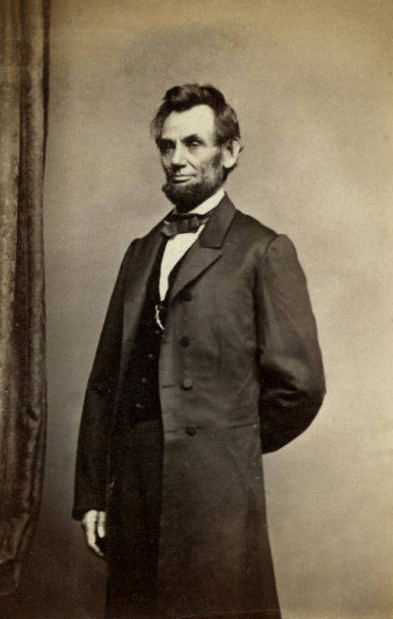
Late in the day, Lincoln returned to his hotel for the formal dinner. Joining him at his table were the Honorable Edward Everett (who had been the featured speaker at the Gettysburg Dedication in 1863), former Governor Cannon of Delaware, the Mayor of Philadelphia, several local dignitaries, and General Lew Wallace. The evening began with a toast to the health of the President by Thomas Webster, to which Lincoln responded. In acknowledging the toast he noted the work of the Sanitary Commission with comments that came to be known as his "Hung in Black" speech. Lincoln said:
Mathew Brady [Public domain],
via Wikimedia Commons

I suppose that this toast is intended to open the way for me to say something. War at the best is terrible, and this of ours, in its magnitude and duration, is one of the most terrible the world has ever known. It has deranged business totally in many places, and perhaps in all. It has destroyed property, destroyed life, and ruined homes. It has produced a national debt and a degree of taxation unprecedented in the history of this country. It has caused mourning among us until the Heavens may almost be said to be hung in black....
After noting the important work of the Sanitary and Christian Commissions, Lincoln went on to say, "When is this war to end? I do not wish to name a day when it will end, lest the end should not come at the given time. We accepted this war, and did not begin it. We accepted it for an object, and when that object is accomplished the war will end; and I hope to God it will never end until that object is accomplished." 

These comments by Lincoln were powerful words at a difficult time. Although Lincoln had been re-nominated by his party, his re-election in the fall was by no means assured. The North was still reeling the devastating Battle of the Wilderness in May. After the Wilderness came Cold Harbor, where more than 9,000 men were killed in one hour. In the six weeks before this speech, General Grant’s army had seen 52,000 casualties; people as close to the President as Mrs. Lincoln were demanding Grant's removal. Lincoln stood firm: "I can’t spare him. He fights!" As losses mounted and morale in the North teetered, Lincoln also faced the popular George McClellan, who was running for President as a Democrat, and urging a negotiated settlement with the South to end the war. 

After Lincoln concluded his comments, the next toast was directed to General Wallace. Lew made a brief speech intended to support Lincoln’s stance by declaring that General Grant was the right man in the right place. Lew said his mind was free from all doubt that Grant would capture the rebel capital and capture Lee’s forces. 

After Wallace’s comments, Edward Everett was toasted. In contrast to his long speech at Gettysburg, Everett kept his comments brief, saying in part: "After such an address from the man who has borne upon his shoulder the cares and burdens of this struggle, what can I acceptably say?"

After a few additional comments and presentations, the evening wound down. Lincoln made a more visits around town that night but declined invitations to speak. The next day, Lincoln and his party, which included Wallace, returned to the White House, where additional battles and losses would occupy the President’s days. One of these would be the Battle of Monocacy Junction just three weeks later, where Lew Wallace delayed Jubal Early as the Confederate General advanced on Washington, D.C.

Saturday, May 18, 2013

Armed Forces Day

According to the Department of Defense, Armed Forces Day was created in 1949, which means Lew would never have celebrated it. It would probably have been an important holiday to him, however. Lew was very proud of his military service and remained active in veterans' associations and war memorial efforts.

Lew served in both the Mexican War and the Civil War, and actually volunteered for the Spanish-American War. Because he was 71 at the time of the Spanish-American War, his offer was declined. He delivered speeches at occasions such as the dedication of the Greencastle's Soldiers Monument, the reunion of the 11th Indiana in Terre Haute, a United States Naval Academy graduation ceremony, and the dedication ceremony of the Indiana Soldiers and Sailors Monument. He even built a special case in his Study to display some of his military artifacts. With such evidence, we can say confidently that Lew would have appreciated Armed Forces Day.

Lew wasn't the first of his family to serve in the military--his father, David, was a West Point Cadet. Nor was Lew the last. His two grandsons, Tee and Lew, Jr., served in World War I. Tee enlisted in the American Field Ambulance in 1916, before U.S. entry into the war, and drove ambulances for the French Army. After his graduation from Yale, he enlisted in the U.S. Marine Corps. He was killed during a surveillance mission near St. Etienne in October of 1918.

Lew, Jr. was in the National Guard and served in Texas during the Mexican Revolution. In September of 1918, he was sent to France, where he served as a captain in the intelligence service. In 1919 his division was inactivated and he served as aide to General E.M. Lewis until 1920.

Later generations of the Wallace family also continued the tradition of military service. Lew's great-grandsons  III and Bill Wallace both served in World War II, and Lew's great-great-grandson Sanford Miller served in Vietnam.

With such a strong legacy, is it any wonder we think Lew would have approved of a holiday set aside for civilians to thank members of the military for their sacrifices?

Thursday, May 16, 2013

William Seward, Jr. and the Battle of Monocacy


A photo taken in 1906 of the 1832 Frederick, MD, B&O
station; photo courtesy of Wikimedia Commons
In the summer of 1864, John W. Garrett, President of the Baltimore & Ohio railroad, came to see General Lew Wallace. Mr. Garrett expressed concern for the safety of Washington (as well as his railroad). His personnel were reporting detachments of Confederate troops in the Shenandoah Valley and, according to him, such appearances were precursors of trouble. General Wallace decided to go to the western limit of his command, the Monocacy River, southwest of Frederick, Maryland. Upon his arrival at the blockhouse guarding the rail junction (Monocacy Junction) he found the country alive with rumor. A Confederate army, reported to be between 5,000 and 35,000 men strong, was thought to have crossed the Potomac River on the 2nd or 3rd of July. Its exact whereabouts and destination were both unknown. The civilians that General Wallace sent to gather information were turned back by rebel cavalry at every pass in the mountains west of Frederick. General Wallace believed this cavalry was screening a larger army.

Two miles north of the junction, a stone bridge called the Jug Bridge crossed the Monocacy, carrying the National Road that led to Baltimore. At the junction there was an iron railroad bridge and, a few hundred yards southwest of it, the wooden covered bridge of the Georgetown Pike, the road to Washington. Any invading army intent on Washington or Baltimore would have to come this way. After brief consideration, General Wallace believed that Washington was the objective. He began putting men in place. 

On July 9, 1864, 6,500 troops under the command of General Wallace met 14,000 battle–hardened veterans of the Army of Northern Virginia, commanded by General Jubal Early, on the farm fields near Monocacy Junction. Confederate troops held the field at day’s end, but Wallace and his men had delayed them long enough that reinforcements ultimately sent by Union General-in-Chief U.S. Grant would reach the lightly-defended U.S. capital just in time. Early’s plans to capture Washington were quashed. The battle of Monocacy is now known as the “battle that saved Washington.”

General Grant later wrote that Wallace had done more for the cause by losing this battle than many generals had accomplished by winning.

As the Battle of Monocacy loomed, the city of Washington panicked. One of the men in Wallace’s small army was Colonel William Seward, son of Lincoln’s Secretary of State, William Henry Seward, and the commander of the hard-fighting Ninth New York Heavy Artillery. Seward’s regiment was in the middle of the Monocacy battle and according to Wallace’s official report the Ninth New York had 102 killed and wounded with 99 missing for a total of 201 casualties. Seward’s family, in Washington, received continuing reports from the battlefield and was well aware of Wallace’s valiant defense but ultimate defeat.

William Henry Seward, Jr.
The Secretary of State stayed at the War Department reading telegrams coming in from the battle until almost midnight. He had just returned home when Secretary of War Edwin Stanton arrived at the Seward residence to tell the family that there were reports that young William was wounded and taken prisoner. Colonel Seward’s brother, Augustus, left early the next day to go to Baltimore in an effort to ascertain the truth of the rumors. Based on reports he could gather, Augustus determined that his brother had been wounded, but not captured—although his whereabouts were unknown in the panic and chaos that was gripping both Washington and Baltimore.

By that evening there was a telegram at the Seward home from General Wallace: “I have the pleasure of contradicting my statement of last night. Colonel Seward is not a prisoner, and I am now told he is unhurt. He behaved with rare gallantry.” While Colonel Seward was reported safe on July 10, Washington definitely was not—Jubal Early’s veterans were marching on the city. On July 11, Early’s army arrived in front of Ft. Stevens, the northernmost fort in Washington’s defensive chain. Early could see the flag flying on the dome of the U.S. Capitol.

The city was in real jeopardy--Grant’s reinforcements had not yet arrived--but luck was on the Union side because Early delayed his attack. Grant’s reinforcements arrived on the night of the 11th and battled with Early’s men on July 12. During this fighting, President Lincoln arrived at Ft. Stevens and insisted on watching the action from the ramparts. He was thus exposed to Confederate sharpshooters, who killed an officer standing nearby, whereupon the President was convinced to move off the walls.

As it turned out, Wallace’s information relayed to the Seward family was still not correct. Colonel Seward had in fact been injured. He suffered a slight wound to his arm and broke his leg when his horse was shot and fell on him during the battle. Seward was unable to walk off the battlefield and only escaped capture when he found a mule and, using his silk handkerchief as a bridle, was able to ride off the field ahead of the Confederates. Within eight weeks Seward was promoted to brigadier general and served throughout the remainder of the war. A banker before the war, General Seward returned to a successful career in banking after his time in the military. He followed politics, supported charitable causes, served as a director for a number of corporations, and was involved in historical and patriotic societies until his death in 1920, over 50 years after Lew Wallace’s battle that saved Washington—a battle that directly affected the outcome of the Civil War and likely changed the history of the nation.

Many years later General Wallace encountered one of the Confederate commanders, J. B. Gordon, at a White House reception. Gordon told Wallace he was the only Yankee who ever whipped him. Wallace replied that, in the end, his men ran from the field. “In that sense you are right,” Gordon countered, “but you snatched Washington out of our hands.”

Sources: Shadow of Shiloh, Gail Stephens, Indiana Historical Society Press, 2010
                Seward, Lincoln’s Indispensable Man, Walter Stahr, Simon & Schuster, 2012

The General Lew Wallace Study & Museum celebrates & renews
belief in the power of the individual spirit to affect
American history & culture.

Sunday, May 5, 2013

Happy Cinco de Mayo!

It might surprise you to learn that Lew Wallace may have celebrated Cinco de Mayo, but the idea isn't as crazy as you might think!

Cinco de Mayo commemorates the Battle of Puebla on May 5, 1862. Lew was busy with the aftermath of the Battle of Shiloh in the area of Corinth, Mississippi, at the time, and may not have heard about the battle until long afterwards. Puebla certainly had little impact on his life for two years.

Then in 1864, Lew was sent to Mexico under Grant's orders. During an interview with Frank G. Carpenter, Lew related the circumstances of that mission:

I was the agent of General Grant in giving the Mexicans such assistance as enabled them to keep their country a republic; Louis Napoleon wanted to make it a monarchy. He was backing Maximilian, and was in a fair way to succeed. This was just at the close of the rebellion, when we were still in an unsettled condition, and did not dare risk a war with France.
I was sent by General Grant, without the knowledge of Secretary Seward, to consult with General Juarez, the Mexican President, to see if we could not in some way assist the republic. I went to the Rio Grande and pushed my way through the country to Chihuahua, where I met Juarez. He was in a bad way; had but few troops and but few arms, and it looked as though Maximilian must succeed. We discussed the matter, and as a result he sent the Governor of Tamaulipas with me back to the United States; and there in connection with Matias Romero, the Mexican Minister to Washington, we bought about $5,000,000 worth of Winchester rifles, cannon, and other munitions of war, and paid for them with Mexican Government bonds.
We put these arms on a ship and, in broad daylight, started for New Orleans as our nominal port. After a while we changed our course and made for the mouth of the Rio Grande, where we unloaded the guns and passed them on to the Mexican troops. These guns changed the tide of victory. From that time on President Juarez conquered, until finally he executed Maximilian at Queretaro.

It's safe to say Lew had a strong interest in the Mexican Republic. According to Wikipedia, Cinco de Mayo was first celebrated by Californians during the Civil War, as well as in Mexican-American communities in the western parts of the United States. So Lew probably didn't spend May 5 drinking margaritas and singing Mexican folk songs, but he definitely contributed to the overall cause behind Cinco de Mayo.

Tuesday, April 30, 2013

The Singing Tree


April is National Poetry Month. Lew and Susan both wrote dozens of poems, and occasionally we like to share them here. To celebrate the end of National Poetry Month, take some time to relax and read some of Lew's poetry from his celebrated novel Ben-Hur.


TIRZAH’S SONG

Wake not, but hear me, love!
      Adrift, adrift on slumber’s sea,
       Thy spirit call to list to me,
Wake not, but hear me, love!
        A gift from Sleep, the restful king,
         All happy, happy dreams I bring.

Wake not, but hear me, love!
        Of all the world of dreams ‘tis thine
         This once to choose the most divine,
So choose, and sleep, my love!
         But ne’er again in choice be free,
          Unless, unless – you dream of me.


THE  LAMENT

I sigh as I sing for the story land
    Across the Syrian sea
The odorous winds from the musky sand
    Were breaths of life to me.
They play with the plumes of the whispering palm
     For me, alas! No more;
No more does the Nile in the moonlit calm
    Moan past the Memphian shore.

O Nilus! Thou god of my fainting soul!
     In dreams thou comest to me;
And dreaming, I play with the lotus bowl,
     And sing old songs to thee;
And hear from afar the Memnonian strain,
    And calls from dear Simbel;
And wake to a passion of grief and pain
     That e’er I said – Farewell!


KAPILA

  I.

Kapila, Kapila, so young and true,
   I yearn for a glory like thine,
And hail thee from battle to ask anew
   Can ever thy Valour be mine?

Kapila, sat on his charger dun,
   A hero never so grave;
Who loveth all things hath fear of none,
  'Tis love that maketh me brave,
A woman gave me her soul one day
The soul of my soul to be alway;
   Thence came my Valour to me,
    Go try it – try it – and see!

II.

Kapila, Kapila, so old and gray,
    The queen is calling for me;
But ere I go hence, I wish thou wouldst say,
    How Wisdom first came to thee.

Kapila stood in his temple door.
     A priest in eremite guise.
It did not come as men get their lore,
     'Tis faith that maketh me wise,
 A woman gave me her heart one day,
 The heart of my heart to be alway;
    Thence came my Wisdom to me,
     Go try it – try it – and see.


Wednesday, April 24, 2013

People Lew Knew: Gene Stratton-Porter

One of the great Hoosier authors of the early 20th century was Gene Stratton-Porter. Her literary career began its ascent at the turn of the century and continued until her death in 1924 when her limousine was hit by a streetcar in Los Angeles. Always a trailblazer, she had moved to Los Angeles from her beloved Indiana for health reasons and because she had become so popular that she had formed a movie studio and production company to bring her characters from books such as Laddie, Freckles and A Girl of the Limberlost to life on film. At the peak of her popularity it is estimated that she had more than 50 million readers enjoying her romantic novels, magazine articles, and her studies of nature and wildlife.

An avid reader, photographer, and lifelong scholar on conservation and ecology, with the income that she earned from her writings, Mrs. Stratton-Porter enjoyed developing native gardens and natural areas on her northeastern Indiana properties—most famously her Cabin in the Wildflower Woods. In one of her last books, Tales You Won’t Believe, published in 1925, Mrs. Stratton-Porter related a wonderful little story about the white strawberries sent to her from the garden of General Lew Wallace.  

In relating her story, Mrs. Stratton-Porter’s great admiration for Wallace is evident. As her books and her interests in wild flower gardening became known, people from all over the country and, in fact, the world sent her clippings, cuttings, seeds, and plants for her gardens. She wrote: “...perhaps the greatest thrill of the entire collection came when I received a packet containing half a dozen wild strawberries, guaranteed to bear white wild strawberries from the home grounds of General Lew Wallace.”  These plants held special meaning for her as she knew Wallace was a great flower lover and he himself had found them in the woods near his home. Mrs. Stratton-Porter had visited the home and she knew of Wallace’s magnificent trees—especially the Beeches “...which grew for the General in the most elaborate manner, truly lordly Beeches with wide-spreading arms of gray moleskin, great velvet trunks and branches almost sweeping the ground.”

Mrs. Stratton-Porter took great care in personally planting these special gifts—searching her property for just the right soil, light, moisture and shade. She had read and practically memorized The Fair God and Ben-Hur and fairly worshipped Wallace. For many years the strawberries grew and flourished. Then in 1914, a very long and cold winter severely damaged her garden. Among the plants that did not return in the spring of 1914 were the beloved white strawberries. General Wallace had died by 1914 and Mrs. Stratton-Porter considered approaching Wallace’s son for one more plant—hoping that the cold winter had not destroyed the original beds. But time got away from Mrs. Stratton-Porter and fate intervened.

One of her large Beech trees that she had been trying to save also died in the cold winter of 1914 and had to be taken down. After cutting the tree it was discovered that even the roots were rotted and hollow. Squirrels had been using them to hide their winter stores. Mrs. Stratton-Porter and her staff filled the hole left by the beech, smoothed the soil and moved on to other tasks. A year later, Mrs. Stratton-Porter was passing through the woods near where the Beech tree had been and was dumbfounded when she discovered a big circular bed of wild white strawberries spreading over every inch of ground that the Beech had occupied.

After much pondering Mrs. Stratton-Porter came to the conclusion that the squirrels must have been feeding on the white strawberries and sowed the seeds throughout the roots and soil of the old Beech tree. When the tree was gone, the soil smoothed, and sun and rain reached the ground, Wallace’s white strawberries returned with a vigor she had never seen in her original beds. As she recorded, “Nature returned to me my lost gift from the wildings of the great general.” Given Wallace’s love of his Beech trees, there was some poetry for Mrs. Stratton-Porter in knowing that the loss of her Beech tree gave new life to the General’s strawberries that she so valued. Sadly, after all the pleasure these little plants brought both the General and Mrs. Stratton-Porter, the white wild strawberries seem to have disappeared from both the grounds of the Wallace Study and from the Cabin in the Wildflower Woods—but as any gardener knows, hope springs eternal and we will be keeping an eye out for these tasty treasures for seasons to come.

*Information in this post is from an article by Joann Spragg.

Monday, April 22, 2013

Lew Wallace and Conservation

One of Lew Wallace's favorite places on earth was the Grand Kankakee Marsh that spread across Northwestern Indiana into Illinois. Over the course of his life he often traveled to the marsh to fish and hunt. He owned a houseboat, descriptively called The Thing, which served as his home base while on the marsh.
Lew's power barge on the Kankakee

The U.S. Fish & Wildlife Service website says the Grand Kankakee Marsh covered up to 500,000 acres of land. (Other sources claim up to 1 million acres.) The first European explorer to visit the marsh was La Salle in 1679, but the Native Americans had already been living there for generations. Throughout the 1860s and 1870s numerous attempts were made to drain the marsh, but by the 1880s it had become a hunter's paradise.

"Never, in all my world travels, have I found a more perfect spot, not a more tantalizing river."

According to the Starke County Historical Society, Lew spent a great deal of time at Bass Lake, where a tree was named the Ben Hur Oak (much like our Ben-Hur Beech!) because he sat under the tree and wrote. Sportsmens clubs were common along the Kankakee, including the Ben Hur Club run by a Civil War veteran and acquaintance of Lew's. Prominent figures such as the Studebaker family, President Teddy Roosevelt, and others came to the marsh to relax.

The glory days of the Grand Kankakee Marsh were not to last, unfortunately. Counterfeiters and other criminals on Bogus Island (located in what was the largest freshwater lake in Indiana), along with increased desire for arable farm land, led residents to dredge, channelize, and drain much of the marsh. Today less than 5% of the original marshland remains.

Groups such as the Indiana Grand Kankakee Marsh Restoration Project and the Kankakee River Awareness Program in Illinois are making a concerted effort to preserve what is left of the marsh and restore what they can to its natural state. While Earth Day didn't exist in Lew's day, we think he would have approved of the efforts to care for the wilderness he so enjoyed as a refuge from day-to-day life.

Monday, March 18, 2013

Lew Wallace and his Lost Masterpiece

Lew Wallace is generally given credit for writing three novels of historical fiction. The Fair God: The Last of the ‘Tizins (1873), Ben-Hur: A Tale of the Christ (1880); and The Prince of India; or, Why Constantinople Fell (1893). It is true that these were his three major novels that were actually published, but he wrote another novel that didn’t survive long past its initial public presentation.

While a student at the Indianapolis Seminary, Lew Wallace attended meetings of the Union Literary Society where students shared debates, recitations, readings, and parliamentary proceedings. In time, Lew began writing and publically reciting a lengthy historical poem he had written with John Smith of Virginia the hero. In the poem, this hero is aptly named “Virginia John.” Written in the flavor of Sir Walter Scott’s Marmion his poem ended with the dramatic rescue of Pocahontas.
A young Lew Wallace

Irving McKee in his book The Early Life of Lew Wallace speculates that Lew might have been inspired by a production of the play Pocahontas by Robert Dale Owen that was performed by the Indianapolis Thespian Corps in the winter of 1839. In this production, Lew had the role of “Numony,” Pocahontas’ sister and his real-life brother, William, had the lead role of John Smith.

Lew’s historical poem was then followed by his Travels of a Bed-bug. In this poem, a bed-bug, born in the office of an Indianapolis lawyer passes from office to office and from hotel to hotel with adventures and commentary on local citizens along the way until it dies from over drink—much like the famed Alexander the Great. Lew had this effort published to the great amusement of the town, but to his regret, as he wrote of: “. . . the just indignation of the gentlemen concerned. Learning that several of them were looking for me, canes in hand, I went hunting, and was gone time enough for the flurry to blow over.”

After these two efforts at epic poetry, Lew realized that his forte might rather lie in prose. He then commenced writing a lengthy novel that he read to the Literary Society in installments. This work, The Man-at-Arms: A Tale of the Tenth Century truly became an epic production. Just the synopsis in Lew’s autobiography runs from page 63 to page 72! To summarize the summary, the hero was a page named Pedro, who was of good blood and bore himself like a paladin. A talented youth, he played the lute, sang ballads of knights and ladies fair, excelled at horsemanship, spoke with grace and was generally heroic. Among the cast of hundreds, the story included an evil duke, a fair maiden named Inez, and a hateful old widow, and a kindly hermit who married the young lovers in a cave in the mountains.

Trials and tribulations flowed from Lew’s pen as the story wound on and on with the young lovers separated by the evil duke. Set in the year of our Lord 1097, Pedro eventually finds glory on a Crusade to Jerusalem. The finale included a famine, a plague, and a dying hero. As Lew wrote in remembering this work: “On a bed of straw she found him lying, to all appearance dying. Not minding his feeble protest, she unlaced his helmet and took it off. The recognition was instantaneous. The scene that ensued was to the author’s heart, and he gave it his best power.” Ultimately Pedro was restored to health because “there is no leech like love” and the duke, seeing Pedro and Inez’s love grants Pedro his dukedom.

By the time Lew had finished this gripping tale it had stretched to over 250 pages of text closely written and bound in a book. He kept the book at his home for several years, but while away serving in the Mexican War, the book was misplaced or destroyed. Even as Lew penned his autobiography some fifty years later he wrote that the loss of this book was one of his standing regrets—not so much for its literary quality, but for the amusement it would have provided. He stated that even with his youthful tendency to waste time, writing this book proved to him that he was capable of continuity of purpose. It also proved to him, that although sophomoric and overly sentimental, he could capture an audience with his writing and with his public speaking. The members of the Union Literary Society turned out in force whenever he had a new installment of the story to present. In theme and prose this effort presaged his later works of religious fiction. More importantly, this lost masterpiece demonstrated to Lew that he had abilities that deserved further self encouragement and ultimately led to the writing of The Fair God and ultimately, Ben-Hur.


The General Lew Wallace Study & Museum celebrates and renews belief in the power of the individual spirit to affect American history and culture.


Monday, March 11, 2013

The Angel of Grief


The Angel of Grief by William Wetmore Story is one of the most evocative stone carvings of the late nineteenth century. It became so famous that the term has become synonymous with many grave stones erected in Story’s style. William Wetmore Story was born in 1819 in Boston, educated at Harvard and his father was Supreme Court Justice Joseph Story. A child of privilege; as his life developed he was surrounded by influential people like Robert Browning, Thackeray, Nathaniel Hawthorne, Hans Christian Anderson, Henry James, and James Russell Lowell. William had a successful law career and was a published poet and essayist, but also pursued sculpture as a hobby. The hobby took on new meaning in 1845, when he was commissioned to execute a monument in memory of his father. This commission combined with a bout of typhoid fever caused Story to leave his law practice and pursue sculpting full time.

William W. Story ca. 1885
In the 1850s, Story moved his family to Rome where he completed one of his most famous works, Cleopatra, in 1858. With this statue, he moved American sculpture toward a new romanticism that combined realism and psychological drama that proved to be in sync with the Victorian tastes of the day. Pope Pius IX so admired Cleopatra that the Roman government paid all shipping costs in order to exhibit it in 1862 at the Roman Court of the International Exposition in London, where it made Story's reputation.

William Story married the love of his life Emelyn Eldredge in 1843. Together they had three accomplished children and their home in Rome became world famous for its hospitality. Their hospitality was helped by the fact that their “home” was a forty room apartment in the Barberini Palace, one of the most important examples of Baroque architecture in Rome. It was begun in 1625 and built according to the desires of Urban VIII, the Barberini pope.

Among the world famous guests who visited Mr. and Mrs. Story were Lew and Susan Wallace. The Wallaces visited the Barberini Palace in 1883, and the two couples developed a significant friendship. In a letter Anne Hampton Brewer, who was in attendance when the Wallaces were visiting the Palace, wrote “how the General literally charmed us all last evening at Mr. Story’s with his brilliant conversation. It is so seldom that a fine writer is a fine talker.”

In 1884, William Story penned a letter to: My Dear Mrs. Ben-Hur. In this letter Story noted how touched he had been by a letter from Susan Wallace and he apologized for his delay in responding. He blamed his delay on the desire to finish reading Ben-Hur before writing. He said that with all of the interruptions of his life he just could not find time for the book until he and his wife decided to read the story aloud to each other. They developed a deep and sustained interest in the vivid prose and both felt great regret as they finished the last page.

The relationship continued through letters between the families. In 1886, Mrs. Story wrote in a long letter to Susan Wallace: “Many a time, impatient of the silence which has come between us, have I wished to break it on my side, but so vague was my knowledge of your whereabouts that I was frightened about launching into infinite space my little skiff. Your most kind letter came and helps me to find you out. . . . The book of books [Ben-Hur] of this age read aloud for the second time has lost none of its rare charm and it is beyond words to say how greatly we prize it. All our English friends to whom we have introduced it join in this chorus and its reputation is fast growing there as in America. . . . I do not like you to think that being snugly settled in your old home, ‘outre mer,’ we are not likely soon to see you in Rome, but we cling to the hope that it is not impossible. . . .How pleasant had we hope of seeing you there [Plazzo Barberini] this winter, I do not like to wait too long for my good things, but am impatient in my old age to snatch them up lest the escape me altogether.”

Angel of Grief created by William W. Story
to mark the grave of his wife.
When Susan wrote her book, Along the Bosphorus, she wrote warmly of William Story, describing him as one of the finest people she had ever known. She went on to say “Of the friends we left in Rome, Story was among the last to join the silent majority. The loss of the wife of his youth whom he survived but a year, was a bitter blow, and with her passed his interest in affairs. It was only when his children suggested that he should make a monument to her memory that he consented to resume work: the design he chose was the Angel of Grief and it is wrought to exquisite finish, . . When this was done he left the studio never to return. The illness which began shortly afterward was long and severe. Soon he was forced to stay almost continually in his room, and strength waned till time became a burden too grievous to be borne. His best lover would not have held him back from the unseen land of which he wrote so tenderly.” Story died in October of 1895, just a year after the death of Emelyn. The monument he created for her marks their graves in Rome and became one of the most powerful and touching illustrations of love and loss in the Victorian era.


Sources

Letter from Anne Hampton Brewer to Susan Wallace, March 11, 1883
Articles by Joann Spragg, Journal Review, August 18, 2000 & September 21, 2000
Susan Wallace, Along the Bosphorus, Rand McNally & Co., New York & Chicago, 1898.

The General Lew Wallace Study & Museum celebrates and renews belief in the power of the individual spirit to affect American history and culture.


Tuesday, March 5, 2013

Wallace, Trustin Kinder & the Battle of Buena Vista

“A victory so great, so unprecedentedly glorious, could not have been purchased without loss on our side. Among the 700 heroes who were slain and wounded on that bloody day we who knew him from infancy have to mourn the death of Captain Kinder. Poor Truss. The glory which shall forever shine upon the field which was thy deathbed, which shall reflect luster upon thy name and fate, is but sorry consolation for the loss this death inflicts upon his country and friends. Peace, though, to his name. When we reach Saltillo we will mark his resting place and save it from obliteration and disrespect.”
Lew Wallace, age 20, writing to his “Friend Chapman” on March 12, 1847 regarding the Battle of Buena Vista fought on February 23, 1847.

Lew Wallace about the time he served
in the Mexican War
Trustin Kinder, Truss to his friends, was born in 1822 and grew up in Indianapolis. He graduated from Asbury College (DePauw University) in 1845. He returned to Indianapolis, but soon moved to Paoli, the county seat for Orange County, where he practiced law. In letters back home to friends in Indianapolis, he described Paoli as “. . .a very pretty little town of about six hundred inhabitants who are very kind and clever people. The scenery around the town is delightful. Indeed, it is quite romantic and I am inclined to think that if I was given to writing poetry that it would be an admirable location. But my genius not inclining that way, I just stand and look out and think upon the subject.”

When the Mexican-American War broke out, he volunteered for service and was voted First Lieutenant of Company B, 2nd Indiana Regiment of Volunteers. Kinder was a talented young lawyer and a gifted speaker. In support of the war, he delivered a speech of considerable length and great strength declaring that he “. . . would leave his bones to bleach on the sunny plains of Mexico rather that see his country’s flag dishonored and trailed in the dust.”

By the fall of 1846, Kinder’s letters were being posted from distant locations like Camp Belknap in Texas and Monterey in Mexico. On January 1, 1847 he wrote his parents to wish them a happy new year from a camp near Saltillo, Mexico. He detailed the march to the new encampment, the countryside, and some of the skirmishes that had raised excitement in the area. In letters Kinder also discussed activities of Lt. Governor Paris Dunning who was serving in Mexico but was also engaging in personal business that brought him financial gain such as selling liquor to soldiers at exorbitant prices. Kinder’s charges were quickly reported in Hoosier newspapers and created a stir but Kinder and other officers stood by the comments.

By early February of 1847, Kinder’s letters are reflecting increased fighting between the Mexicans and Americans. He also noted that members of Congress who were not supporting the war effort were doing a favor to the Mexicans noting that “In fifteen years they will deny their opposition to this war. They had better back out in time to save their credit, if they have any to save.” Finally, he wrote that rumors were afloat that reinforcements would be arriving and his regiment might be headed home in early April.


News of the Battle at Buena Vista did not reach Indianapolis for almost a month after the fighting on February 22 & 23. Although Lew Wallace’s letter was written just two weeks after the battle, with slow mail delivery, it did not reach home for several more weeks. In the Battle, General Zachary Taylor with 4,600 men faced Mexican General Santa Anna with over 15,000 men. During the fighting, the 2nd Indiana was given orders to retreat and some men left the field of battle in confusion leading Taylor and his son-in-law Jefferson Davis to later accuse them of cowardice. Kinder was wounded in battle and placed in an ambulance wagon. As the wagon was leaving the field it overturned when it fell into a shallow ravine. Before it could be righted it was attacked by Mexican lancers who killed and robbed Kinder. Although Taylor was considered victorious at Buena Vista, it was a hard fought and bloody win.

On April 5, the Indiana State Sentinel published a lengthy tribute to Trustin Kinder, saying in part: “. . . It is not for us to tell the merits of the departed one—for many know him, and many a weeping eye and heavy heart responded to the news that the open and noble-souled Kinder was gone.”

Kinder was buried in Mexico, but in an unusual effort his elderly father travelled to Mexico and in June made arrangements for the body to be shipped back to Indiana. It was announced that a procession would be formed at the Palmer House (hotel) which would proceed to the city limits to meet the remains and escort them to the Orange County Courthouse. After a short time in Paoli, the body was removed to Indianapolis.

Until the death of Oliver P. Morton in 1877, the funeral was the largest seen in Indianapolis and included a lengthy procession from the Kinder home to the State House Square where the body lay in state in the Capitol rotunda on July 12, 1847. A funeral train under military escort then took the body to the City Cemetery in Indianapolis. Kinder was considered the first war hero from Indianapolis and was the only casualty from the capital city to be returned from Mexico. His mother had the body moved to Crown Hill Cemetery in the fall of 1864 shortly after Crown Hill was established. This made Trustin Kinder the first man to die in service of his country to be interred in Crown Hill.

The Battle of Buena Vista affected Wallace deeply. He quit his father’s Whig party and joined the Democrats because of his contempt for the comments made by General Taylor, a leading Whig, regarding the actions of the 2nd Indiana. In 1861, Wallace served as adjutant general for Indiana at the outbreak of the Civil War. After barely two weeks of service with his initial mission accomplished Wallace resigned and Governor Oliver P. Morton placed Wallace in command of the 11th Indiana Volunteer Infantry regiment as its colonel.


Harper's Weekly image of Lew Wallace and his
11th Indiana Volunteers at the Indiana State House
in May of 1861 swearing to "Remember Buena Vista!"
 Before the regiment left Indianapolis, Colonel Wallace had his men march to the Indiana State House, where he had them kneel and swear an oath to avenge their comrades whom Wallace believed had been unjustly accused of cowardice at the Battle of Buena Vista by none other than Jefferson Davis. Wallace had his regiment take as its battle cry: “Remember Buena Vista!” This stirring scene was captured in a full-page illustration by the influential magazine Harper’s Weekly and circulated nationwide. Although Kinder was not singled out by Wallace at the time, he certainly would have reflected on his friend killed fourteen years earlier who had been lauded in the press as one whose “. . . memory will forever live; for he was of the number who nurtured the rose around which our affections twine—and who by his frank and noble nature secured the love of all with whom he daily walked.”

Thanks: Sharon Gerow for flagging Wallace’s letter in a book during her inventory of Wallace’s library.
www.griffingweb.com/trustin_brown_kinder.htm, Crown Hill Heritage Foundation

The General Lew Wallace Study & Museum celebrates and renews belief in the power of the individual spirit to affect American history and culture.


Friday, March 1, 2013

Employee Appreciation Day, Lew Wallace Style

Today is Employee Appreciation Day! If you're a manager, take a moment to say thank you to your staff. If you're an employee who hasn't received appreciation today...take heart. Even the great Lew Wallace didn't always receive thanks for his brilliant job performance.

As he wrote in his autobiography:
There can be no question, I think, that my services were fully appreciated except in Washington and the executive office in Indianapolis. Acknowledgements pour in upon me from every quarter save the two, silencing my detractors, especially such of them as had made light of the danger and my methods of meeting it and the other set who had sought to displace me.
General U.S. Grant, in particular, was less than appreciative of Lew's services, largely because of their misunderstanding at the Battle of Shiloh. It wasn't until the end of Grant's life that he acknowledged his condemnation of Lew might have been mistaken.

Regardless of official appreciation during the Civil War, Lew went on to do great things, including serving as a territorial governor, receiving several patents, and writing the best-selling novel of all time.

1895 Speaking Tour

On October 14, 1895, a local news item announced that a lecture bureau out East had arranged for a lecture tour. Lew Wallace was named as one of the important people to be a part of this tour. The tour was unusual because of the diversity of the assembled speakers. In addition to Lew Wallace, the speakers included Max O’Rell, C.E. Borchgrevick, and Robert E. Peary. Each of these men was considered a “hot topic” of the day. The diversity came with the two others named to the tour—a woman, Rose G. Kingsley and an African American, Booker T. Washington. The details of the tour are not specified, but it is clear Lew Wallace was a highly sought after speaker to be included with this group.


Max O’Rell was born Leon Pierre Blouet in Normandy in 1847. He moved to Paris at the age of 12 and eventually graduated from the conservatoire and the collège in Paris and went on to take a B.A. degree in 1865 and a B.Sc. in 1866 at the Sorbonne. After 1866, he enrolled at the École Militaire which he left in 1869 with the rank of lieutenant in the French artillery, spending five months in Algeria and, after a short stay in the Versailles garrison, was called up to fight in the Franco-Prussian War. Wallace surely would have found this military career fascinating.

Max O'Rell
Blouet left France and secured a position teaching French at the prestigious St. Paul’s London boys’ school. Like Lew Wallace, he wrote on the side, but unlike Lew he published his works under a pseudonym in an effort to protect his teaching position. He published a book of sketches and observations about England under the name Max O’Rell that gave an overview of English customs, peculiarities, and institutions. He discussed everything from British colonial ambitions to the Anglo-Saxon concept of home. His book went through 57 editions within two years, eventually selling 275,000 copies in England and over 200,000 in America.

In 1885, he resigned his teaching post and began working full time as an author and lecturer. In seven lecture tours—including the one announced in 1895, he spoke over 2,600 times. Earlier in 1895, O’Rell and Mark Twain had a heated exchange about French morals that the world press documented even hinting at a physical altercation between the two men. Although he fell out of the limelight later in life, to American and British audiences, O'Rell served as a reference for everything French and he had great impact on public discussions of political, social and cultural matters. He continues to be of particular interest to cultural historians studying the presentation of gender roles.

C.E. Borchrevick
C.E. Borchgrevick was a famed Anglo-Norwegian explorer of the Antarctic. At the time of the 1895 announcement he had just returned from a Norwegian whaling expedition, from which he brought back a collection of the first specimens of vegetable life from within the Antarctic Circle. Like Lew Wallace, Borchgrevick was child with a restless nature and a passion for adventure. Born in Norway, he studied forestry in Germany and worked in Australia for four years, where he became interested in polar exploration. His first expedition to Antarctica came in 1894. On August 1, 1895 just weeks before he was hired for the lecture circuit, he addressed the Royal Geographical Society in London announcing plans to develop a research station that would overwinter in Antarctica. His enthusiastic but brusque presentation did not result in financial support from the Royal Geographical Society so he used the 1895 lecture circuit to raise both awareness of and funding for continued polar expeditions. He continued his explorations for years including some to the Caribbean for the National Geographic Society.

Robert Peary
Perhaps to balance Borchgrevick and Antarctica, the 1895 selection of speakers included Robert Peary who was an explorer at the other end of the world. Peary’s explorations that would ultimately take him to the North Pole in 1909 began in the mid-1880s with trips over Greenland’s ice caps in an effort to determine whether or not Greenland was an island. His explorations captured the public imagination throughout the 1890s and turn of the twentieth century.

Rose G. Kingsley (no image available) was famous first as the daughter of the Reverend Charles Kingsley, Canon of Westminster in the 1870s and widely known at the time as a professor, historian and novelist. Perhaps his most famous work was a tale about a chimney sweep entitled The Water-Babies, A Fairy Tale for a Land Baby (1863). Retaining its popularity well into the 20th century, the story demonstrated his concern for social reform and dealt with the scientific debate over human origins, as Kingsley was one of the first influential religious leaders to embrace Charles Darwin’s theory of evolution. With a curious and learned father, it was no surprise that Rose Kingsley was an adventurous spirit.

Rose moved from England to Colorado Springs in 1871, just one year after it was founded. For a young woman raised in affluence, life on the frontier was challenging, but Rose soon helped establish the Fountain Colony Club for natural sciences which served as a vehicle to counter some of the rougher elements on the frontier. She soon began her own writing career with her book South and West which was published in London in 1874 and detailed her experiences in Colorado and New Mexico. The book was illustrated with sketches of local scenes drawn by Rose and hers are the first sketches made of Colorado Springs. By the 1890s, Rose was gaining notice for her books on nature and gardening.

The final speaker listed in the 1895 lecture program was Booker T. Washington. As the newspaper notice said: “The world is moving very rapidly these days, when an eloquent and brainy negro is named in the same list with eloquent and brainy white men as platform favorites.” Washington was born into slavery but went on to become an educator, author, fund-raiser, orator, and advisor to Republican presidents. As the first leader of Tuskegee Normal & Industrial Institute, he became the dominant leader in the African-American community in the United States from 1890 until his death in 1915.

Booker T. Washington
Although much respected and admired, Washington was not without controversy. In October 1895, when he was included in the lecture bureau, he was in the news for his Atlanta Exposition speech delivered at the Atlanta Cotton States and International Exposition. This speech, delivered just four weeks earlier in September, was viewed as a revolutionary presentation at the time it was delivered. Although the Exposition was opened by President Grover Cleveland, it was and still is best remembered for Washington’s speech.

In this speech he advocated a “go slow” approach to integration to avoid a white backlash and emphasized the need for blacks to concentrate all their energies on industrial education, accumulation of wealth, and conciliation with the leadership of the South. He thought these skills would lay the foundation for the creation of stability that the African-American community required in order to move forward. He believed that in the long term "blacks would eventually gain full participation in society by showing themselves to be responsible, reliable American citizens." His approach advocated for an initial step toward equal rights, rather than full equality under the law. Ultimately this philosophy would put him at odds with many in the black community who felt disenfranchised and placed in subordinate roles in society.

Each of these speakers announced in the 1895 lecture tour was either at or approaching the pinnacles of their respective careers. Their names were widely known and their topics would have been of great interest. Given his broad personal interests Wallace would have certainly appreciated the opportunity to travel with and privately discuss the pressing issues of the day with this distinguished group. While Wallace was widely recognized as a gifted speaker, it is intriguing to wonder if sharing the stage with some of these other gifted orators inspired him to install the roll-out full length mirror in his Study that was under construction in 1895, so that he could practice his speeches and refine his presentations.


The General Lew Wallace Study & Museum celebrates and renews belief in the power of the individual spirit to affect American history and culture.