
Showing posts with label Ben-Hur. Show all posts

Saturday, October 19, 2013

People Lew Knew: Robert C. Ingersoll

Why did Lew Wallace write Ben-Hur?

In 1876, Lew was on a train headed for a reunion of Union soldiers. Also on the train was Robert C. Ingersoll, a noted agnostic. During the trip, the two men began a conversation on the divinity of Christ and other religious issues. In his efforts to sway Lew with his views, Ingersoll’s arguments instead had an opposite effect.
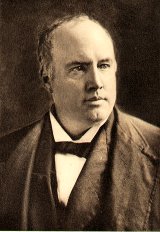
When the men detrained in Indianapolis, Lew waved the waiting cab off, stating he needed to walk to clear his thoughts. As he walked to his hotel he realized he needed to create a powerful refutation of Ingersoll’s arguments, but that he was ill prepared to do so.

In the mid-1870s, Lew had drafted a short story about the three wise men and their journey guided by the Star of Bethlehem.  He ultimately decided expand this story, through exhaustive research, as a convincing argument supporting the divinity of Christ. This "redraft" of his short story became Ben-Hur.

That's the story we relate to visitors about how Lew wrote the best-selling novel of the 19th century. But a couple of weeks ago, some great visitors who stopped in while waiting on car repairs asked me what happened to Ingersoll, and I didn't know! I had to find out.

What about Ingersoll?

The son of a Presbyterian minister, Ingersoll was an attorney. He served in the Civil War with the 11th Illinois Cavalry Regiment. He fought and was captured at the Battle of Shiloh in 1862. He became the Illinois Attorney General, was active in the Republican Party, was an abolitionist, supported women’s suffrage, was a noted orator, and a famed agnostic.

After their conversation, as Lew pursued his writing, Ingersoll also moved on. Later in 1876, Ingersoll nominated James G. Blaine for President at the Republican Convention in Cincinnati. Hayes. While Blaine lost to Rutherford B. Hayes, Ingersoll’s "Plumed Knight" nomination speech was electrifying and long remembered. Almost 50 years later in 1928, Franklin D. Roosevelt likely used that speech as a template for his "Happy Warrior" speech when he placed Alfred Smith’s name in nomination as the Democratic candidate for President.

In 1884, Ingersoll spoke at the Republican National convention in Chicago. On his trip home from the convention, Ingersoll passed through Crawfordsville. It’s not known whether Ingersoll and Lew crossed paths on this particular trip, but while in Crawfordsville, Ingersoll was encouraged to give an oration. Joanna Lane graciously offered the front porch of her home, Lane Place, for the event. The wife of Senator Henry S. Lane, Joanna was a committed Republican who did all she could to support the party. She was also a devout Methodist; sharing her lawn with the agnostic Ingersoll must have been a trial for her. The crowd was enormous and according to news accounts of the day, Mrs. Lane listened attentively.

Like Lew, Robert Ingersoll travelled in powerful circles. Walt Whitman considered Ingersoll the greatest orator of his time and stated: "It should not be surprising that I am drawn to Ingersoll, for he is Leaves of Grass... He lives, embodies, the individuality, I preach. I see in [him] the noblest specimen--American-flavored--pure out of the soil, spreading, giving, demanding light."  Ingersoll later delivered the eulogy at Whitman's funeral.

Ingersoll's Continuing Legacy

Ingersoll died in 1899 and was buried in Arlington National Cemetery. In 1902, a twelve volume set of his complete works was published. In the early 20th century he was referenced in works by authors such as William Faulkner, Sherwood Anderson, Sinclair Lewis, and P.G. Wodehouse.

More recently a popular edition of Ingersoll's work, edited by Pulitzer Prize winner Tim Page, was published in 2005, by Steerforth Press. Ingersoll's thinking is being brought to new audiences with, "What's God Got to Do With It: Robert Ingersoll on Free Speech, Honest Talk and the Separation of Church and State".

As Robert Ingersoll once said: "There are in nature neither rewards nor punishments, there are consequences." How interesting that one of the consequences of a conversation on a train in the 1870s questioning the divinity of Christ led to the creation of a work like Ben-Hur.


Wednesday, July 10, 2013

Ben-Hur Around the World

The Wallace name has spread far and wide and with it the name Ben-Hur. Schools, taverns, and businesses of all sorts have traded on the marketing juggernaut that was Ben-Hur in the late 19th century.  There are a handful of places around the world that also took these names in tribute and likely in hopes of trading on the famous names.

The small community of Wallace, Indiana, is located in southeast Fountain County. Established in the early 1830s, the village had a blacksmith, cabinet maker, general stores, shoemaker and two doctors. When the community received its first post office, local leaders named it after Lew's father, Governor David Wallace. In 1951, there were eight students in the high school graduating class and Wallace could boast about the same number of firms that had been in business in 1880. As of the 2010 census, there were 105 people spread among 52 households in Wallace. 

It is interesting, given Lew Wallace’s lack of enthusiasm for traditional learning, that at least two schools in Indiana adopted his name. Lew Wallace High School in Gary, Indiana, has had an impressive history and continues to have an active alumni association. In Indianapolis, elementary school P.S. #107 is also named for Lew Wallace. At least one school in Albuquerque has also been named in honor of Lew Wallace, and New Mexico also has a Lew Wallace building as part of their State government complex. 

The name Ben-Hur saw greater utilization by people looking to identify their communities. Ben-Hur, California is an unincorporated community in Mariposa County. Again, a rural post office led to the naming of the community in the 1890s. The post office was closed in the 1950s, but the Ben-Hur name continues to be associated with the tiny settlement that remains. Ben-Hur in Lee County of western Virginia is another unincorporated settlement.

Yet another of the Ben-Hur communities is an unincorporated area in Limestone County, Texas. This town near Waco was originally named Cottonwood, but by 1895, there were three other communities in Texas named Cottonwood. The local residents decided to rename the town. At that time Ben-Hur, Texas, had a population of about 100. By World War II it had a thriving population of over 200, but today there are fewer than 100 people and a couple of closed businesses in Ben-Hur, Texas. 

Perhaps the most exotic of the Ben-Hur communities is a small settlement in the Kalahari Constituency of the Omaheke Region of Namibia on the border between Namibia and Botswana. Just how or why Ben-Hur was used to identify this settlement is not known.

Monday, July 1, 2013

Lew Wallace in the Movies

The name of Lew Wallace is widely remembered for the wildly successful movie interpretations of his masterwork Ben-Hur in 1925 and 1959. These were not the only times that the General’s name (and even the General) showed up in Hollywood movies. In 1914, Wallace’s book, The Prince of India, was adapted as a silent movie. This forty-four minute film moved along at a rapid pace and bore little resemblance to Wallace’s book. Starring Thurlow Bergen and William Riley Hatch, the plot involved a devil-may-care newspaper reporter, a stolen gem, a fun-loving Indian prince, a temptress, and a climatic scene with a run away trolley car. Lew Wallace would not have been pleased with the artistic license taken in the filming of this movie. 

The General himself has been represented in several productions. These include Land Beyond the Law (1937) which starred Dick Foran, a matinee idol of "B" movies and one of the movie industry’s most successful singing cowboys. Foran played wild and woolly Chip Douglas, who becomes a lawman after his father is killed in the New Mexico territory; through his efforts he helps avoid a range war. Although uncredited in the movie, Governor Lew Wallace is portrayed by Joe King. King was a talented character actor, director and writer. Working steadily from 1912 until 1946, he was in such significant movies as: They Died With Their Boots On, Sergeant York, Destry Rides Again, Mr. Smith Goes to Washington, Alexander’s Ragtime Band, Cain & Mable, and Anthony Adverse.

In 1955, director Mervyn LeRoy brought Wallace to life in Greer Garson’s, Strange Lady In Town. In this movie, which co-starred Dana Andrews and Cameron Mitchell, Garson sets a western town on edge when she arrives and begins her own medical practice. Her first patient in Santa Fe has a toothache and is brought in by Billy the Kid. After all sorts of intrigue, Garson’s character attends the Governor’s ball where she meets Governor Lew Wallace who happens to mention two things. First, that he is working on a novel called Ben-Hur, and second, that he has a chronic heart condition. The ever helpful lady doctor suggests that perhaps his collar is too tight. This “miracle cure” for a heart condition actually contradicts what the town’s male doctor has told the Governor and more intrigue follows until (spoiler alert) the lady doctor and the gentleman doctor ride off together in his buckboard at the end of the movie.

The actor who portrayed Lew Wallace was Ralph Moody, a big, burly man who looked nothing like the real Lew Wallace. Moody often played gruff old men or Native Americans. He had an extraordinary career as a working actor from 1948 to his death in 1971 with well over 100 appearances in both movies and on TV. He was, in fact, one of Jack Webb’s favorite actors and appeared frequently in Dragnet.

Strange Lady in Town also introduced audiences to Susan Wallace in one of her rare portrayals on screen. Mrs. Wallace was portrayed by Louise Lorimer. Like Ralph Moody, Ms. Lorimer was a talented actress who worked steadily from 1934 until her retirement at age 87 in1985. She played alongside some of Hollywood’s leading lights in both the movies and on TV. Among the more significant movies she worked in were: Gentleman’s Agreement, Sorry Wrong Number, The Snake Pit, Sorrowful Jones, The Heiress, The Young Philadelphians, and Marnie. Her appearance as Mrs. Wallace was only slightly closer to reality than Ralph Moody’s presentation of Lew Wallace.

More recently Wallace has been portrayed (often more accurately) in documentaries and videos, including a 2006 film called: No Retreat from Destiny: The Battle That Rescued Washington. This production tells the story of the Battle of Monacacy. On the History and Discovery Channels, documentaries on Billy the Kid often discuss Wallace’s governorship using period photos and an occasional actor portraying Wallace.

Beyond the feature movies, Wallace’s Ben-Hur also appeared in books and movies as part of the plot. In Raymond Chandler’s The Big Sleep, the famed private eye, Philip Marlowe, enters a book store that he believes is a front for evil doings. In an effort to trap the seductive woman running the store, Marlowe asks: "Would you happen to have a Ben Hur 1860?" She asks: "A first edition?" to which Marlowe replies "Third. The one with the erratum on page 116." The lady obviously doesn't know her Ben-Hur (since it was published in 1880 and there is no edition with an erratum on page 116) and, therefore, isn't the store owner. In Anne of Green Gables, Anne is caught reading Ben-Hur at school when she is supposed to be studying another subject.

For over 130 years Ben-Hur and Lew Wallace have been part of popular American culture. The impact of Wallace’s book is demonstrated in the many ways it and its author have been incorporated in other creative endeavors over the past century. Keep your eyes open and ears tuned, as you never know when Lew Wallace or Ben-Hur will show up to move a plot along.  


Sources: Marie Stocks for finding blog comments on the Slate article regarding Wallace in the movies and Kyle Gobel for watching The Big Sleep. Internet Movie Database (IMDb)

Wednesday, June 5, 2013

Dr. Howard Miller speaks about the 1959 Ben-Hur

We were fortunate to have Wallace Scholar Dr. Howard Miller with us in March for the Historic Artcraft Theatre's screening of the 1959 film Ben-Hur. Dr. Miller brought a treasure trove of pieces from his collection of Ben-Hur memorabilia to share with movie-goers. He also spoke briefly before the screening to provide information on the making of the film and what an impact it had in American culture.

Thanks to videographer Nancy Van Arendonk, you can view Dr. Miller's entire talk here on our blog. Dr. Miller is an engaging speaker with a distinguished teaching career. So make yourself some popcorn, turn up the volume, and enjoy!


Tuesday, April 30, 2013

The Singing Tree


April is National Poetry Month. Lew and Susan both wrote dozens of poems, and occasionally we like to share them here. To celebrate the end of National Poetry Month, take some time to relax and read some of Lew's poetry from his celebrated novel Ben-Hur.


TIRZAH’S SONG

Wake not, but hear me, love!
      Adrift, adrift on slumber’s sea,
       Thy spirit call to list to me,
Wake not, but hear me, love!
        A gift from Sleep, the restful king,
         All happy, happy dreams I bring.

Wake not, but hear me, love!
        Of all the world of dreams ‘tis thine
         This once to choose the most divine,
So choose, and sleep, my love!
         But ne’er again in choice be free,
          Unless, unless – you dream of me.


THE  LAMENT

I sigh as I sing for the story land
    Across the Syrian sea
The odorous winds from the musky sand
    Were breaths of life to me.
They play with the plumes of the whispering palm
     For me, alas! No more;
No more does the Nile in the moonlit calm
    Moan past the Memphian shore.

O Nilus! Thou god of my fainting soul!
     In dreams thou comest to me;
And dreaming, I play with the lotus bowl,
     And sing old songs to thee;
And hear from afar the Memnonian strain,
    And calls from dear Simbel;
And wake to a passion of grief and pain
     That e’er I said – Farewell!


KAPILA

  I.

Kapila, Kapila, so young and true,
   I yearn for a glory like thine,
And hail thee from battle to ask anew
   Can ever thy Valour be mine?

Kapila, sat on his charger dun,
   A hero never so grave;
Who loveth all things hath fear of none,
  'Tis love that maketh me brave,
A woman gave me her soul one day
The soul of my soul to be alway;
   Thence came my Valour to me,
    Go try it – try it – and see!

II.

Kapila, Kapila, so old and gray,
    The queen is calling for me;
But ere I go hence, I wish thou wouldst say,
    How Wisdom first came to thee.

Kapila stood in his temple door.
     A priest in eremite guise.
It did not come as men get their lore,
     'Tis faith that maketh me wise,
 A woman gave me her heart one day,
 The heart of my heart to be alway;
    Thence came my Wisdom to me,
     Go try it – try it – and see.


Friday, March 29, 2013

Wallace Scholar Dr. Howard Miller to Speak in Franklin

Wallace Scholar Dr. Howard Miller will be speaking about Ben-Hur before the evening screenings of the film at the Historic Artcraft Theatre in Franklin, Indiana.

Dr. Miller is a Professor Emeritus with The University of Texas at Austin and a world-recognized scholar on the history of American religion. His article "The Charioteer and The Christ: Ben-Hur in American from the Gilded Age to the Culture Wars" was published in Indiana Magazine of History, and he has also authored a book-length study of Ben-Hur.

Dr. Miller will be speaking at 7:15 Friday and Saturday evenings. If you're planning on joining us for the movie, make sure you arrive early to hear him speak!

Friday, March 22, 2013

Growing Up With Ben Hur - a Guest Post

by Nancy VanArendonk


When I was growing up -- back in the days before Netflix, Redbox, Movies On Demand and the like -- there were just two possibilities if you wanted to see a film that had been made some years earlier. You could hope that it might someday be run on one of the four existing TV channels (three national networks and one local station), or that the film studio would deem it worthy of re-release and that it would come back briefly to theaters. Which is why I remember that when I saw the splashy newspaper ad for the re-release of the 1959 Ben-Hur (possibly for the 10th anniversary of its release?), I put up a positively merciless campaign of begging to get my parents to take me to see it. Eventually my dad gave in and took me to a drive-in theater where it was showing.

And I loved it. :)

Apparently I had good taste. No film in history has ever won more Academy Awards (11), and only two have even tied with it (Titanic and The Lord of the Rings) -- and it took 40 years and the invention of computer generation to do that!

I read the novel, and for once thought the film version of a story actually better than the book. Mind you, I definitely enjoyed Wallace's tale, but for me the film had an impact that the written version didn't deliver in the same way... especially in regard to the final part of the character Messala's story.

Eventually it became possible to see the film every few years, as it began to be shown on TV on some Easter weekends. With each viewing I appreciated new aspects. Were not the Sheik's horses the most gorgeous in filmdom? And how deliciously potent those three words, "You're wrong, Messala," just before Judah steps from the shadows!

Then came the availability of the home videocassette recorder. As my husband Larry remembers it, we purchased our first VCR -- a Beta, yet -- specifically to record Ben-Hur, which was scheduled to be run on TV. This was not the casual investment that VCRs later became; at that time each blank cassette tape cost $26 and could record just over four hours of material. But we'd end up splurging still more because of the film: Years later, when friends from another country moved to Indiana, we discovered in conversation that they'd never seen the movie. We invited a group and planned to make a big evening of it, and how better to do that than to buy a bigger TV? (Hey, you can't fully appreciate the chariot race when it's all compressed can you?) ;-)

There's a family story about Ben-Hur that predates me by many decades, though I hadn't heard it until after I'd developed my own fondness for Lew Wallace's tale. My parents were married in 1926. Since they were young and without money, someone suggested that they drive out of state to the farm of an aunt for their honeymoon. The drive there was a disaster in itself, as they camped in a pup tent en route; one night it not only rained, but a stray cat ran into their tent to escape the weather and used the dry area therein as a toilet, forcing them to relocate. And then, as you might imagine, staying with an elderly aunt wasn't really a honeymoon-conducive scenario. My father started reading Ben-Hur, and continued to do so throughout their stay. My mother, bored and frustrated with the entire situation, was still aggravated decades later about my dad having read that book on their honeymoon!

My own fondness for Lew Wallace's story began to give family members ideas when searching for birthday or Christmas presents for me. My younger daughter bought an autographed photo of Charlton Heston as a galley slave. Larry began shopping for unusual editions of the novel. One vintage volume, for instance, is illustrated with photos from the 1899 Broadway stage production, which ran for 21 years and featured live horses in the chariot race. Later, Larry found for me a century-old program from that play. And, since the novel's decades-long popularity had led to countless things being named after it, another of my surprises was an antique box of Ben-Hur brand black pepper (see photo)... the box was still filled with peppercorns!


The search for such things is half the fun, and today I was again rewarded with a "find." I attended a Vintage Book & Paper show, and while there I found an 1880s copy of Ben-Hur that had been autographed by author Lew Wallace! This makes my second autographed Wallace volume, the other being a copy of The Prince of India.

Such finds are fun. The search (to paraphrase a line from the film) goes on. :)

Larry & I appreciate a lot of classic films, so when the historic Artcraft Theatre in Franklin reopened about a decade ago and began showing classic movies to raise money to restore the 1922 building, we attended regularly, and seven years ago we sponsored our first film there. It was (surprise!!) Ben-Hur.

In the years since, we have sponsored many other films at the Artcraft. But when we learned that Ben-Hur was once again on the schedule, there was no question; we had to sponsor the movie! And so, on March 29th & 30th we will again be sponsoring this. I hope that many will come and enjoy this film as it was meant to be seen, on the Artcraft's 33-foot-wide screen. 
Showings will take place both days at 2:00 and at 7:30, but for the evening showings I strongly recommend finding seats no later than 7:00. Tickets are $5, or just $4 for students or seniors.

The Artcraft, by the way, is interesting in its own right. All those who work in the theater are volunteers. This way all the funds from the ticket sales can go to restoring the theater. The popcorn sold there is grown just five miles away and is popped fresh as you watch, and all evening films are preceded by door-prize drawings, the singing of the national anthem, and the showing of a vintage cartoon. For a few hours, you've gone back in time.

But those added benefits won't distract us; we'll all know why we're there:  To see BEN-HUR!  :)


*

Note: Nancy and her husband Larry are members of the Lew Wallace Study Preservation Society as well as enthusiastic Ben-Hur fans. I asked Nancy to write this guest post so we could learn more about her reasons for sponsoring the movie screen as well as her relationship with Lew Wallace's legacy. If you have a story you'd like to share with our friends and readers, let me know! I'm always interested in sharing your stories.
<!--[endif]-->

Tuesday, March 19, 2013

1959 Ben-Hur Screening at Historic Artcraft Theatre

Ten days from now, the 33-foot screen at the Historic Artcraft Theatre in Franklin, Indiana, will be home to a film spectacular. Just in time for the celebration of Easter, movie-goers can see Charlton Heston starring as Judah Ben-Hur. The 1960 Academy Awards presented Ben-Hur with eleven of twelve awards for which it had been nominated. In 1998 the American Film Institute listed Ben-Hur as one of the 100 Greatest Movies. For more information about the movie, as well as the book which inspired it, check out our website's Ben-Hur page. Lew Wallace Study Preservation Society members Nancy and Larry VanArendonk are sponsoring the showing. (Stay tuned next week for a guest post from Nancy about her love for Ben-Hur and her reasons for sponsoring it.)

What: 1959 Ben-Hur movie screening
When: Friday, March 29 at 2:00 p.m. and 7:30 p.m. and Saturday, March 30 at 2:00 p.m. and 7:30 p.m.
Where: The Historic Artcraft Theatre in Franklin, Indiana (map)

Tickets are $5 for adults and $3 for children 12 and under, with discounts for seniors, college students and military (with ID). Each performance includes skits, classic cartoons, door prizes, and a fully-stocked concession stand.

Check out the Artcraft's website for further details and to purchase advance tickets.

Wednesday, February 20, 2013

1925 Ben-Hur and its Cast of Unknowns


The two leading actors in the 1925 silent movie version of Ben-Hur, Ramon Navarro and Francis X. Bushman, are still well remembered. Many of the others who played lead roles in the movie and were famous in their day have fallen into relative obscurity. Because of the large crowd needed for the Chariot race, it’s not surprising that famous actors like Douglas Fairbanks, Mary Pickford, Charlie Chaplin, John and Lionel Barrymore, Joan Crawford, Marion Davies, John Gilbert, Sam Goldwyn, Dorothy & Lillian Gish, Sid Grauman, Colleen Moore, and Harold Lloyd were pressed into service. What’s surprising is the number of actors and actresses who worked as unbilled players or extras, unknown at the time but who went on to fame and fortune.

Among the lesser lights who made early screen appearances in Ben-Hur were Gary Cooper and Clark Gable as uncredited Roman guards. Beyond these two men, the list of guards is noteworthy, but the list of uncredited slave girls is equally significant. While the names of many of the girls who toiled, twirled and danced as slaves have been lost, the list of those who have been identified is impressive. Among these actresses are:

Janet Gaynor
• Janet Gaynor, who went on the win the very first Academy Award for Best Actress in 1927 just two years after Ben-Hur. Gaynor then became one of the most accomplished actresses to make the transition from silent to talking pictures. After a string of successes in the 1930s, Gaynor largely retired from the industry in 1938 shortly after the release of A Star is Born. Gaynor was nominated for best actress in this film that was nominated for seven academy awards, including best picture. Beyond Gaynor’s performance, this film is remembered as the first color film nominated for best picture.

Carole Lombard
• Carole Lombard, who was born in Fort Wayne and went by the nickname the Hoosier Tornado. Lombard was one of the most beloved actresses in Hollywood and met future husband, Clark Gable on the set of Ben-Hur. Beyond her extraordinary film career, she was posthumously awarded the Medal of Freedom by Franklin Roosevelt as the first woman killed in the line of duty during World War II.

Myrna Loy
• Myrna Loy, who was discovered by Rudolph Valentino’s wife, played a variety of roles and by the mid-1930s was considered the Queen of Hollywood movies to Clark Gables’ King. Her work included the Thin Man series and an extraordinary film, The Best Years of Our Lives. Beyond her film career, Loy was an outspoken critic of Adolph Hitler ultimately making his blacklist, was Co-Chairman of the Advisory Council of the National Committee against discrimination in housing - exposing segregation in federally funded projects, and was the first actress to work for the United Nations (UNESCO) as a film advisor.

Although they haven’t been officially identified, some speculate that Sally Rand, who was famous for her ostrich feather fan dances, and Fay Wray, who went on to greater things as the girl friend to King Kong, also made screen appearances as seductive slave girls.

The impact of the 1925 film version of Ben-Hur resonated throughout Hollywood and the film industry for years. It assured the survival of MGM as a major studio, it put “business” in the driver’s seat in show business as accountants and financiers took firm control of creative projects, and it gave countless numbers of struggling young actors and actresses precious time on screen as they rose from obscurity to become leaders in Hollywood for decades.

The General Lew Wallace Study & Museum celebrates and renews belief in the power of the individual spirit to affect American history and culture.


Friday, December 28, 2012

Ben-Hur on Broadway


In our tours of the Study, we often mention the mechanism that allowed the chariots to race on stage with eight horses galloping at full speed. This was an amazing feat for a stage production in the first decade of the 20th century. This was not, however, the only reason the Broadway presentation of Ben-Hur electrified audiences. There were a number of other tricks and mechanical devices that wowed the crowd.

First, as Scientific American pointed out in their August 25, 1900 issue, the wait time between the falling and raising of the curtain between scenes in Ben-Hur generally varied from between five and thirty seconds—although the arrangement for the chariot race sometimes took as long as eight minutes. In other complicated productions of the day the change of each scene routinely took between five and fifteen minutes! An interruption of the story long enough for many in the audience to loose interest. In Ben-Hur, the fast pace of the show was virtually uninterrupted.

Even before the chariot race, the audience had already received a bit of Broadway magic with the sea battle and wreck of Arrius’ ship. The scene opened with Arrius on a dais at center stage and the galley slaves rowing below him. At the climax of the battle, the theater was suddenly plunged into total darkness and the audience heard panicked screams and the crashing and grinding of timbers courtesy of a “crash” machine. Within seconds, the lights were brought up and Ben-Hur and Arrius were “adrift” at sea. The actors were up in a raft several feet off the floor in front of a dramatic shipwreck scene, lighted with special electrical effects. The raft itself was hinged to allow a rocking motion in two directions.

In order to accomplish this change of scene on stage in front of the audience without dropping the curtain, the “crash” machine kept crashing to cover the noise of movement on stage as the actors and stage hands used split second timing in the pitch black dark of the theater. The second the lights went out, the galley slaves with their oars fell flat to the floor and their benches were immediately pulled into the wings, Ben-Hur leapt to the dais with Arrius and pins were removed to allow the dais to be converted into a rocking bit of flotsam. One set of stage hands raised the backdrop scene of the galley ship to reveal the shipwreck scene, while another group of hands brought a large canvas from the back of the stage forward to the footlights, pulling it over the galley slaves laying on the floor. The galley slaves, covered by this tarp used their oars, arms and legs to simulate the rolling waves of the ocean. All of this was accomplished in the dark, among the props and scenery without stepping on anyone in about seven seconds!

Lew Wallace meeting with Joseph Brooks and
William Youngrepresentatives of the Broadway
producers, Klaw and Erlanger in front of
General Wallace's Study.
One of the most evocative special effects was the presentation of Jesus. Lew Wallace would not permit an actor to portray Christ--a central figure to the storyline. After much discussion and debate, it was decided that whenever the script called for Jesus to move the story forward, a strange and ethereal light would appear on stage and a voice that permeated the theater would be used. This unique solution left much to the imagination of the audience which made each performance a personal experience heightening the spiritual impact of the play and it eliminated any controversy about putting Christ on stage. It should also be pointed out from the producers point of view that it eliminated the need to pay an actor to play Jesus on stage as well.


One of the scenes that left little to the imagination was the chariot race. Cue the chariots! Horses on treadmills had been used before Ben-Hur, but never with the sophistication that was used in this production. The effect of the treadmill that allowed the eight horses to race at full gallop was heightened by the addition of belts turned at 90 degrees to the floor near the horses’ hooves, so that as they ran—faster or slower—these belts looked like the ground was moving at pace with the horses. To further the effect of the racing horses, a combination of powders was forced up through the treadmill by blowers under the floor to resemble dust.

Beyond the racing of the chariots and the paced rotation of the back and side scenes of the “arena”, the dramatic wreck of Messala’s chariot at the climax of the race was accomplished with a trick chariot. While Ben-Hur’s chariot wheels were actually in contact with the treadmill, Messala’s chariot rested on a yoke with springs that kept the wheels slightly above the treadmill. A motor was used to spin his wheels. At the critical moment, another small electric motor blew the wheels off of Messala’s chariot, the basket and rider dropped onto the springing yoke and the treadmill and adjacent flooring carrying Messala jerked back 15 feet allowing Ben-Hur to win. According to William S. Hart, who played Messala, this complicated mechanism worked all but one of the 400 times his horses raced.

With “crash” machines, rapid scene changes, and powder spewing horses, it’s no wonder the stage play electrified an estimated 20,000,000 people for over 20 years on several continents—making Lew, Susan, Henry, Harper Brothers, and the Broadway producers several fortunes. It also forever changed the way Broadway would present it's blockbuster productions.

Thursday, September 20, 2012

Ben-Hur & J.K. Lilly, Jr.

Lew Wallace, Jr.
In the mid-1930s, Josiah K. Lilly, Jr. noted Indianapolis philanthropist and partner in the Eli Lilly pharmaceutical business was acquiring papers and memorabilia significant in Indiana history. One of the documents he acquired was the original manuscript of Ben-Hur. He purchased the document, hand-written in purple ink by Lew Wallace, from the author’s grandson, Lew Wallace, Jr.

J.K. Lilly

Upon closer inspection, Lilly realized that the manuscript was missing the opening pages of several chapters including the pages from Book 1, Chapter 1. Lew, Jr. had no idea where the missing pages had gone, but speculated that his grandfather might have taken the pages and had them bound in a long missing special edition. A total of twenty-seven pages were gone. Lilly searched for almost twenty-five years, but never found the missing pages.

J.K. Lilly, Jr. donated over 20,000 books and 17,000 manuscripts to Indiana University in the 1950s. These gifts became the foundation for the Lilly Library at IU which was dedicated on October 3, 1960. At the dedication, Frederick B. Adams, Jr., director of the Pierpont Morgan Library in New York, was one of the featured speakers. Adams diverted from his prepared script to say: “It is not easy to hit the moon with a satellite and it is almost equally difficult to plan the right conjunction of mind and book and time. The proper conditions are here in Lilly Library . . .ready and waiting.”

The audience did not understand Adams’ point until with a broad smile he announced that “Here in my hand are the missing leaves to the original Ben-Hur manuscript.” Confusion turned to disbelief and then to cheers as the audience realized the magnitude of the announcement. Wallace’s original manuscript was on display for the dedication and the pages held by Adams were taken over and matched to the torn edges in the original manuscript. All twenty-seven pages were there!


Ben-Hur. First Edition, First State
Adams explained that Harper Brothers, the original publishers of Ben-Hur had held the missing pages until 1959. At that time, the publishing house gave them to the Pierpont Morgan Library. When the Lilly Library dedication was announced the trustees of the Morgan Library and Harper Brothers decided the pages should be reunited with the Wallace’s original work. On October 3, 1960, after a separation of almost eighty years, Lew Wallace’s masterwork was again whole thanks to the generous philanthropy of the Pierpont Morgan Library, Harper Brothers and Josiah K. Lilly, Jr.

Source: Montgomery Magazine, November 1980, article by Pat Cline

Tuesday, May 15, 2012

The Mystery Statue


Lew Wallace in his Study with the bust by Randolph Rogers on the bookcase


Ben-Hur the galley slave
At least eight important sculptors (not counting the General himself) have contributed to the artistry of the General Lew Wallace Study. Inside the building, there is a bust of Wallace created by Randolph Rogers, a statue of Ben-Hur the galley slave done by George Peterson in 1888, and two plaster studies done by H. R. Saunders. These plaster studies were used by a fourth

O'Connor statue of Wallace with
foundation by Sidney Speed
important sculptor, Bohumir Kryl. Kryl was the young man who carved the four faces representing characters from Wallace’s books in the exterior limestone frieze. The largest piece of stone carving on the grounds was added about 1911 and is by Sidney Speed who carved the pedestal that supports the bronze statue of Wallace that was created by Andrew O’Connor.
Acopy of Michelangelo's "Il Pensiero"
of Lorenze de Medicid caption
 Lew Wallace felt that an ideal study or retreat needed a copy of "The Thinker." In 1885, ten years before he began work on the Study, Lew Wallace asked a friend of his to contract for a Carrara marble copy of Michelangelo's "Il Pensiero" of Lorenze de Medici. The writer, Francis Marion Crawford who was living in Italy, made arrangements for this important marble statue. Finally, there is an additional piece of sculpture on the grounds—a bust of David Wallace that was once part of a decorative frieze on the old English’s Opera House and Hotel in Indianapolis. The name of this eighth artisan who created this particular work of art is unknown.

Bust of David Wallace
from English's Opera House
While the Study grounds have at least one piece of sculpture by an artist whose name is missing, we may also have an artist with a name whose sculpture is missing! In an article in the July 11, 1907 issue of the Crawfordsville Journal, that is entitled “A Statue of Ben-Hur” Bohumir Kryl describes a statue that he created for General Wallace’s Study that has disappeared. Lew Wallace had been gone for just two years and Susan was still alive when this article was written. It opens with the sentence: “Those who have had the pleasure of a visit to the study of the late Gen. Lew Wallace will recall the statue of Ben-Hur which occupies a prominent place there, and also other busts and ornaments in stone and plaster.”

In the short article, Mr. Kryl discusses his work on the Soldiers’ and Sailors’ Monument in Indianapolis and is quoted as saying: “. . . During this time I went over to Crawfordsville and worked on busts and ornaments that were placed in Gen. Lew Wallace’s studio. Some of these were figures representing characters in the “Prince of India” and in “Ben-Hur.” A statue of Ben-Hur was the largest figure I made at that time.”

The article by the local paper is very specific about the existence of this statue, Susan Wallace was still alive, and Kryl had worked at the Study barely ten years earlier, yet no historic images or other references to this statue have been found. Did this statue really exist? If so what did it look like and where did it stand on the property? Where did it go? Is it in someone’s basement? Given Bohumir Kryl’s talent, this must have been an impressive work of art that would have contributed much to the property. While mystery and intrigue add to the aura of historic sites, this is one mystery we’d love to solve so keep your eyes open when you are checking out those Saturday morning yard sales around Crawfordsville--Ben-Hur may be out there!

The General Lew Wallace Study & Museum celebrates and renews belief in the power of the individual spirit to affect American history and culture.


Carving of the Prince of India by Bohumir Kryl
based on a plaster model by H.R. Saunders

Tuesday, April 3, 2012

Ben-Hur on the London Stage

In March of 1901, it was announced that Klaw and Erlanger, the producers of the Broadway presentation of Ben-Hur, had made arrangements with Arthur Collins, the director of London’s Drury Lane Theater to take the play to England. Collins had travelled to New York to stage a play, but also to secure the rights to Ben-Hur. Ben Teal and A.L. Erlanger were to superintend the London production. Collins, himself, would oversee the creation of the stage scenery and costumes. Rather than the eight horses generally used for the chariot race, the London production was to boast 16 horses in the great race. The horses and mechanical apparatus for the race were to be sent from America. In January of 1902, Joseph Brooks, who worked for Klaw & Erlanger and had negotiated with Lew Wallace for New York’s original production, sailed for England to supervise the final preparations for the London premier which was set for March 31.


The Drury Lane Theater that premiered Ben-Hur had been built in 1812 on the site of several earlier important theaters. It is still considered one of the most significant theaters in the world. Over the years the Drury Theater has seen its share of historic performances and personnel ranging from Edmund Kean and Lord Byron to Noel Coward to Rodgers & Hammerstein to Monty Python to Shrek the Musical.

Drury Lane Theater
Back in 1901, original plans called for using the Broadway cast for the London staging of Wallace’s play. However, as things turned out, only J.E. Dodson, who portrayed Simonides, travelled overseas. While most of the other cast members, almost 500 of them, were members of British theatre troops, Judah Ben-Hur was portrayed by the popular American actor Robert Taber. Taber had started his career in 1886 portraying Silvius in the play As You Like It with the famed acting company of Helena Modjeska. Taber went on to marry leading Shakespearean actress Julia Marlowe and enjoyed a string of successful stage performances in the 1890s in America. He also enjoyed great success in London at the turn of the 20th century including portraying Macduff in Macbeth at the Lyceum Theater and Orsino in a production of Twelfth Night at Her Majesties Theater.

Constance Collier as Cleopatra
The impressive London cast of Ben-Hur also included Constance Collier as the temptress, Iras, despite the fact that she was also starring as Calypso in Ulysses, another stage epic, at His Majesty's Theatre nearby. She would run between the theatres and slip out of Calypso's flowing robes into Iras's unkempt wig and exotic, dishevelled clothing. Born in Kensington, like her friend Charlie Chaplin, Collier had been a Gaiety Girl before she switched to "legitimate" theatre, specializing in goddesses, queens and romantic heroines.

With Taber in the lead, the play opened on schedule in early April of 1902. Friends of General Wallace who saw him about town in Crawfordsville at the time of the premiere were amused by published reports that he attended the London opening, sitting in the audience with famed actress Mary Anderson. Even the great General Wallace could not be two places at the same time!

The play had received acceptable reviews in America, and many in the English press liked the performances and were overwhelmed by the ingenuity of the production. The Illustrated London News's critic, stated that Robert Taber played the Jewish prince with "rare personal charm" and the whole was "capitally acted," while Collier was coyly described by the Sketch's critic as "very alluring.”

In spite of positive reviews some London critics were not amused and their reviews were scathing. If Wallace, Klaw & Erlanger, and Collins were distressed by these reviews, the thousands and thousands of dollars that came streaming in probably softened the blow. Ben-Hur opened to the largest receipts of any dramatic production for the Drury Lane Theater making over $50,000 in just 20 presentations. As word of mouth spread, attendance increased and the Saturday performances always exceeded $6,000 and its average take in a week was $23,000 making it the greatest financial success the London stage had ever seen. In May 1902, newspapers reported that attendance at the Drury had so hurt other theaters, that certain managers had lost heart and were closing until the excitement surrounding Ben-Hur subsided.

Although some critics continued to take issue with the play, their voices were drowned out by public acclaim. Even King Edward and Queen Alexandra enjoyed the show. They had a specially constructed box in the pit, which was considered a radical departure for royal viewing. According to published reports, their majesties highly commended the drama and its production and spoke of the very reverent manner in which its religious theme was treated.

Robert Taber with
Lena Ashwell
Although he was only in his 30s, Taber’s portrayal of Judah Ben-Hur would be among his last roles. He and Julia Marlowe had divorced by 1900. In 1901 and 1902, he was on the London stage and in 1903 he was involved in a scandalous affair with an English actress named Lena Ashwell. Just a year later he was ill with pleurisy and dying. His former wife, Julia, provided him a home in the Adirondacks in hopes that he would recover his health, but Taber died in 1904 at the age of 39.

At the same time the London production was being readied for its opening in 1902, another staging of the play was preparing for its opening at Her Majesty’s Theater in Sydney, Australia and plans were being discussed for productions in France, Germany, Austria, and Russia. While Wallace’s literary efforts had reached an international audience in the nineteenth century, just after the turn-of-the twentieth century, the stage play was proving equally successful at spreading the message of Ben-Hur and the name of Lew Wallace. The impressive production of the play contributed to this success, but beyond its theatrical presentation, as the critic for Sketches wrote of the London production, this play had the unique ability to move audiences, especially by its "beautiful finale, breathing peace to those who have suffered."


Sources:
Samantha Ellis, The Guardian, 2003
The Crawfordsville Journal, March 12, 1901
The Crawfordsville Journal, April 15, 1901
The Crawfordsville Journal, January 24, 1902
The Crawfordsville Journal, May 14, 1902
The Crawfordsville Journal, May 21, 1902


The General Lew Wallace Study & Museum celebrates and renews belief in the power of the individual spirit to affect American history and culture.


Tuesday, March 13, 2012

William Farnum & Ben-Hur

The play Ben-Hur opened on Broadway in 1899. The first male lead was an actor named Edward Morgan and Messala was first portrayed by William S. Hart. Lew Wallace attended the opening night performance at the Broadway Theater and, like the rest of the audience, was pleased with the dramatic presentation of his work. An opening night critic penned: “Mr. Morgan looks well, and has a few stirring moments. Mr. Hart, as Messala, is as crudely violent and incoherent as ever.” This critic, while apparently underwhelmed with the lead performances, had complimentary things to say about other performers and the music.


William S. Hart went on the play Messala for hundreds of performances over many years. In his autobiography he wrote how honored he was when Lew Wallace asked for a meeting where he praised Hart’s interpretation of Messala. In fact, Hart was still performing the role of Messala on stage when he also played Messala in the first filmed version of the story in 1907. Mr. Morgan as Ben-Hur, on the other hand, was soon replaced. Morgan had been an actor of note in the 1890s. He was a handsome man who had some ability on stage, but for reasons unknown he left the production. Although he continued with a limited stage career for more than a decade, the role of Ben-Hur did not do for him what it did for others and Morgan slipped into obscurity.

Morgan was replaced by William Farnum, who, thanks to Ben-Hur, became one of the leading actors of his day and is still widely remembered. He was born on the 4th of July in 1876 in Boston, Massachusetts and came from a family of performers. He was the son of actor G.D. Farnum and singer Adela Le Gros. As stage performers they trained William and his two brothers, Dustin and Marshall, in the family business.

William Farnum as Judah Ben-Hur
Farnum made his stage debut at the age of ten in the play Julius Caesar with famed actor Edwin Booth as the title character. Farnum had a number of small roles in the 1890s, but his casting as Judah Ben-Hur in 1900 made him a star. His highly regarded portrayal of the Jewish prince led to a string of successful performances in other plays including the Broadway adaptation of Lew Wallace’s Prince of India, which had a limited run in 1906.

After his successes on Broadway, Farnum took his good looks and acting flair to the silent screen in 1914. He became one of the most successful of the silent screen stars with more than 50 films and even made the transition to talking pictures in the late 1920s. During the silent film era he became one of the highest paid actors in Hollywood earning $10,000 per week. He was injured in 1924 while filming the movie, The Man Who Fights Alone and this forced him to take smaller and less stressful roles. During the 1920s, he returned to the Broadway stage at different times with well received performances.

When his roles as a leading man became fewer and farther between, he deftly switched to playing a character actor, often in westerns, and continued his career for many years. In 1951, Farnum and Francis X. Bushman (who played Messala in the 1925 Ben-Hur movie epic) had cameo roles together in a movie called Hollywood Story, which had a storyline based on the murder of silent screen director William Desmond Taylor, who had been a friend to both men. Farnum died in Hollywood on June 5, 1953 and his pall bearers included Hollywood luminaries Cecil B. DeMille, Jesse Lasky, Frank Lloyd, Clarence Brown, Leo Carillo and Charles Coburn with a eulogy by Pat O’Brien. Gary Cooper, William Boyd (Hop-A-Long Cassidy), Noah Beery, Randolph Scott, and John Wayne were all directly influenced (and in some cases coached) by Farnum. While most of us remember Charlton Heston’s impressive performance, actors such as Francis X. Bushman, Ramon Navarro, William S. Hart, and William Farnum also became Hollywood legends because Lew Wallace gave life to Ben-Hur.


P.S. William Farnum was not the only child of G.D. Farnum and Adela Le Gros to make good in Hollywood. His brother, Marshall, became a highly regarded actor and director until his death in 1917. The third brother, Dustin, developed a Vaudeville act and became a leading man on Broadway. Like William, he followed his Broadway successes by becoming one of the leading actors of the silent film era. Perhaps, his most famous role was in the 1914 movie, The Squaw Man by Cecil B. DeMille. For his role in the movie, he was paid with cash and stock in the company formed to film The Squaw Man. He thought so little of this company that he gave the stock to his valet who became an overnight millionaire when the movie was released and became a huge hit. Farnum retired from acting about 1926 and died in 1929 from kidney failure. Beyond his acting career he is also remembered by movie trivia experts because in 1937 Lillian Hoffman of Los Angeles, named her son after her favorite movie actor, Dustin Farnum.


Sources:
Internet Movie Data Base
FilesofJerryBlake.netfirms.com
Internet Broadway Data Base


The General Lew Wallace Study & Museum celebrates and renews belief in the power of the individual spirit to affect American history and culture.


Saturday, April 30, 2011

Ben-Hur 1925: The Most Expensive Silent Film Ever Made

At almost four million dollars, the 1925 version of Lew Wallace’s Ben-Hur is widely considered the most expensive silent movie ever made. Expenses for the movie began in 1919 with the initial negotiations with Henry Wallace and with Abraham Erlanger, producer of the successful stage play. Erlanger eventually concluded a deal with MGM for generous profit participation and total control over the production. Cost escalation accelerated in 1923 when filming of the movie began in Italy. There were accidents, changes in directors, corporate mergers, and changes in cast, including the hiring of Ramon Navarro as Ben-Hur replacing George Walsh. Walsh had been hired to play the title role and went to Italy, but he felt he was being treated shabbily and went home in a huff.

As the MGM publicity machine continued its promotion emphasizing the quality of the production, actors wearing heavy costumes who jumped overboard to escape burning ships during the sea battle had to be rescued from drowning and horses were being maimed and killed with alarming regularity because of the punishing demands placed on them. Even the building of the elaborate sets by Italian craftsmen was delayed by Italy’s new leader, Benito Mussolini. In a bold move, Irving Thalberg, MGM’s head of production, closed the Italian operation and moved the entire effort to Hollywood to contain costs. This was an early instance where the “business side” of show business significantly curtailed the “show side.” Because of the cost overruns in Italy, for decades after Ben-Hur, most movies were mounted on Hollywood’s back lots so that the business men could keep an eye on the productions and their bottom lines.

Filming ran from October 1923 through August 1925—almost two full years. This lengthy filming and final editing of the movie also added to the expenses. For instance, 42 cameras were used and over 200,000 feet of film was shot for the chariot race—in the final cut of the movie only 750 feet of the filmed race was used. Also, sections of the movie boasted an early 2 tone version of Technicolor using red and green filters. While not the first movie to boast color sequences, it was an early use of this technology raising its production value and audience interest.

The enormous chariot race arena was constructed at what is now the intersection of La Cienega and San Vicente Boulevards in Los Angeles. The chariot race sequence was filmed in one day and MGM made the most of it. They made the day of filming a holiday for the studio which gave the day a circus like feel. With the exception of the leading men, Ramon Navarro and Francis X. Bushman, the other titled characters from the movie are today largely unknown. However, because of the holiday, established stars such as John and Lionel Barrymore, Joan Crawford, Marion Davies, Douglas Fairbanks, John Gilbert, Dorothy and Lillian Gish, Harold Lloyd, and even America’s sweetheart—Mary Pickford made special appearances in the crowd scenes. While they weren’t matinee idols, Samuel Goldwyn and Sid Grauman (of the Chinese Theater) also showed up on screen rooting for Ben-Hur.

Although the movie made over nine million dollars in its original run, it was not considered to have made any money for the studio because of the production and promotion costs and because of the deal struck by Mr. Erlanger. In subsequent releases it continued to make money for the studio, but more importantly, it cemented MGM’s reputation as the quality studio in Hollywood. This reputation helped Thalberg and his associates leverage other successful projects and for the next three decades allowed MGM to attract more stars than there were in the heavens.

Note: The color sequences were removed from the 1925 film and replaced with black and white footage when it was re-released. These color sequences were thought lost forever when they were found in the 1980s in a Czech film archive. The restoration of the 1925 film by Turner Broadcasting includes these color sequences.

Saturday, July 3, 2010

Former Messala Recalls Ben-Hur Stage Play

In his autobiography (My Life East and West), William S. Hart (Messala) related some of his memories of the stage production of Ben-Hur. Hart remembered that at one of the final rehearsals prior to the opening of the show, Charles Frohman, a renowned actor at the turn of the century known as the “Napoleon of Drama” announced to Klaw and Erlanger, the producers of the Broadway version of Ben-Hur. “Boys, I’m afraid you’re up against it—the American public will never stand for Christ and a horse race in the same show.” (Frohman was killed years later in the sinking of the Lusitania.)

Hart gained fame in Hollywood after his stage career faded playing in Westerns. His ability with horses in the movies was no act. He was a gifted horseman and raced Messala’s team on stage over 400 times. He said he always felt bad that his four horses (Tom, Jerry, Rosie and Topsy) raced Ben-Hur’s team of four bays every night and lost. His horses tried with all their might every night to win. No matter how hard they tried, the result was always the same—just at the moment it looked like they would win, Hur’s treadmill would speed up and the bays would draw away—winning the race.

Hart described the night that the race was reaching its climax. The eight horses racing for all they were worth. Hart’s (Messala’s) horses raced faster and faster, stretching until their bellies were almost on the treadmill—and then Hart realized that his team was going to win. He crawled out on the chariot tongue; put his hands on their backs imploring them, urging them to slow so Ben-Hur could win but “. . . They ran like creatures possessed—their veins stood out like ropes—they were out in front—they were gaining! They strained every muscle to the breaking point, then they lunged ahead in a deathlike dash! And—they won! They Won!” After 400 tries, his team finally out-raced the treadmill.

Hart was always proud that after the first performance, he was sent for and Lew Wallace singled him out telling Hart: “Young man, I want to thank you for giving me the Messala that I drew in my book.”

William S. Hart was one of the most successful early film stars. Hart passed away in 1946 and left his estate to the people of Los Angeles because the community had treated him so well. His Spanish Revival mansion with its outstanding collection of western art, Hollywood memorabilia, and Native American artifacts and its surrounding 260 acres are now part of the Natural History of Museum of Los Angeles.

Friday, April 16, 2010

Ben-Hur vs. Twilight

“So Ben-Hur was the Twilight of the 1800s.”

Out of the mouths of babes – an eighth-grader on a recent school visit made a striking connection between the popularity of Lew Wallace’s masterwork and the rise of new novels made into films. One aspect of the Ben-Hur legacy is merchandising in a variety of franchises and media – books, films, comics, you name it. Just as Mel Brooks immortalized in the film Spaceballs, after Ben-Hur rose to great fame they came out with Ben-Hur the children’s books, Ben-Hur the action figures, Ben-Hur the hairpins, Ben-Hur the freezer...and on and on. Merchants figured they could sell just about everything imaginable by attaching the name of a popular novel to the products. The concept has continued into modern literature and films as merchants continue to market lunchboxes, posters, and clothing by attaching images of popular media. It all comes back to Ben-Hur.

Thursday, March 4, 2010

Member Sneak Preview Party, 3/3/10


Larry Paarlberg, Director of the General Lew Wallace Study and Museum, greets guests to the Member Sneak Preview Party for the opening of the Museum's new exhibit, "Sanctuary: Preserving the Legacy of Lew Wallace."