So last week I warned you I was going to ask you for money. Well, this is it--brace yourselves.
We would really appreciate it if you donated money to our Making A Historic Difference campaign.
(That wasn't so bad, was it?)
Thanks to our many generous supporters, we currently have $230,000 secured towards our $300,000 goal. The Jeffris Foundation granted us $100,000 for interior paint restoration, with the caveat that we must double-match that amount--that is, we need to raise $200,000 on our own to match their grant. Because we are owned by the City of Crawfordsville, the city has agreed to provide $30,000 for our efforts. Many private donors have given us $1,000 or more and will be honored with an engraved brick to be placed in front of the Carriage House. Lots of smaller donations have added up.
We're getting close to reaching our goal--but the last few milestones always seem to be the hardest to reach.
If you are able to give and want to be a part of this exciting effort to restore and preserve Lew's ornate interior decorations, won't you consider donating to the Making A Historic Difference campaign?
We've done our best to make the donation process as easy and painless as possible. You can donate from this blog post using your credit card. Our secure payments are processed through PayPal.
You can also donate by calling us at 765-362-5769 and providing your credit card information over the telephone.
Board Member Jerry Spillane was instrumental in helping us have a video created so you can learn more about the campaign. If you have four minutes, join me, Director Larry Paarlberg, and Jerry for a look around the Study.
It's exciting to be so close to reaching our goal. We hope you're excited too, and that you'll be with us through the whole process of restoring the Study interior to Lew's original vision.
Tuesday, November 5, 2013
Friday, November 1, 2013
Introducing Our New Website
We are going to be rolling out a new website in the next day or so. Don't worry, all the same information will still be there, along with some new stuff! And you won't have to update your bookmarks; we'll still be at www.ben-hur.com. We are changing the site's appearance, but the menu structure has a similar design as the old website. You shouldn't have to update any links if you've been linking to our website. We'll be using the name page names as far as possible.
So why change things, you're probably wondering?
Over 35% of our 2013 website traffic so far has come from
mobile devices such as smartphones and tablets; unfortunately, our old website
wasn't built with a design that would respond to the various screen sizes--it just wasn't something we had to worry about back then. Our
new design will adapt the display for optimal viewing across devices from
iPhones to iPads to 23" computer monitors.
Here's the biggest change for you blog readers--our blog will no longer be located here at
wallacestudy.blogspot.com but will be self-hosted at www.ben-hur.com/blog. If you use a feed-reader to keep up with our posts, you'll need to update your feed. To make it simple, we have a little RSS icon in the right sidebar of our blog page. If you'd prefer, you'll also be able to subscribe to our blog via email and have our entries sent straight to your inbox.
Our new site design will eventually incorporate an online gift shop and e-book sales. Our presence on
social networks such as Twitter, Facebook, and Pinterest will be better
integrated with our website as well as the blog. We will continue to support online
memberships and online donations, and this year for the first time Holiday Tea
tickets are available to purchase by credit card on our website at www.ben-hur.com/programs/holiday-tea/.
I hope you like the new website design. If you have any
comments, questions, or suggestions, I'm always happy to receive feedback
from our members, supporters, and friends. Comment here, at the new blog, or email me with any feedback.
Thursday, October 31, 2013
Happy Halloween!
![]() |
| Henry's uniform, on loan from Children's Museum of Indianapolis |
In Lew's day, Halloween wasn't celebrated much outside of Irish and Scottish immigrant communities, but even in the 1860s children did play dress-up. Lew and Susan's son Henry was eight at the outbreak of the Civil War, and he had a child-sized Union uniform and kepi. We currently have the uniform on display in our Carriage House. It is on loan from the Children's Museum of Indianapolis, and in less than two months, when our 2013 Generations exhibit ends, we'll be returning it to them. If you want to see it, make sure you stop in sometime between now and December 14!
Friday, October 25, 2013
Making A Historic Difference - Part One
If you're a Crawfordsville local, you may have seen signs around town with a big drawing of the Study and the phrase "Making A Historic Difference." You might be wondering why we're trying to raise $300,000 and what we're going to do with that money. We're going to have a series of posts on our blog about The Making A Historic Difference Campaign so you find out why we're so excited and, hopefully, get excited along with us.
Lew's mural
Ella Kostanzer was raised in Montgomery County and was teaching in Chicago when she visited Lew in his Study on January 1, 1900. She described a fresco painted inside the Study dome. An elaborate work of trompe l'oeil,
After analysis by Matthew Mosca of Baltimore, we contacted Brian Fick and Mary Yeager of Acanthus Arts in Indianapolis. Thanks to their hard work, Lew's frescoes were partially uncovered.
That's great, but why are you asking for money?
Well, one of our goals here at the General Lew Wallace Study & Museum is to present the Study as close as possible to the way it looked when Lew used it. With very few exceptions, we have accomplished that. One of the exceptions, however, is the interior paint.
Except for the one corner of the interior paint uncovered by Acanthus Arts, the Study is decorated with paint put up in the 1990s. Not only is that historically inaccurate, but it's just not as dramatic as the paint decorations Lew had. We want to bring back the paint conservators and have them uncover all of the interior paint.
On top of that, we can't turn on the lights in the main room of the Study.
Lew had electricity in the building. Crawfordsville was one of the first cities in Indiana to be electrified. Lew was a wealthy man, and he spared no expense in creating this "pleasure house for [his] soul". The main room of his Study had almost 100 light bulbs in it. But the wiring in many places still dates back to the 1890s. No one wants to be responsible for burning down the Study, so we rely on natural light from the skylight. But we'd love to update the wiring so we can light the Study for evening events.
It'll be a lot of work, and it'll take a lot of money. The Jeffris Foundation of Wisconsin has generously awarded us a $100,000 grant, but we have to match that with $200,000 in funds we raise.
So this is where you come in.
We know you're a dedicated supporter of our museum and mission. After all, you read our blog, and you might even be a member of the Lew Wallace Study Preservation Society. But right now we need a little bit more from you.
Yep, you guessed it, I'm about to ask you for money.
But we'll save that for next week. I want you to take some time to browse our website and Flickr account. Take a look at the pictures we have of Lew's amazing interior paint. Read the articles written for this blog in 2011 while the original paint analysis was being done. Then next week, when you're still on a sugar high from Halloween, come back to the blog and we'll talk about how much we've raised so far and how far we have yet to go.
Lew's muralElla Kostanzer was raised in Montgomery County and was teaching in Chicago when she visited Lew in his Study on January 1, 1900. She described a fresco painted inside the Study dome. An elaborate work of trompe l'oeil,
"The border around the skylight is handpainted, designed by the owner. It consists of implements of warfare in groups chained together. We see the shield, helmet, sword, bugle, breastplate, etc..." - Ella KostanzerFast forward to 2011. Workers at the General Lew Wallace Study & Museum were in the midst of their Study Restoration Project designed to address structural deterioration and water damage inside the Study building. With the Study emptied of artifacts, it was an ideal time to have a paint analysis done.
After analysis by Matthew Mosca of Baltimore, we contacted Brian Fick and Mary Yeager of Acanthus Arts in Indianapolis. Thanks to their hard work, Lew's frescoes were partially uncovered.
That's great, but why are you asking for money?
Well, one of our goals here at the General Lew Wallace Study & Museum is to present the Study as close as possible to the way it looked when Lew used it. With very few exceptions, we have accomplished that. One of the exceptions, however, is the interior paint.
Except for the one corner of the interior paint uncovered by Acanthus Arts, the Study is decorated with paint put up in the 1990s. Not only is that historically inaccurate, but it's just not as dramatic as the paint decorations Lew had. We want to bring back the paint conservators and have them uncover all of the interior paint.
On top of that, we can't turn on the lights in the main room of the Study.
Lew had electricity in the building. Crawfordsville was one of the first cities in Indiana to be electrified. Lew was a wealthy man, and he spared no expense in creating this "pleasure house for [his] soul". The main room of his Study had almost 100 light bulbs in it. But the wiring in many places still dates back to the 1890s. No one wants to be responsible for burning down the Study, so we rely on natural light from the skylight. But we'd love to update the wiring so we can light the Study for evening events.It'll be a lot of work, and it'll take a lot of money. The Jeffris Foundation of Wisconsin has generously awarded us a $100,000 grant, but we have to match that with $200,000 in funds we raise.
So this is where you come in.
We know you're a dedicated supporter of our museum and mission. After all, you read our blog, and you might even be a member of the Lew Wallace Study Preservation Society. But right now we need a little bit more from you.
Yep, you guessed it, I'm about to ask you for money.
But we'll save that for next week. I want you to take some time to browse our website and Flickr account. Take a look at the pictures we have of Lew's amazing interior paint. Read the articles written for this blog in 2011 while the original paint analysis was being done. Then next week, when you're still on a sugar high from Halloween, come back to the blog and we'll talk about how much we've raised so far and how far we have yet to go.
Saturday, October 19, 2013
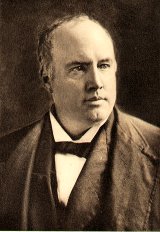
People Lew Knew: Robert C. Ingersoll
Why
did Lew Wallace write Ben-Hur?
In 1876, Lew was on a train headed for a reunion of
Union soldiers. Also on the train was Robert C. Ingersoll, a noted agnostic. During
the trip, the two men began a conversation on the divinity of Christ and other
religious issues. In his efforts to sway Lew with his views, Ingersoll’s
arguments instead had an opposite effect.
When the men detrained in Indianapolis, Lew waved
the waiting cab off, stating he needed to walk to clear his thoughts. As he
walked to his hotel he realized he needed to create a powerful refutation of
Ingersoll’s arguments, but that he was ill prepared to do so.
In the mid-1870s, Lew had drafted a short story
about the three wise men and their journey guided by the Star of Bethlehem. He ultimately decided expand this story,
through exhaustive research, as a convincing argument supporting the divinity
of Christ. This "redraft" of his short story became Ben-Hur.
That's the story we relate to visitors about how Lew
wrote the best-selling novel of the 19th century. But a couple of weeks ago, some
great visitors who stopped in while waiting on car repairs asked me what
happened to Ingersoll, and I didn't know! I had to find out.
What
about Ingersoll?
The son of a Presbyterian minister, Ingersoll was an
attorney. He served in the Civil War with the 11th Illinois Cavalry Regiment. He
fought and was captured at the Battle of Shiloh in 1862. He became the Illinois
Attorney General, was active in the Republican Party, was an abolitionist,
supported women’s suffrage, was a noted orator, and a famed agnostic.
After their conversation, as Lew pursued his writing,
Ingersoll also moved on. Later in 1876, Ingersoll nominated James G. Blaine for
President at the Republican Convention in Cincinnati. Hayes. While Blaine lost to
Rutherford B. Hayes, Ingersoll’s "Plumed Knight" nomination speech
was electrifying and long remembered. Almost 50 years later in 1928, Franklin
D. Roosevelt likely used that speech as a template for his "Happy Warrior"
speech when he placed Alfred Smith’s name in nomination as the Democratic
candidate for President.
In 1884, Ingersoll spoke at the Republican National
convention in Chicago. On his trip home from the convention, Ingersoll passed
through Crawfordsville. It’s not known whether Ingersoll and Lew crossed paths
on this particular trip, but while in Crawfordsville, Ingersoll was encouraged
to give an oration. Joanna Lane graciously offered the front porch of her home,
Lane Place, for the event. The wife of Senator Henry S. Lane, Joanna was a
committed Republican who did all she could to support the party. She was also a
devout Methodist; sharing her lawn with the agnostic Ingersoll must have been a
trial for her. The crowd was enormous and according to news accounts of the
day, Mrs. Lane listened attentively.
Like Lew, Robert Ingersoll travelled in powerful
circles. Walt Whitman considered
Ingersoll the greatest orator of his time and stated: "It should not be
surprising that I am drawn to Ingersoll, for he is Leaves of Grass... He lives,
embodies, the individuality, I preach. I see in [him] the noblest specimen--American-flavored--pure
out of the soil, spreading, giving, demanding light."
Ingersoll later delivered
the eulogy at Whitman's funeral.
Ingersoll died in
1899 and was buried in Arlington
National Cemetery .
In 1902, a twelve volume set of his complete works was published. In the early 20th
century he was referenced in works by authors such as William Faulkner,
Sherwood Anderson, Sinclair Lewis, and P.G. Wodehouse.
More recently a popular edition of Ingersoll's work, edited by Pulitzer
Prize winner Tim Page, was published in 2005, by Steerforth Press. Ingersoll's
thinking is being brought to new audiences with, "What's God Got to Do
With It: Robert Ingersoll on Free Speech, Honest Talk and the Separation of
Church and State".
As Robert Ingersoll once said: "There are in nature neither rewards
nor punishments, there are consequences." How interesting that one of the
consequences of a conversation on a train in the 1870s questioning the divinity
of Christ led to the creation of a work like Ben-Hur.

Wednesday, October 9, 2013
A Review of Our Genealogy Lecture Series
We've been trying some new things out this year. One of those new things is live-tweeting our lectures. For those of you who aren't on Twitter, that may not mean anything, but it's a quick way of communicating little tidbits of information from our events to people who are unable to be here physically. Of course, if you're not on Twitter, you might feel like you're missing out on some of our services!
This is where another new thing comes in: We've collected those tweets using a service called Storify, so if you aren't familiar with Twitter, you can still read those tidbits easily. We've collected four of our genealogy lectures here for your enjoyment.
Cemeteries
Jeannie Regan-Dinius kicked off our lecture series with a discussion of Indiana cemetery laws and how to preserve them and conduct genealogical research using cemetery records and tombstones.
1940 Census
Allison DePrey spoke about the 1940 Census, which was recently released to the public. She discussed what questions were asked, how to search the census records, and how to use the results for genealogy.
From Daguerreotype to Digital: Dating and Preserving Your Family Photos
Joan Hostetler of Heritage Photo and Research Services gave a great presentation on family photographs, and there was a great deal of audience participation as she helped people with their own collections.
Maria's Journey: Writing Your Family HistoryRamon and Trisha Arredondo gave an entertaining and informative presentation on their own journey through researching and writing their book Maria's Journey, about Ray's mother.
We hope this proves to be a helpful service to you. Please let us know what you think!
Saturday, October 5, 2013
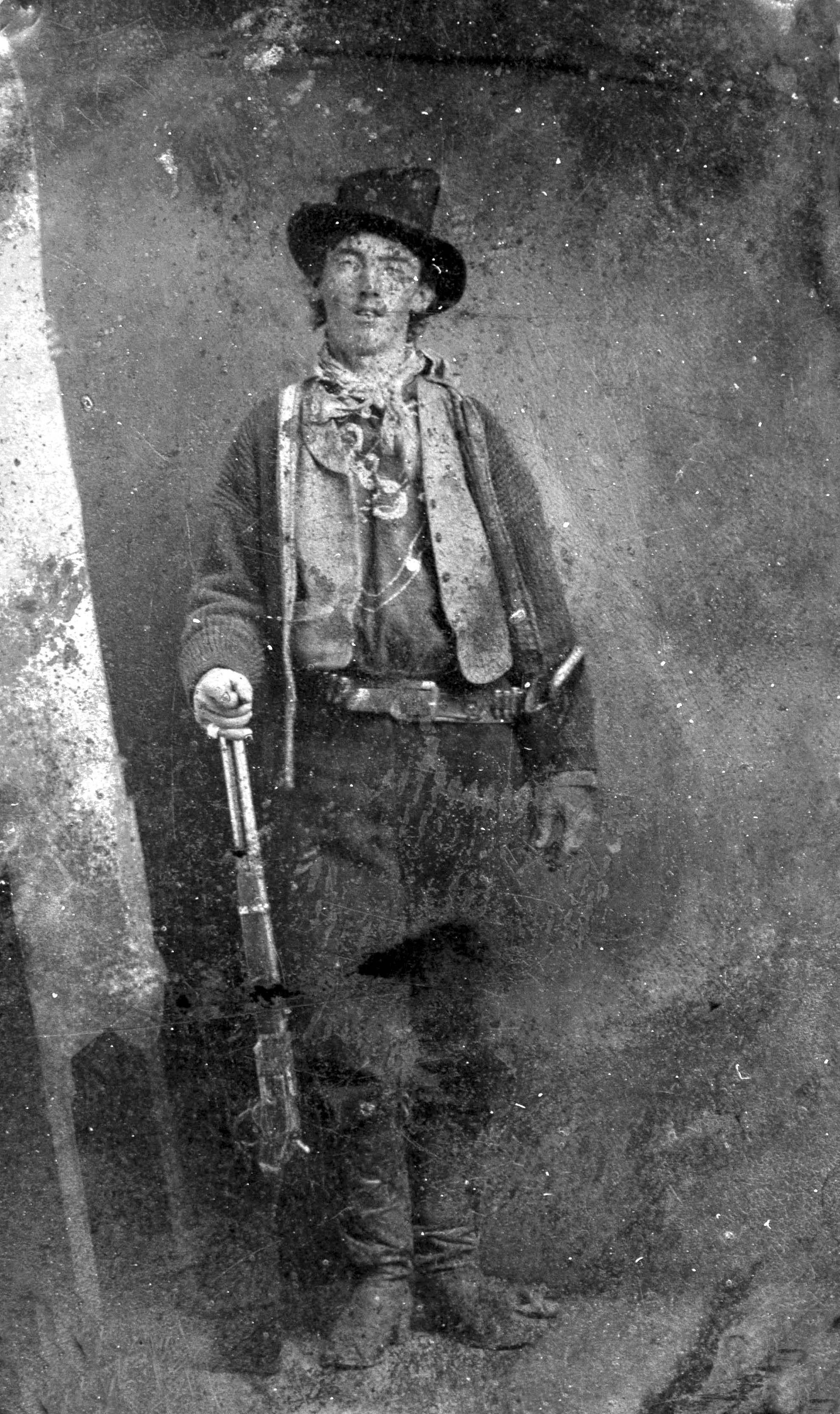
People Lew Knew: Billy the Kid and Pat Garrett
On May 30, 1881, Lew Wallace boarded a rail car on the Atchison, Topeka, and the Santa Fe to leave New Mexico Territory. Lew had calmed the Territory during his term in office from 1878 through 1881, and his tenure in office was considered successful. He accomplished much in addressing the critical issues of the Territory; however, his time out west was not wholly satisfying to him and not without controversy. Just a month before his departure, Lew wrote his wife, Susan, a long letter. In it he penned words that have resonated with governors of New Mexico ever since: “All calculations based on our experiences elsewhere fail in New Mexico.”
Although Lew left New Mexico and headed on to the publication of Ben-Hur and his service as U.S. Minister to the Ottoman Empire, he didn’t leave all of his New Mexico experiences behind him. While Lew was the Governor of the New Mexico Territory, Pat Garrett had been appointed Sheriff of Lincoln County by the Republican Party. Prior to that, Garrett had led a complicated life as a cowboy, buffalo hunter, and saloon operator. He was hot-tempered and had already killed a man. Within weeks of his appointment had already killed one of Billy the Kid’s gang members. Just days later, another gang member was killed and Garrett’s posse had captured the Kid.
A few months after his capture in April of 1881, Billy killed two prison guards and escaped. Lew had personally signed Billy's death warrant and ordered the posse that ultimately cornered the outlaw who had threatened to get Lew. This set up a massive man-hunt that was still in progress when Lew boarded his train to leave the Territory. In July of 1881, Pat Garrett shot Billy in a killing that remains controversial 130 years later.
Garrett’s term as Lincoln County Sheriff ended shortly after the killing. He ran for a number of political offices and lost each of them. As his career as a lawman foundered, Garrett moved back and forth between Texas and New Mexico throughout the 1880s and 1890s. With his rough persona and some of the whispers circulating about Billy's death, Garrett found it increasingly difficult to earn a living.
In December of 1901, the Crawfordsville Daily News-Review reported that thanks to Lew's intervention, Pat Garrett had been appointed collector of customs at El Paso, Texas. While Lew did accompany Garrett to the White House in support of the aging lawman, this newspaper report may have been giving Lew more credit than he deserved; Garrett had ingratiated himself with President Theodore Roosevelt, who made the appointment.
As things turned out, Lew ultimately may have wished to distance himself from the former sheriff. Garrett served his five year term but was not reappointed. At a reception for Roosevelt’s beloved Rough Riders, Garrett showed up his friend, the notorious gambler Tom Powers. Among other things, Powers had been run out of his native Wisconsin after beating his own father into a coma. Photos of Garrett and Powers with the President opened Roosevelt to public criticism.
When his reappointment was denied, Garrett travelled to Washington to personally meet with Roosevelt. Instead of bringing someone with the reputation of Lew Wallace, as he had done in 1901, Garrett brought Tom Powers to the meeting! A plain-spoken man, Roosevelt made it clear to Garrett that he was not going to be reappointed. Although Lew Wallace and Pat Garrett shared a connection through their associations with Billy the Kid, these two men who brought law and order to the New Mexico Territory could not have been more different.
Although Lew left New Mexico and headed on to the publication of Ben-Hur and his service as U.S. Minister to the Ottoman Empire, he didn’t leave all of his New Mexico experiences behind him. While Lew was the Governor of the New Mexico Territory, Pat Garrett had been appointed Sheriff of Lincoln County by the Republican Party. Prior to that, Garrett had led a complicated life as a cowboy, buffalo hunter, and saloon operator. He was hot-tempered and had already killed a man. Within weeks of his appointment had already killed one of Billy the Kid’s gang members. Just days later, another gang member was killed and Garrett’s posse had captured the Kid.
A few months after his capture in April of 1881, Billy killed two prison guards and escaped. Lew had personally signed Billy's death warrant and ordered the posse that ultimately cornered the outlaw who had threatened to get Lew. This set up a massive man-hunt that was still in progress when Lew boarded his train to leave the Territory. In July of 1881, Pat Garrett shot Billy in a killing that remains controversial 130 years later.
Garrett’s term as Lincoln County Sheriff ended shortly after the killing. He ran for a number of political offices and lost each of them. As his career as a lawman foundered, Garrett moved back and forth between Texas and New Mexico throughout the 1880s and 1890s. With his rough persona and some of the whispers circulating about Billy's death, Garrett found it increasingly difficult to earn a living.
In December of 1901, the Crawfordsville Daily News-Review reported that thanks to Lew's intervention, Pat Garrett had been appointed collector of customs at El Paso, Texas. While Lew did accompany Garrett to the White House in support of the aging lawman, this newspaper report may have been giving Lew more credit than he deserved; Garrett had ingratiated himself with President Theodore Roosevelt, who made the appointment.
As things turned out, Lew ultimately may have wished to distance himself from the former sheriff. Garrett served his five year term but was not reappointed. At a reception for Roosevelt’s beloved Rough Riders, Garrett showed up his friend, the notorious gambler Tom Powers. Among other things, Powers had been run out of his native Wisconsin after beating his own father into a coma. Photos of Garrett and Powers with the President opened Roosevelt to public criticism.
When his reappointment was denied, Garrett travelled to Washington to personally meet with Roosevelt. Instead of bringing someone with the reputation of Lew Wallace, as he had done in 1901, Garrett brought Tom Powers to the meeting! A plain-spoken man, Roosevelt made it clear to Garrett that he was not going to be reappointed. Although Lew Wallace and Pat Garrett shared a connection through their associations with Billy the Kid, these two men who brought law and order to the New Mexico Territory could not have been more different.
Subscribe to:
Posts (Atom)