Friday, June 21, 2013

Learning about the 1940 Census

Our Genealogy Lecture series continued last night with a fun and informative talk from Allison DePrey about the 1940 Census.
Allison DePrey from IHS
talks about the 1940 Census

Allison DePrey is Assistant Coordinator for Education and Community Engagement at the Indiana Historical Society. She went over some interesting facts about the 1940 Census and discussed how to read the forms and maximize your research and understanding of the census.

The 1940 Census records were just released last year. Census records are held for 72 years before being released publicly, and they are an invaluable tool for genealogy researchers. The 1940 Census had some new features that previous census questionnaires didn't have, and the method used to take the census was new in 1940.

Here are a few tidbits we learned last night:

  • Section 14 covered highest grade completed in education for the first time on a census.
  • 16 supplemental questions were asked of only 5% of the population--place of birth, earliest language spoken, etc.
  • People probably didn't admit on the 1940 Census that they spoke German at home thanks to anti-German sentiment from WWI.
  • The supplemental questions asked for information about Social Security for the first time.
  • Before 1940 no record was made of who provided the information--it could have been a neighbor or milkman!
  • There were questions about place of residence in 1935, which reflected the impact of the Great Depression. About 14% of the population had migrated within the United States.

If you want to do genealogy research, start with the free official 1940 Census website. Other sources include Archives.com, FamilySearch.org, and Brightsolid. Ancestry.com also provides access to the 1940 Census.

Three additional Genealogy Lectures are planned throughout 2013.  Topics include Wallace family history (July 25), how to date and preserve your family photographs (September 12), and how to write your family history (October 3).  This lecture series is made possible through a grant from the Indiana Humanities Council in cooperation with the National Endowment for the Humanities.

Monday, June 17, 2013

Author Gail Stephens Stops In at Study

Lew Wallace scholar and author Gail Stephens made a brief stop at the Study Friday while traveling west. Gail serves on the Lew Wallace Study Preservation Society Board of Trustees and wrote Shadow of Shiloh, winner of the 2011 William Henry Seward Award for Excellence in Civil War Biography. A volunteer at Monocacy National Battlefield, Gail has given talks here in the past about the Battle of Shiloh and the complex misunderstandings that occurred there.

While Gail was here, she graciously agreed to sign our stock of her book. If you come in soon, you can purchase an autographed copy of Shadow of Shiloh for only $27.95--but do it soon! Supplies are limited, and we aren't expecting to see Gail again until early 2014.


Friday, June 14, 2013

The Flag of the Nighthawk Rangers

Today is Flag Day--the anniversary of the day in 1777 that the Second Continental Congress adopted the United States Flag. It is also celebrated as the birthday of the United States Army, though according to Wikipedia, the Army is actually two years older than the flag.

Rather than talking about the US Flag, today I'm going to talk about a Confederate flag--one particular Confederate flag. This is the flag carried by Company F of the 17th Virginia Cavalry and captured by Union Colonel Clendenin at the Battle of Monocacy.

Company F was formed in September of 1862 in counties that now belong to West Virginia. Though West Virginia became a Union state, the members of Company F were dedicated Rebels. According to the West Virginia Reenactors Association website, many members of Company F even neglected to take the oath of allegiance administered to Confederates after the end of the war.

Lew Wallace acquired this flag after the Battle of Monocacy as a gift from a subordinate officer of his, Colonel Clendenin. In his autobiography, Lew gives a detailed account of how the flag came to be in his possession: 
One Confederate officer sat his horse in the middle of the street. He was the first to see the coming storm [of the Battle of Monocacy]. A bugle at his signal sounded the assembly, and snatching a flag from a man near by, the officer waved it shouting lustily. The rush to the banner was general, but formation was impossible. There was not time. Into the paralyzed mob the Federals burst, knocking out riders and men afoot, overturning horse, yelling like mad, and cleaving with vengeful fury. [Union Colonel] Clendenin spurred towards the gallant fellow with the flag. A pistol-ball outflew [sic] him. His opponent reeled in the saddle, and the flag-staff in his dying hand fell forward, its point lodging in the flank of a horse. A moment after he mustered his length in the dust; in another moment Clendenin, regardless of the press, dismounted and secured the trophy.
...A few days after the battle Colonel Clendenin brought the flag to me. I declined it, saying he had won it in combat against odds, and that he must keep it. He persisted, on the ground that as I had made the fight in the first instance, the trophies belonged to me of right, and that I must take and keep it as a lasting souvenir from him.
Lew brought the flag home and hung it in his Study, where he described it as an flash of electric crimson that caught the eye. Unfortunately, the flag's fabric deteriorated over time. The General Lew Wallace Study & Museum loaned the flag to Monocacy National Battlefield for restoration before their 140th anniversary. It is now on display at the Visitor Center.


Tuesday, June 11, 2013

Lew Wallace and the "Hung in Black" Speech

One of our Facebook friends recently asked us about Lew's speech given in Philadelphia after Lincoln's famous "Hung in Black" speech. This blog post is adapted from our research and response.

On June 7 and 8, 1864, the Republican National Convention met in Baltimore and nominated Abraham Lincoln to a second term in the White House. Earlier that year, Lew Wallace had been appointed Commander of the 8th Army Corps in Baltimore by Lincoln. Lew had already successfully supported an election in Maryland that assured that the state would remain in the Union. Holding the Convention in Baltimore furthered the Union cause.

On June 16, the President traveled from Washington to Philadelphia for the Philadelphia Fair, which was being held as a benefit to the Sanitary Commission. The Sanitary Commission was a private relief agency established by federal legislation to support sick and wounded Union soldiers. Upon his arrival the President was greeted by local dignitaries and great applause by people lining Chestnut Street.

Buildings of the Great Central Fair
Seeing the exceptional response, the Executive Committee of the Fair raised the price of admission to $1 during the time the President was to be there. President Lincoln, Mrs. Lincoln, and one of their sons arrived at the Fair at 4:30. The crowd swelled to over 15,000 people as people strained to get a glimpse of Lincoln.

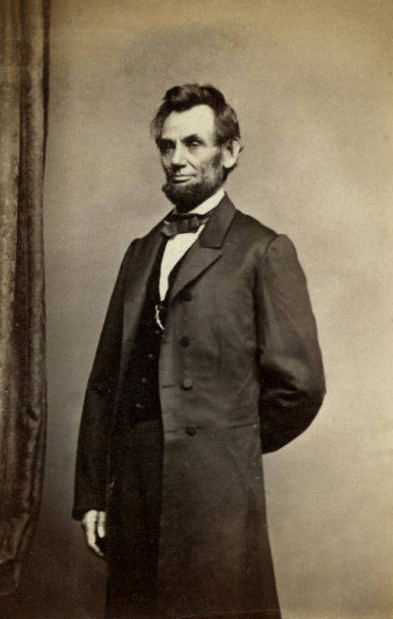
Late in the day, Lincoln returned to his hotel for the formal dinner. Joining him at his table were the Honorable Edward Everett (who had been the featured speaker at the Gettysburg Dedication in 1863), former Governor Cannon of Delaware, the Mayor of Philadelphia, several local dignitaries, and General Lew Wallace. The evening began with a toast to the health of the President by Thomas Webster, to which Lincoln responded. In acknowledging the toast he noted the work of the Sanitary Commission with comments that came to be known as his "Hung in Black" speech. Lincoln said:
Mathew Brady [Public domain],
via Wikimedia Commons

I suppose that this toast is intended to open the way for me to say something. War at the best is terrible, and this of ours, in its magnitude and duration, is one of the most terrible the world has ever known. It has deranged business totally in many places, and perhaps in all. It has destroyed property, destroyed life, and ruined homes. It has produced a national debt and a degree of taxation unprecedented in the history of this country. It has caused mourning among us until the Heavens may almost be said to be hung in black....
After noting the important work of the Sanitary and Christian Commissions, Lincoln went on to say, "When is this war to end? I do not wish to name a day when it will end, lest the end should not come at the given time. We accepted this war, and did not begin it. We accepted it for an object, and when that object is accomplished the war will end; and I hope to God it will never end until that object is accomplished." 

These comments by Lincoln were powerful words at a difficult time. Although Lincoln had been re-nominated by his party, his re-election in the fall was by no means assured. The North was still reeling the devastating Battle of the Wilderness in May. After the Wilderness came Cold Harbor, where more than 9,000 men were killed in one hour. In the six weeks before this speech, General Grant’s army had seen 52,000 casualties; people as close to the President as Mrs. Lincoln were demanding Grant's removal. Lincoln stood firm: "I can’t spare him. He fights!" As losses mounted and morale in the North teetered, Lincoln also faced the popular George McClellan, who was running for President as a Democrat, and urging a negotiated settlement with the South to end the war. 

After Lincoln concluded his comments, the next toast was directed to General Wallace. Lew made a brief speech intended to support Lincoln’s stance by declaring that General Grant was the right man in the right place. Lew said his mind was free from all doubt that Grant would capture the rebel capital and capture Lee’s forces. 

After Wallace’s comments, Edward Everett was toasted. In contrast to his long speech at Gettysburg, Everett kept his comments brief, saying in part: "After such an address from the man who has borne upon his shoulder the cares and burdens of this struggle, what can I acceptably say?"

After a few additional comments and presentations, the evening wound down. Lincoln made a more visits around town that night but declined invitations to speak. The next day, Lincoln and his party, which included Wallace, returned to the White House, where additional battles and losses would occupy the President’s days. One of these would be the Battle of Monocacy Junction just three weeks later, where Lew Wallace delayed Jubal Early as the Confederate General advanced on Washington, D.C.

Saturday, June 8, 2013

Lew's Gift to the Sultan

As his tour of duty as envoy extraordinary and minister plenipotentiary to the Ottoman Empire came to an end in 1884, Lew Wallace was offered a number of gifts from his friend, Sultan Abdul Hamid II. These included Arabian horses, jewels, and works of art. As a representative of the government of the United States, Wallace graciously declined these expressions of friendship and gratitude. According to legend, as Wallace closed his office and packed his residence, the Sultan was able to secretly include the painting called The Turkish Princess, some elaborate carpets and a few other items in the shipping crates. The crates were delivered to Crawfordsville before Lew and Susan returned home. These items sent by the Sultan remained undiscovered by Wallace until he was back in Crawfordsville and opened the crates. The Turkish Princess, said to be one of the Sultan’s daughters, remains one of the highlights of the Study. These were not the only presents exchanged between the Sultan and Wallace.

One of the reasons the crates returned to Crawfordsville in advance of Wallace was because Lew and Susan concluded their time in the Middle East with a tour of Europe. On that tour, Lew stopped in London to fulfill a favor asked of him by the Sultan. The sovereign leader of the Ottoman Empire wanted a dog. As Lew wrote to his son, Henry, in February of 1885, he spent four days in London doing nothing but looking at dogs as London was the greatest dog market in the world. He looked at everything from a King Charles spaniel that was so small it could be put in an overcoat pocket to a boar-hound as big as a burro.

He first considered a St. Bernard but realized the breed would not do well in hot and humid Constantinople. He then considered the boar-hound like Prince Bismarck of Prussia owned. When Wallace inspected the dog, he felt the face was treacherous and full of malice. “He did not seem so much a dog as a dangerous beast of prey.”

Another dog considered was the stag-hound. A breed of dog belonging to Sir Walter Scott that Wallace ultimately felt entirely unsuited for his mission. These were hunting dogs, and in his opinion not particularly handsome, which would not do for the Sultan, who was known for his appreciation of all things beautiful.

English Mastiff from Wikimedia Commons
After considering several breeds, Wallace looked at the English mastiff. The first one brought to him was about two years old and had won first prize in competition in the United Kingdom. Wallace was immediately impressed and asked about buying the animal. Both the dog and its purchase price were fit for a king. The seller noted that the dog was priced at only 500 guineas—or about $3,000!! In Wallace’s day, that was a lot to pay for a dog—even one headed off to be a royal companion. When Wallace declined the purchase, the dealer offered an eight month old offspring from the first dog at a more reasonable price.

Wallace purchased the puppy. It was the finest dog he had ever seen with a head like a lion’s and already standing thirty-six inches at the shoulder and six feet from tip of the tail to muzzle. Not only was he the size of a lion, the dog had the tawny color of a lion. When Wallace was showing the dog at his hotel, one of the curious guests climbed on a window to look in as a burglar or thief might do. When the dog saw this “thief” his eyes reddened, the hair on this back stood up, and he growled in a most menacing manner. Wallace was thrilled at this protective stance taken by the dog.


Wallace named the dog ‘Victorio’ after an Apache Indian chief who caused Wallace great difficulty in New Mexico, but whom Wallace respected for his military prowess. After Wallace shipped the dog, the Sultan began asking after the dog, inquiring about its delivery and was thrilled when it arrived. He immediately ordered that the dog be sent to the palace. When it was brought into the reception room, the crowd scattered believing it was, in fact, a lion. In reports that Wallace received he was pleased to hear that the dog was happily playing with the Sultan’s daughter, perhaps the girl in the painting given to Wallace of The Turkish Princess, and becoming a favorite companion of the Sultan himself. It proved to be a present that held special meaning for both the gift giver and the recipient and represented the special bond between two men of such different backgrounds. 

Wednesday, June 5, 2013

Dr. Howard Miller speaks about the 1959 Ben-Hur

We were fortunate to have Wallace Scholar Dr. Howard Miller with us in March for the Historic Artcraft Theatre's screening of the 1959 film Ben-Hur. Dr. Miller brought a treasure trove of pieces from his collection of Ben-Hur memorabilia to share with movie-goers. He also spoke briefly before the screening to provide information on the making of the film and what an impact it had in American culture.

Thanks to videographer Nancy Van Arendonk, you can view Dr. Miller's entire talk here on our blog. Dr. Miller is an engaging speaker with a distinguished teaching career. So make yourself some popcorn, turn up the volume, and enjoy!


Sunday, June 2, 2013

Lew Wallace, Jr.'s 1930 Duesenberg visits the Study


1930 Duesenberg sits in front of Lew Wallace's Study

We have been incredibly fortunate this weekend to receive a visit from Lew Wallace, Jr.'s 1930 Duesenberg, currently owned by Jack and Drena Miller of Georgia. The car was custom built for Lew, Jr. at an estimated $16,000 or more--and in 1930 that was a lot of money! As the Great Depression deepened, the Duesenberg was sold, but fortunately it has been preserved and restored for us to view today.

The car weighs 6100 pounds and gets about 10 to 11 miles per gallon. The 8-cylinder engine features double overhead camshafts, four valves per cylinder, and a mechanical computer. Standard features on the Duesenberg include power brakes, an altimeter, and a chronograph.

Lew, Jr.'s son William Noble Wallace related in an email the following story about the Duesenberg:
The family chauffeur, Arthur Slaughter, was an auto expert. One time he was driving the Duesy alone from Burt Lake back to Rye, a 700-mile trip. The shortest distance was through southern Ontario, from Port Huron-Sarnia to Niagara Falls, N.Y.
Enroute Slaughter was pulled over by a Canadian provincial policeman on a motor cycle. Slaughter, always careful to stay within speed limits, was startled. The officer told him the stop was one of curiosity. He'd never seen a Duesenberg before. Could he, maybe, drive it a bit? "Sure," said Art. And the officer stepped in and drove it around for awhile.
Art told that story to me but I think he kept it from my father.
We're very grateful for Jack and Drena Miller's generosity in bringing the Duesenberg to visit us this weekend, and to Mike Shotwell for researching the Duesenberg's history.

1930 Duesenberg sits in front of Lew Wallace's Carriage House