Tuesday, March 6, 2012

Dan Macauley

Lew Wallace was not the only famous member of the 11th Indiana Volunteers during the Civil War. The visage of Colonel Dan Macauley, another famous man in the 11th Indiana graced the cover of the sheet music for the “The 11th Indiana Quickstep” a toe-tapping song composed for the piano by Hubert J. Schonacker in 1863.


Dan Macauley was born in New York City on September 8, 1839. His parents were Irish and when Dan was seven years old, the family moved to Buffalo, New York where his father died of cholera in August of 1849. Although he spent a little time acting on the stage, after the death of his father, he was apprenticed to a book-binding business where he stayed until about 1860. At that time he moved to Indianapolis to work for Mr. Bingham and Mr. Doughty at the Sentinel book-binding company.

When the war broke out in 1861, Macauley joined the Indianapolis Zouaves as a private but was soon elected first lieutenant. His unit was assigned to the 11th Indiana volunteers under the command of Colonel Lew Wallace. Wallace personally asked Macauley to serve as his adjutant (assistant). Promotions followed and within a year Macauley was a major, by September of 1862 he was a lieutenant-colonel, by March 1863 he was a colonel and during the war was made a brevetted a brigadier general. He was made Brevet Brigadier General by General Phillip Sheridan for gallantry on the field, having been specifically recommended for the promotion by General Grant.

Macauley saw significant action throughout the war including fighting along side Wallace at Romney, Fort Heiman, Fort Henry, Fort Donelson, and Shiloh. He fought at Corinth, was wounded during the Vicksburg campaign, and wounded again during a battle in the Shenandoah. Macauley lived for the rest of his life with a bullet in his hip from this second wounding. By April of 1865 he commanded the defenses of Baltimore. After almost five years of continuous service, in August of 1865 he returned to Indiana with his regiment and was mustered out of the army.

Macauley married on March 26, 1863, and after the war he and his wife returned to Indianapolis where he again entered the book-binding business and they raised their family. In April of 1867, he was nominated by the Republicans for Mayor of Indianapolis. He won the election and served for six years from 1867 to 1873 as the youngest Mayor of Indianapolis up to that time. His Irish ancestry together with his Civil War record made him an appealing cross-over choice. In 1867, thirty-one percent of Indianapolis’ foreign population was Irish but most of the Irish were Democrats. Macauley contributed much to his adopted hometown including being one of the developers of the Woodruff Place suburb.

Dan Macauley had a varied career. After serving as mayor, he served as superintendant of the Indianapolis water works and as manager of the Academy of Music. In 1880, he left Indianapolis and in 1882 was engaged in developing Mexican mining interests, followed by stints managing hotels in New York City and Columbus, Ohio. During Benjamin Harrison’s administration he held the position of appointment clerk for the Treasury Department. In his last job he worked for the Nicaragua Canal Company that ran steamers on Lake Nicaragua. While on business for the company he died unexpectedly in Nicaragua in 1894 and was buried there with full military honors. Macauley’s family later brought his body home and he was buried with honors in Arlington National Cemetery. As Dan Macauley was laid to rest, one of the memorials stated: “The Eleventh Indiana Infantry was distinguished as one of the fighting and best drilled regiments, and from the date of its muster in until it finished its splendid career it never suffered defeat. When it is considered that such men as Gen. Lew Wallace and Dan Macauley were the directing influences that inspired this gallant command one has to look but little further to discover the reason for the success of the Eleventh Indiana.”

The revolver used by Macauley during the war as he fought beside Lew Wallace is part of the permanent collection of the General Lew Wallace Study & Museum and on display in the 2012 exhibit, Courage & Conflict: Lew Wallace in 1862.

The General Lew Wallace Study & Museum celebrates and renews belief in the power of the individual spirit to affect American history and culture.


Tuesday, February 21, 2012

Wallace & Presidential Assassinations

TIDBIT


Lew Wallace was personally acquainted with each of the three American presidents who were assassinated during his lifetime. Abraham Lincoln had known Wallace and members of his family for years and was personally involved in aspects of Wallace’s Civil War career. James Garfield had come to know Wallace during the Civil War, through Republican Party politics, and was so impressed when he read Ben Hur that he appointed Wallace Minister to the Ottoman Empire. Wallace also knew William McKinley through Civil War service and Republican Party politics.

Wallace had been booked to be a guest speaker at the Pan American Exposition in Buffalo, New York in 1901 where McKinley was assassinated. After the assassination, because he continued to be concerned about the betterment of the country the 74 year-old Wallace began to ponder the question of presidential assassinations. In December of 1901 he wrote an article for the North American Review entitled: “Prevention of Presidential Assassinations.”

Lew Wallace in his personal Study, ca. 1901
He opened the article with the statement: “The duty of doing something to stop the assassination of our Presidents is upon us heavily.” He noted the impact of presidential assassinations on the populace and the phases of shock, panic, daze and sorrow that people went through. A popular leader, McKinley was assassinated in September and by the time this article was published in December, people were wondering what Congress was going do to protect the president. With his training as an attorney, for Wallace the real question was not what Congress would do, but what they could do.

For each point Wallace heard publically raised, he penned a reply in the article. There were some who wanted Congress to declare assassination a murder. Wallace dismissed this as an unnecessary action. Others wanted the immigration commissioner to double the guard at immigration gates and make incomers prove themselves worthy, separating the anarchists so that they could be sent home. While Wallace mused about how our international friends would react to such action, his real concern was about the anarchists already in the United States. He pointed out that the assassins of both Lincoln and Garfield were native born.

The argument that Wallace next addressed was the desire for Congress to give the president all the soldiers he needed to watch over him at every waking (and sleeping) moment. Wallace argued that while Congress might have the authority to impeach a president, it could not control him personally or dictate his movements under the pretense of a guard of honor. He also pointed out that the president, as commander-in-chief, already had the power to order the entire regular army to camp out at the White House if he so chose.

Wallace pursued this line of logic with a short aside about the how such a protective screen might work for Teddy Roosevelt, writing:

Then I had to smile, for to the eyes of my fancy there rose a vision of the utterly impossible—a vision of Teddy the Strenuous about to go in search of a breath of sweet, outdoor air. The big, black horse so in his love is brought to the door; along with it comes a detachment of mounted guards, high-booted, sabred, and in far-flashing yellow splendor. Now the cavalcade is starting. It stretches out in lengthened column. The Strenuous looks back over it, and asks himself: “What’s this for?” His cheeks begin to burn, and feeling equal to his own salvation against any solitary anarchist in hiding somewhere on the road, he bids the chief of the escort: “Halt the guard, Now send it to quarters.” And so it is done, for the order is from the Commander-in-Chief direct. Then, while the Hero of Santiago pursues his way alone, he thinks the American thought: “The ways of the great and good Emperor William are for Germany; our American skies are not favorable to them. We are satisfied to patronize his beet sugar, without imitating his style of mustache or borrowing his idea of a nickel-helmeted bodyguard.”

 
Wallace then reminded the reader that while Congress could not make assurance of absolute protection, there were opportunities available to it. He suggested that Congress could make an annual appropriation of money that would be placed at the President’s disposal sufficient to enable him to maintain a secret service. Wallace felt this discretionary fund would help protect the president without loss of dignity or personal humiliation, would not bow to the appearances of Imperialism, and would not interfere with the president’s ability to interact with the American public, while it provided as much security as possible.

He also felt that Congress could reform regulations that governed the admission of immigrants and he outlined the five improvements he deemed appropriate. Wallace then closed his article with the issue that he felt most important for Congress to address—an amendment to the definition of treason against the United States. In 1901, there were two acts treasonable acts—levying war against the United States and adhering to its enemies giving them aid and comfort. Wallace felt that the forefathers could not have anticipated in America that a day “would dawn hideous with open proselyting [sic] in aid of societies founded upon assassination as a means of promoting an era of Chaos. In other words, Nihilism and Anarchy were in a sense unheard of. . .”

Wallace follows his argument with detailed discussion of nihilism, anarchy, murder and revolution and their impacts on society. His argument lifting anarchy from an atrocious principle to the highest possible crime against society and the state touched on the issues of crimes of passion, torture, retribution, Christian belief, and punishment. Wallace closed by offering his suggestions for the wording of a Constitutional amendment defining treason against the United States. He believed that with this amendment, “government would never again be compelled to sit helplessly by, knowing a conspiracy is making ready to destroy it.” This amendment would also give Congress the opportunity to unite with other powers to pursue the obliteration of Anarchy—something that was not clearly possible under the existing definition of treason.

While Wallace’s amendment to the definition of treason against the United States was not pursued by Congress, since 1901 in times of national stress and unrest statues have been passed or discussed that reflected Wallace’s thoughts. In 1917, the Espionage Act was passed which allowed for a broader interpretation of crimes against the country. This is why spies are often convicted of espionage and not of treason. During the Cold War of the 1950s the issue was again much in the public mind with the McCarthy hearings. Perhaps because of the fallout from the McCarthy hearings, when our fourth president was assassinated by a man enamored of other forms of government, there was little interest in revisiting the broader issue of what constitutes treason and how it relates to presidential assassinations.

Throughout his life, Wallace pondered many of the issues of the day, always with an eye to strict interpretation of the law. While Wallace’s Constitutional amendment regarding treason was not passed and his plan for immigration reform was not implemented, it is worth noting that the president and other high ranking government officials are now served by a secret service with expanded powers, and changes were made to immigration laws in the early 20th century that reflected some of his concerns. Wallace was not just a man of his time. One hundred and eleven years after he penned his article, we still struggle with the issues of how to adequately protect the president without separating him from the people, we worry about treason and attacks on America, and the issue of immigration continues to be in the news.

Sources:


North American Review. No. DXLL, December 1901. “Prevention of Presidential Assassination” by General Lew Wallace

The General Lew Wallace Study & Museum celebrates and renews belief in the power of the individual spirit to affect American history and culture.

Tuesday, February 14, 2012

The Wallaces & the Canbys

Off Wabash Avenue on the east side of Crawfordsville is Canby Avenue. It is one of the few local reminders of E.R.S. Canby, a local boy, friend of Lew Wallace, and one of Crawfordsville’s five Civil War generals. The Canby family settled in Crawfordsville in the 1830s and lived in a home that stood on the site of the old high school (now the Athena Center). Mr. Canby was in charge of the Federal Land Office. His son, Edward Richard Sprigg Canby (E.R.S.) grew up in Crawfordsville, attended Wabash College for one year and then was appointed to West Point. Upon graduating from West Point, E.R.S. returned to Crawfordsville and married a local girl, Louisa (Lou) Hawkins.
The Wallaces and the Canbys travelled in the same social circle and remained friends throughout their lives although their travels and careers often took the couples in different directions. Like the Lew and Susan Wallace, E.R.S. and Lou Canby had a strong marriage with each being a significant partner.

After graduating from West Point, Canby continued in military service seeing combat in Florida during the Second Seminole War in the late 1830s and early 1840s and in the Mexican-American War in the mid-1840s. Canby’s military service included posts in upstate New York, California, Wyoming, and Utah in the 1850s. By 1860, he was posted in New Mexico. Lou travelled to these postings with her husband and during these early years they had one child, Mary, who died young.
General E.R.S. Canby

When the Civil War broke out, Canby remained out west. He was promoted to colonel of the 19th U.S. Infantry on May 14, 1861 and less than a year later was promoted to Brigadier General in February of 1862. After some success in the west, particularly in Texas, Canby was posted to New York in the wake of the draft riots in 1863. Canby had a varied military career serving in both important administrative positions and active battle service.

While he was a gifted administrator, there were some in the army, including General Grant, who thought he was not aggressive enough in the field. In May of 1864 he was promoted to Major General, was posted to Louisiana for a time and then placed in command of the Military Division of Western Mississippi. He was wounded in November of 1864, but his wife nursed him back to health. When the Confederacy fell in April of 1865 he accepted the surrender of the Confederate forces west of the Mississippi. Immediately after the war, Canby was posted to Washington, D.C. where Grant came to hold Canby in great esteem for his knowledge and understanding of policy, law, and army regulations.

Like Lew Wallace, Canby’s family was divided during the War. At one time, his father had owned slaves and he had cousins who fought for the Confederacy. After the war other relatives became carpetbaggers in Louisiana where Canby had been posted as a military governor. These family members sought favors from Canby, who declined their requests for support.

After the war he had a number of postings around the country including his service as military governor in Louisiana. This was followed by his appointment as Commander of the Fifth Military District, comprising the states of Delaware, Maryland, Alexandria and Fairfax, Virginia, and Washington, D.C. Many of these areas had been under the jurisdiction of Lew Wallace just a couple of years earlier. Additional postings in the Reconstruction South followed in Texas, North and South Carolina. Although he was seldom a favorite of either Republicans or Democrats, whites or blacks, state or federal officials, he conducted his business in fairness and honesty and was generally well respected.

Captain Jack


In 1872, he was posted to the Pacific Northwest in the Oregon Territory in an effort by the U.S. government to address issues with the Modoc Indians. Relations between the Modoc tribe and the United States were tense after a series of failed negotiations and treaties over native lands. After a number of false starts, Canby was able to arrange a meeting with the leader of the Modoc tribe. Canby attended this meeting in April of 1873 unarmed, hopeful that he could relieve the building tension between the two sides. Although he understood the tension and knew that the Modoc were volatile, he arranged the meeting at a neutral site and went with a small group of men. During discussion when Canby indicated that he did not have the authority to grant the Modoc their ancestral lands, the leader of the Modoc tribe, Captain Jack, became enraged and attacked Canby. The general and the peace commissioner were killed and others in the party were injured.

There was a funeral service for Canby out west before the body was returned to Indianapolis for burial at Crown Hill. Civil War generals William Tecumseh Sherman, Phillip Sheridan, Irvin McDowell, and Lew Wallace were in attendance with McDowell and Wallace, his long-time friend, serving as pall bearers.

Just as Susan Wallace would, at times follow her husband, Lew, during his postings during the Civil War, Mrs. Canby followed her general. Like Susan, Lou was also a woman who admired her husband, respected him, and helped him in many ways. Like Susan, Lou was also her own person. However, unlike Susan, some of Lou’s activities complicated her husband’s life. To his credit, when Lou was involved in controversy, Canby stood steadfast in his support of her.

Lou and Susan were good friends, but Lew’s relationship with Mrs. Canby went much farther back. When Lew’s mother died, his father placed his three sons in the care of Mrs. John Hawkins where they lived until his father married Zerelda. Mrs. Hawkins had a son and three daughters, including young Louisa.


The affection shared by the families continued through the years and in the collections at Lane Place there is cream pot given by Lou to Susan as a token of esteem. In 1873, after General Canby’s death, Susan said of her friend that Louisa practiced charity, tending to give things away to the needy wherever she went in the South, endearing herself to the local populace, but at some cost to her household. "I can hardly keep anything, there is so much suffering about us," Louisa wrote Wallace from New Orleans. She sometimes pled the case of someone in need to her husband if she thought he might help. Mrs. Wallace also said that Louisa was far more sociable than her husband and that she, rather than he, would arrange for any gatherings at the Canby residence.
Louisa Hawkins Canby

Like Susan Wallace, Lou was a member of the Methodist Church. She was, however, a very forward thinking woman. At her husband’s funeral service in Portland she arranged for clergy from the three Protestant churches to conduct a joint service (a fourth clergyman bowed out) and at Crown Hill the service was conducted by both a Methodist and a Baptist minister.

Years earlier, Lou had demonstrated her openness with respect to religion. The Canbys followed William Tecumseh Sherman in a military posting in Monterey, California. Lieutenant Colonel Henry Stanton Burton, who was also posted in Monterey, caused a firestorm when he fell in love with Maria Amparo Ruiz, the granddaughter of the former governor of Baja, Mexico. The Roman Catholic Bishop of California condemned the marriage as Burton was Protestant and Ruiz was Catholic. Unable to marry in the church, Lou offered the Canby home for the ceremony which took place on July 7, 1849. Canby was away on official business when Lou extended this offer and upon his return, her husband was forced to publically explain that he had been away and that his wife, a civilian, had acted alone and out of compassion.

Both of the Canbys vigorously supported statehood for California in 1850. To help the cause Lou copied documents for the statehood convention and indexed Territorial records. Still out west when the Civil War broke out, the Canbys were stationed in New Mexico. While the Union troops were engaged in battle against the Confederates in distant parts of the territory, the cities of Albuquerque and Santa Fe fell to the southerners. Lou and several of the other officers’ wives made the bold decision to stay in Santa Fe instead of fleeing.

Although the confederates were soon forced out of Santa Fe, they left their sick and wounded behind. Winter was approaching and these men were left under-fed and ill housed. Lou went to visit these men and was so moved by their plight that she revealed a hidden store of blankets and food and turned her home into a hospital. She rounded up other wives to serve as nurses, went to out-lying areas to bring the wounded Confederates in for care or treated them in-situ if they couldn’t be moved. While she was given the name “the angel of Santa Fe” her actions were not without controversy. There were some who accused her of aiding and abetting the enemy by using Union supplies for wounded Confederates. Her actions also fed support to a whispering campaign against Canby, who had been born in Kentucky.

Lou continued to follow her husband wherever his military career took him. After his murder in 1872, the people of Portland rallied to her side. When they realized how small her widow’s pension would be, they raised $5,000 as a gift. While she accepted the money, she invested it and used only the interest generated. In her will, the full principal of $5,000 was returned to the people of Portland. She devoted the last sixteen years of her life to assuring that her husband would be remembered and was buried beside him in Crown Hill in 1889.

While she worked to keep the memory of her husband alive, Lou too was well remembered. In 1893, R.O. Fairs, a Confederate veteran, wrote the U.S. War Department looking to find Mrs. Canby. Not knowing that she had passed away in 1889, Fairs explained: "I wish to show her we still entertain kind remembrance and esteem for her, by inviting her to our reunion." While it’s not surprising that the two generals and life-long friends are remembered, it’s significant that both Susan Wallace and Lou Canby, who also remained friends for life, are remembered not only as devoted wives to their military husbands, they are also remembered for their individual contributions, kind hearts, and personal achievements.

Sources


Erin Gobel-research
Journal Review, June 1962, information in the article provided by Robert F. Wernle
Wikipedia for E.R.S. Canby, Louisa H. Canby
Shadow of Shiloh by Gail Stephens
Lew Wallace An Autobiography by Lew (& Susan) Wallace
American History Illustrated, August 1978, Article, “The Modoc Indian War” by Dave Wilkinson


The General Lew Wallace Study & Museum celebrates and renews belief in the power of the individual spirit to affect American history and culture.


Monday, February 6, 2012

Camp Morton

In downtown Indianapolis there are a number of historic markers that recognize the contributions of Lew Wallace and members of his family. One of the markers recognizes Wallace’s selection of the site of Indianapolis’ Civil War camp 1861. Today, the area is known as the Herron-Morton neighborhood, but in 1861 it was on the outskirts of town and served as the State Fairgrounds. When Governor Oliver P. Morton called on Wallace to serve as adjutant general, one of the first orders of business for the two men was the selection of a site that could accommodate the anticipated influx of men responding to Morton’s call to arms.
When Fort Sumter was attacked on April 12, Morton’s first telegram was to Abraham Lincoln and reportedly his second was to Wallace. Wallace was involved in a trial in Clinton County and when he received Morton’s urgent telegram he quickly left the courtroom asking an associate to complete the presentation. Upon his arrival, Wallace and Morton went all over Indianapolis looking for a site suitable for receiving the recruits. It became readily apparent that the best location to organize the recruits would be the State Fairgrounds. By April 17, the site was renamed Camp Morton and the first of the volunteers were being processed.


The State Fairgrounds were bounded by Talbott Avenue on the west, Central Avenue on the east, 22nd Street on the north and 19th Street on the south. It was approximately 36 acres in size and had been owned by the first mayor of Indianapolis, Samuel Henderson. In 1859, it was purchased for use as the State Fairgrounds and in short order a number of buildings were built, including stables for horses, stalls for up to 250 cows, as well as spaces for hogs and sheep. An exhibition building, a dining hall, and even a two story office building were in place by the time Wallace and Morton were looking for a camp site.

The existing buildings on the site were quickly modified and additional ones built. These included barracks for the men with bunks in four tiers along both sides of the barracks and dining tables down the middle. Even though the barracks could hold up to 320 men, the available space was quickly exhausted and Wallace was soon housing men in tents. As more and more men arrived, even the space available on the grounds was soon exhausted and some of the men were housed outside the perimeter fence of Camp Morton. Land adjacent to the south of the camp was also purchased so that the troops would have suitable space to begin learning their drills.

Although Lincoln initially requested that Indiana provide 4,600 men for the service, within nine days, adjutant general Wallace had put in place the systems needed to process the 12,000 men who had volunteered and arrived at Camp Morton. This was almost three times the number of young men that had been called for or expected. Wallace accepted the job on April 15. By April 18, there were 1,800 men at Camp Morton and by the next day there were over 2,400 men in camp waiting processing.

For Wallace, the processing of the men involved hiring a capable staff, coordinating train schedules, wading through the flood of telegrams that were constantly arriving, making speeches, arranging housing, inducting the men, placing them within their regiments and companies, finding and purchasing supplies, securing food and people to prepare the food, securing doctors for medical examinations, developing security systems, assuring discipline, and more. In completing this task, Wallace proved adept, able, hardworking and resourceful. He completed this monumental task by April 23rd.

Wallace had accepted the position of adjutant general with the understanding that when he felt he had accomplished the immediate needs of gearing Indiana up for war, he would be given his own command. On April 23, with the six regiments in place, Wallace resigned as adjutant general and became colonel of his own regiment the 11th Indiana Volunteer Infantry Regiment.

As the men marched off to war the utilization of Camp Morton changed. By early 1862 it began service as a place to hold prisoners of war. In his war service in February of 1862, Wallace had been instrumental in the Union victory at Fort Donelson. Some of the first prisoners housed at Camp Morton were Confederates captured at Donelson and by the end of February 1862 the camp was housing over 3,700 prisoners. The men who were arriving were often young, underfed, and poorly clad. Meeting their needs for food, shelter, and medical care was difficult for the camp and military hospitals were opened throughout the city. By late March there were over 5,000 men in the camp and another 1,000 arrived after the Battle of Shiloh in early April.

Although the officers in charge of the camp did their best and were generally successful there were difficulties when caring for the prisoners and assuring security. In August, most of the confederate prisoners were shipped on to other facilities or exchanged for Union prisoners of war. In September, the camp saw its next group of men. This time 3,000 Union men who had been captured in battle and exchanged for confederates were shipped to the camp. By the time they were moved on or released in December the camp was in great need of cleaning and repair.

These repairs took place in early 1863. Confederates began arriving at the Camp in June and by August, there were over 3,000 men incarcerated. Prisoner exchanges halted so the camp saw some level of stability for a time but conditions were not good and men continued to get sick and die. By July of 1864, there were almost 5,000 men housed at Camp Morton. Although improvements were called for and some made, conditions in the camp continued to deteriorate over the winter of 1864. Early 1865 was cold and wet and the ill-housed, under-clad, and underfed men continued to get sick and die. Some also continued to rebel and there were a number of escapes and challenges to authority. In one dramatic escape some 50 to 60 men charged the fencing armed with rocks and bottles overwhelming the surprised guards and escaped into the countryside and Indianapolis.

With the fall of the Confederacy in April of 1865, the prisoners housed at Camp Morton were released and the Camp abandoned. Within a few months the camp had been cleaned up and it was returned for use as the State Fairgrounds. It continued to be used for the fair until 1892 when new fairgrounds were purchased at 38th and Fall Creek, a site further out of town. The land that had been Camp Morton was sold for over $275,000 and the area developed as the Herron-Morton neighborhood. The appropriateness of the selection of this site by Wallace and Morton, the quality of Wallace’s design and installation of the infrastructure of the camp, and Wallace’s organizational brilliance are demonstrated by the fact that from the first days of the Civil War through the last days, this camp continued in full service. It was not abandoned, drastically enlarged or reduced in size, and was able to meeting changing needs. In nine days, Wallace created something that met the needs of the Union army for five years.

The General Lew Wallace Study & Museum celebrates and renews belief in the power of the individual spirit to affect American history and culture.


Sources used:
Shadow of Shiloh by Gail Stephens
http://freepages.history.rootsweb.ancestry.com/~indiana42nd/campmorton.htm
http://www.in.gov/history/markers/194.htm

We invite your membership. For more information on supporting the museum, please give us a call!!


Tuesday, January 31, 2012

Cordelia Wallace Butler


When Lew Wallace courted Susan Elston in the late 1840s and early 1850s, he was pursuing a daughter of one of the richest men in the State of Indiana. By all accounts, Susan adored Lew and was thrilled by his attention. Her very business-like father, however, was not so enamored. Lew had something of a reputation. He hadn’t embraced school, hadn’t been diligent about pursing a career that would provide a stable income, and loved to go off in pursuit of military excitement. Even the distinguished Calvin Fletcher weighed in on young Wallace commenting on Lew and his friends running around Indianapolis as rascals.


William Wallace

In the 1840s, Lew was not the only Wallace boy pursuing Hoosier heiresses. Lew’s older brother William caught the attention of Miss Cordelia Butler. Born in 1828, Cordelia (sometimes spelled Cordilia) was the oldest of Ovid and Cordelia Dyer Cole Butler’s six children. Her father, Ovid, moved to Shelbyville in 1817 and became an attorney. In 1836 he moved his family to Indianapolis where he opened his law practice with partners as prestigious as Calvin Fletcher. Butler was an accomplished orator who quickly gained a reputation for his business skill, for his politics and for his religious views. Butler was a vocal opponent of slavery and in 1849 he established a paper call Free Soil Banner in Indianapolis. Due to poor health and because of his financial successes, he also retired from his law practice about the same time. The Free Soil Banner continued until about 1854 and Lew Wallace, along with William B. Greer, is reported to have had some editorial input into the newspaper.

Although there were schools that had a founding based on Christian theology, there was no state university affiliated with the Disciples of Christ. In the 1840s, Butler and Fletcher became leading proponents for a Christian college in Indiana. In 1850, the State General Assembly authorized the formation of a school for the Christian Movement. The creation of this school became a driving force in Butler’s life and over the next five years he raised $75,000 for the school. In November of 1855 the North Western Christian University opened its doors. For the next sixteen years he served as the head of the Board of Directors and was then made Chancellor of the University. In 1877, the school received a new name, Butler University, in honor of his leadership.

As is common in research, women were much less recorded in historical documents than men. Available records detail much more about Cordelia’s husband and her father than they do about her. No images of Cordelia have come to light and all that we really know about her is that she was born on March 25, 1828 and during their marriage she had nine children. If the date of the birth of her first child is correct, she must have married William Wallace at or before the age of 17. The children of Cordelia and William were Esther (born 1845), Butler (born 1853), Zerelda (born 1854), Willie (born 1856), Lewis (born 1857), Ovid (born 1859), Anna (born 1859), Cordelia (born 1861), and William (born 1866). The birth of William on August 31, 1866 is particularly poignant because Cordelia died that same day at the age of 42.

Given the importance of her father, Cordelia Butler must have been considered one of the most eligible women in Indiana at the time of her courtship. With their limited means and their undoubted concerns about their eighteen year old son, Lew, David and Zerelda Wallace must have been pleased to see their oldest son happily wed to a woman of means with a strong Christian upbringing. As the daughter of Ovid Butler, the wife of successful attorney William Wallace, the daughter-in-law of Governor David Wallace, the sister-in-law to Lew and Susan Elston Wallace and with business associates like Calvin Fletcher and Benjamin Harrison, Cordelia travelled in powerful circles. She must have been a great contributor to the culture and society of Indianapolis during the pivotal years prior to and during the Civil War. While the relationships to the men she was surrounded by have assured that she is remembered to a degree, perhaps one day research will better define Cordelia Butler Wallace as a person in her own right rather just a reflection of those around her.

Tidbit extra: It is through the Butler family that the Wallaces can claim kinship with Booth Tarkington.


The General Lew Wallace Study & Museum celebrates and renews belief in the power of the individual spirit to affect American history and culture.


Saturday, December 10, 2011

The Grand Army of the Republic and the Lew Wallace Veteran Battalion

During observances of the 70th anniversary of Pearl Harbor this week it was announced that at the end of this year, the national association known as the Pearl Harbor Survivors Group will disband. As this group of men and women who shared a unique war-time distinction fades away, it harkens back to another organization that once played an important role in American military history.

Shortly after the end of the Civil War a fraternal organization was created in Decatur, Illinois. It was called the Grand Army of the Republic, or G.A.R. for short, and was composed of men who had honorably served in the Union army. At its peak in the 1890s it boasted almost 500,000 members across the country and was both a political and, at times, a social force of much influence. Generally supportive of Republican candidates, it also pushed for veterans' pensions and for voting rights for African-Americans. Five members of the G.A.R. were elected president and it assured that Decoration Day (Memorial Day) became a national holiday. It was formally dissolved in 1956 when its last surviving member died. The G.A.R. held annual encampments every year from 1866 to 1949. The first encampment in 1866 and last encampment in 1949 were both held in Indianapolis. Although it struggled at times to maintain its stature, its organizational structure was emulated by the American Legion, formed after World War I, and the Veterans of Foreign Wars, created after World War II. Even today, many consider the Sons of Union Veterans of the Civil War (SUVCW) a successor organization.

The G.A.R. was especially popular and powerful in the Midwest. In Crawfordsville, the locals created the Lew Wallace Veteran Battalion. The General himself was an important member of the battalion. Well over 100 men from Montgomery and surrounding counties joined the Lew Wallace Veteran Battalion. Boone County was particularly proud as they could count Ben Herr (not quite Ben-Hur) of the 72nd Indiana Volunteers as a member. The only requirement for membership in the Lew Wallace Veteran Battalion was an honorable discharge from service and the promise to wear dark colored clothes when on parade—no straw hats or linen dusters (long travel coats) permitted!

In September of 1887, Crawfordsville hosted a local encampment. A large tent city was established on the fair grounds called Camp Henry S. Lane, with flags of all sorts waving in the breezes and military music playing. The camp was electrified which lessened the need for men to gather around camp fires. However, a large camp fire was built the first night and Wallace delivered the first speech. The great spectacle of the event was a mock battle. The local paper admitted that owing to the confined space available it was going to be difficult to present much of a battle—but that the Rebel fort, which had been built for the occasion, would fall. The paper also suggested that people should probably leave their teams of horses downtown lest they become frightened and create pandemonium in the crowd. In addition to Wallace, important speakers included Colonel R.P. DeHart of Lafayette, the Honorable Andrew Marshall of Fountain County, the Honorable Joseph C. Suit of Frankfort and Generals George McGinness and Benjamin Harrison of Indianapolis. Over 2,000 men participated in the grand parade.

In 1895, the national G.A.R. encampment was held in Louisville. Initially, the Big Four (Monon) Railroad was selected as the official route to the meeting. With a round trip fare of $3.05, the Big Four promised to match any competing railroad that offered a lesser fare. A special train was to be arranged with hundreds on board. The train was to be decorated with the stars and stripes and the thirty-piece Lafayette Military Band was to provide music en route. Unfortunately, members of the committee got their signals crossed and transportation to Louisville was not quite as smooth as originally intended.

The encampment itself drew over 100,000 men from all over the country. General Wallace drilled and instructed the men prior to departure and then led the members of the Lew Wallace Veteran Battalion in the grand parade. A committee made all lodging arrangements (meaning a cot in the encampment), meal arrangements for the men and banners. The banners were attached to six-foot long staffs of Tennessee red cedar. As stated by the committee members, these Tennessee cedars had protected the boys during the fierce battles they fought and would now support the aging veterans as they again demonstrated their support for the Union. Wallace and his battalion were special features of the encampment and Wallace was booked for at least three camp fire speeches (New Albany, Jeffersonville, and Louisville). The battalion was also invited to attend the ceremonies dedicating the Chickamauga National Park.  

In 1899, Terre Haute hosted a G.A.R. encampment that the local papers called one of the most successful in years. The encampment easily doubled the population of the city and the Terre Haute Gazette issued a sixteen page special edition. General Wallace occupied a “conspicuous position on the front page. A small portrait of Governor Mount also appeared with many other celebrities of the civil war [sic].”

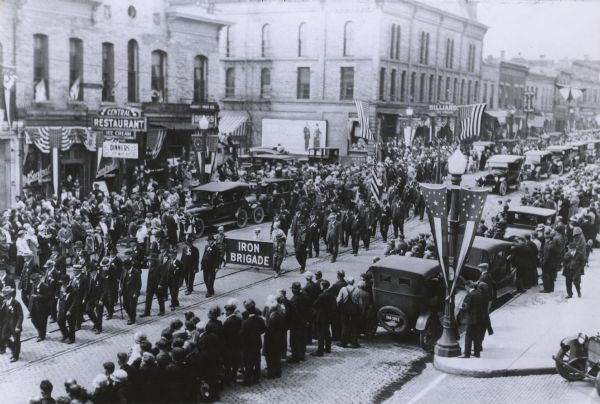
In 1909, Crawfordsville hosted a 30th annual encampment of the G.A.R. By this time many of the Union soldiers, including General Wallace, had gone to their great reward but they were not forgotten in this event hosted from May 19th through the 21st. The homes of Montgomery County Civil War Generals Wallace, Canby, Morgan, Manson, and Hawkins were all featured as was the home of Confederate soldier Maurice Thompson. Wallace’s Study was specially featured with special note made of Wallace’s painting of the Lincoln conspirators and his sketches of Commander Wirz of Andersonville. Other points of interest for the visiting veterans were Wabash College, the Henry Lane Home, the Masonic Temple, the Elks Home and the Public (Carnegie) Library. Even the country club that had served as Wallace’s country home and Oak Hill Cemetery were featured on tours. In the grand parade more than 5,000 men and women marched through a red, white and blue bedecked downtown.

The 1909 encampment was not the last G.A.R. event for Crawfordsville as picnics and gatherings continued for years. Men and women such as Louis Bischof, Henry Talbot, J. McCormick, Arch Austin, George Myers, J. Sellars, William Daggart, S.L. Ensminger, H. Cowan, B. Cowan and others continued to proudly remember the service of Union veterans. The local G.A.R. was also instrumental in the erection of the war memorial on the Courthouse grounds. After the death of Henry Talbot in 1924, almost sixty years after the end of the Civil War, the slow fade of the G.A.R. accelerated. As leaders such as Lew Wallace passed on, this important organization that meant so much too so many became a thing of the past much loved but no longer viable. Because of the buildings and memorials the G.A.R. sponsored, the elections it affected, the organizations it influenced, and the issues it addressed, its impact on communities throughout the country continues to be significant 145 years after it was formed and almost sixty years after it ceased to exist.

Saturday, December 3, 2011

It's Tea Time!

Holiday Tea Raises Necessary Funds for Lew Wallace Study

The General Lew Wallace Study & Museum hosted their 5th Annual Holiday High Tea & Fashion Show in two of Crawfordsville's most beautiful historic homes on Friday, December 2, from 3-6 p.m.  Over 130 guests took in the sights, sounds and delicious tastes of the Tea, which took place in both the Historic Elston Homestead  (now the home of Pat and Chris White, Wabash College's President and First Lady) and the Dorothy Q Chapter House of the Crawfordsville Daughters of the American Revolution.

Guests toured the richly-appointed homes decorated for the holidays, enjoyed tea and coffee along with an enormous variety of sweets and savories, enjoyed a live interactive fashion show with models mingling through the crowd, shopped from a gorgeous display of hand-crafted holiday wreaths created by area artists and designers, and listened to wonderful holiday music performed live by the T-Tones vocal group from Wabash College.

The Holiday High Tea is the second-largest annual fundraiser of the year for the General Lew Wallace Study & Museum, a National Historic Landmark and 2008 winner of the National Medal for Museum Service, the highest honor this country gives to museums.  Funds raised through the Holiday Tea go directly to the educational programming and collections care of the Museum.